 2 months ago
73
2 months ago
73
Frederiksen resigns after meeting with king to set government formation process in motion
And we are just getting a word from the Danish Royal Palace that following last night’s results, Mette Frederiksen has handed in her resignation from the post during her meeting with King Frederik.
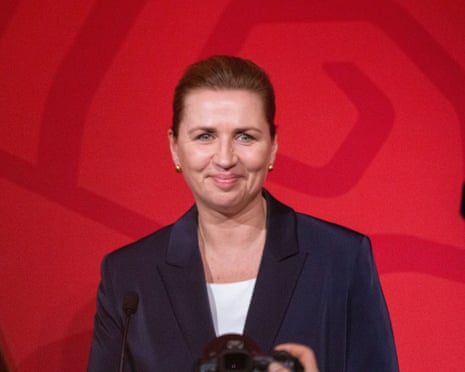
Now, this sounds a bit dramatic, but is not really: it is pretty customary as it sets in motion the new government formation process, particularly as the outgoing three-party government clearly does not have a majority required to continue in office (with 70 seats, well short of 90 required for a majority).
But Frederiksen will be expected to remain in post as a caretaker until a new administration is formed – and still remains one of the favourites to get the top job.
A meeting of political parties at which they will explore a potential way forward – and who could be appointed the “royal investigator” to work on forming the new majority - has been called for 1pm local time (midday UK).
Key events Show key events only Please turn on JavaScript to use this feature
Poland's Tusk calls Hungarian minister's calls with Russia 'a disgrace'
Following the reports on his phone calls with Russian and other third-country leaders, Poland’s prime minister Donald Tusk criticised Szijjártó on social media and calling his behaviour “a disgrace.”
He said:
“Orban’s Foreign Minister has confirmed that he systematically informed Moscow what EU leaders talked about behind closed doors. What a disgrace.”
In response, Szijjártó – who regularly clashes with Tusk and other senior Polish officials on social media – said:
“This is another lie, why do you still believe fake news??”
Hungary's Szijjártó says he often discusses EU issues with Russia, other partners
Jennifer Rankin
in Brussels
Meanwhile, the Hungarian foreign minister Péter Szijjártó has admitted that he routinely calls his Russian counterpart “before and after” EU meetings, amid ongoing questions about Hungary’s contacts with the Kremlin.
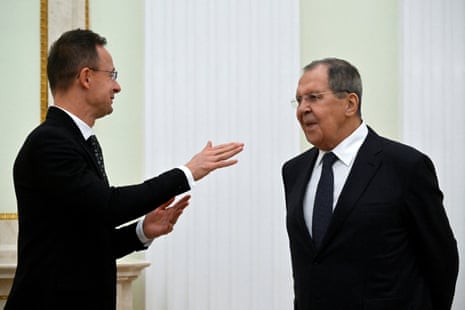
As our friends at Euronews reported Szijjártó confirmed the calls at a campaign event in Keszthely in western Hungary on Monday, but suggested he was just doing his job because EU decisions affect Hungary’s “partners” outside the bloc:
“These issues must be discussed with our partners outside the European Union. I talk not only to the Russian Foreign Minister, but also to our American, Turkish, Israeli, Serbian and others before and after European Union Council meetings… What I say may sound harsh, but diplomacy is about talking to the leaders of other countries.”
After the Washington Post reported that Szijjártó had routine conversations with the Russian foreign minister Sergei Lavrov during EU council meetings, Szijjártó dismissed the allegations as fake news. He maintains that he has not breached any security protocols.
It seems highly unlikely that this explanation will satisfy Hungary’s EU partners. Several have strongly criticised his contacts with Russia, which is heavily sanctioned and routinely condemned by the EU for its relentless aggression against Ukraine.
A council official on Wednesday described reports of the alleged disclosure of closed-door ministerial discussions to a foreign power as “greatly concerning”.
Under the council’s internal rules, discussions are covered by an obligation of professional secrecy, except when decided otherwise, for instance the publication of documents or live-streaming of council discussions.
The council official said this obligation of professional secrecy “is an expression of the principle of sincere cooperation and of the principle of mutual trust that are binding on all member states and are fundamental to the work of the European Union and of its institutions”.
Denmark braces for lengthy and challenging coalition talks — analysis
Miranda Bryant
in Copenhagen
Denmark is braced for lengthy and challenging coalition talks after neither Mette Frederiksen’s leftwing bloc nor the rightwing parties managed to get a majority in Tuesday’s election.
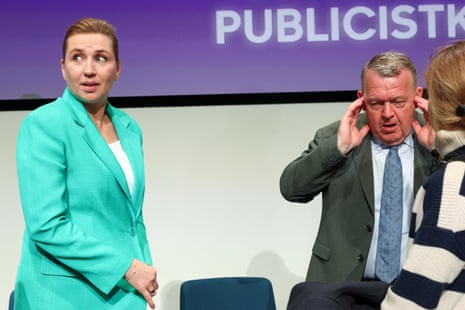
After a bruising night for her Social Democrat party, which despite remaining the biggest party in the Danish parliament had its worst general election since 1903, the prime minister went to Amalienborg palace on Wednesday morning to submit her government’s resignation to the king.
Later in the day, parties will start arriving at the palace in order of size, starting with the largest, the Social Democrats, to tell the king who they think should have the role of “royal investigator” – whose task it will be to try to form a government.
The failure of the left-leaning “red bloc” and right-leaning “blue bloc”, which won 84 seats and 77 seats respectively, to get a majority in the 179-seat parliament left the Moderates, with 14 seats, in a potentially powerful position to play a key role in forming a new coalition, putting committed centrist Lars Løkke Rasmussen in the position of kingmaker.
Drones reported in Estonia and Latvia suspected to be stray Ukrainian UAVs, authorities say
Elsewhere, we now know a bit more about the drones reported in Estonia and Latvia (10:12), with authorities suspecting them to be stray Ukrainian military drones, Reuters reported.
The UAVs that hit the Nato member nations were believed to be part of a wider Ukrainian attack on Russia, Latvian and Estonian authorities said. They follow another stray Ukrainian drone that Lithuania said on Monday had crashed into a lake.
The drones landed in Estonia and Latvia at around the time that Russian officials said a Ukrainian drone attack set fire to oil facilities at Russia’s Baltic Sea ports of Primorsk and Ust-Luga, major export hubs located near Estonia and Finland.
A third drone briefly entered Latvian airspace via Belarus before flying into Russia, Latvian authorities said.
“The drone was not directed at Estonia. This is a concrete consequence of Russia’s full-scale war of aggression,” Estonia’s foreign minister Margus Tsahkna said in a post on X.
“The war, provoked by the aggressor Russia, has got us to this point, with drones falling on the territories of all three Baltic states within 48 hours,” Lithuania’s defence minister Robertas Kaunas said in a statement.
There is 12 parties, so 12 audiences with the King, meaning the process will take into late afternoon.
DR has the schedule, with 10 minutes slots, from 1pm to 2.50pm (local time).
Mette Frederiksen is up first at the top of the hour.
The post-election debate is now over, but the government forming process very much is only starting.
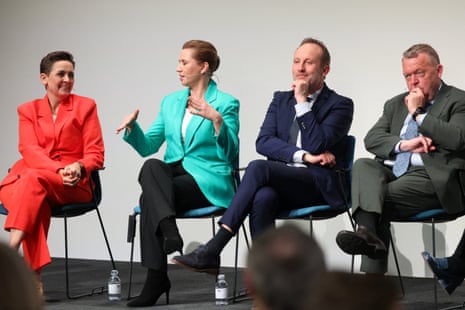
The party leaders are expected to see the King this afternoon to propose the names for who should be the “royal investigator” tasked with exploring what majorities could be formed (11:25).
Let’s see what comes out from that.
'It's not me who blew up this government,' Poulsen hits out at Frederiksen
Miranda Bryant
in Copenhagen
And there are signs of nervousness and tensions among the other leaders too.
Outgoing deputy prime minister Troels Lund Poulsen has hit out at Mette Frederiksen mid-debate, for calling an early election.
“It’s not me who blew up this government. It’s not me who called the election,” he said.
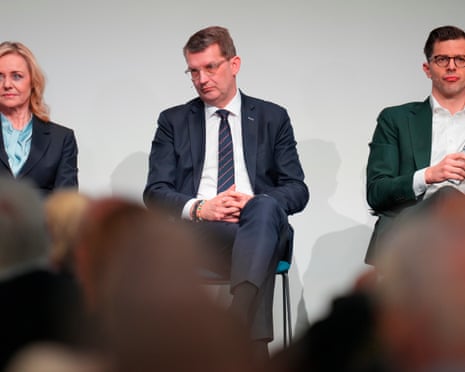
There’s still a lot of laughter in the room, especially after Lars Løkke Rasmussen speaks, despite the enormity of the task ahead.
But Rasmussen refuses to respond to Morten Messerschmidt, leader of the far-right Danish People’s Party, when he suggests the pair “pack our egos together and let Troels [Lund Poulsen] form a government.”
Next government needs to be ready to tackle major crises, Frederiksen says
In her comments at the leaders’ debate, Frederiksen also sets out the scale of challenges that the next government will probably have to face, starting from the consequences of the Iran war.
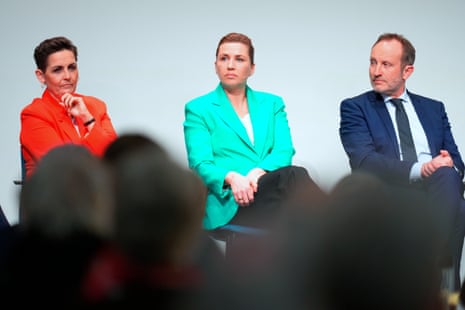
She says the closure of the Hormuz Strait and the impact on petrol, oil, diesel prices could put “Denmark’s overall competitiveness under threat.”
She says that with the ongoing war in Ukraine, increasingly aggressive Russia and “no one knowing what’s going to happen with the Americans,” the leaders should stop “playing word games as if the old world still existed.”
“It does not,” she warns, as she says the next government will have to be ready to take on really tough challenges.
She also takes a swipe at the far-right Danish People’s Party’s leader Morten Messerschmidt for being congratulated on his result by Hungary’s Viktor Orbán.
“When Viktor Orbán congratulates someone on the election, it’s because he sees an opportunity to undermine Europe, to divide us from each other,” she says.
Next steps in Danish government formation process
Essentially, what is expected to happen now is that when the parties meet later today, they will be expected to produce a piece of paper with the name of who they think should be appointed as the “royal investigator” and lead the government formation talks.
12 parties, 12 pieces of paper, 12 names. It is an early indication of who they think they could do business with.
It’s probably worth noting that person does not necessarily have to go on to be the next prime minister, but it tends to happen that’s what happened in 2022 when Mette Frederiksen led the process.
There are several possible investigators: from Frederiksen on the “red” side, Troels Lund Poulsen on the “blue” side, and Lars Løkke Rasmussen in the centre, as his party, the Moderates, is most likely to decide the next government.
For what it’s worth, the latter openly said he did not want to be the next prime minister.
But that was before the election…
'World is not waiting for us,' Frederiksen says as she underlines urgency to form new government
Speaking at the debate, Frederiksen confirms she has submitted her government’s resignation as it is clear the outgoing three-party government will not have enough mandates to continue.
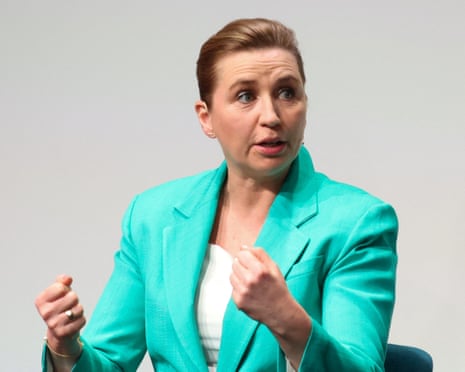
But she stresses the urgency of the task to form the new government, as “the world is not waiting for us out there and it has only become more unsettled since the election was called.”
“We have to figure out how to cooperate,” she says.
She hints that there is a potential way forward with a coalition of left-wing parties and the Moderates.
The Social Democrats, the SF, the Red-Green Alliance, the Alternative, the Citizen’s Party and the Moderates would just cross the line with 92 seats in the parliament.
(You can test yourself as a potential royal investigator and play with possible majorities here, thanks to DR.)
But remember, it’s still very early days – and the likely kingmaker, Lars Løkke Rasmussen, does not seem to be particularly excited by the prospect of being in a government with the Red-Green Alliance.
“It looks a bit difficult,” he says, and you half expect him to pull out his trademark tobacco pipe and ponder on that thought.
Party leaders set to speak at post-election debate at Dansk Industri
Miranda Bryant
The party leaders are now arriving at Dansk Industri in Copenhagen for a post-election debate – but this time there will be a lot more concrete scenarios to discuss.
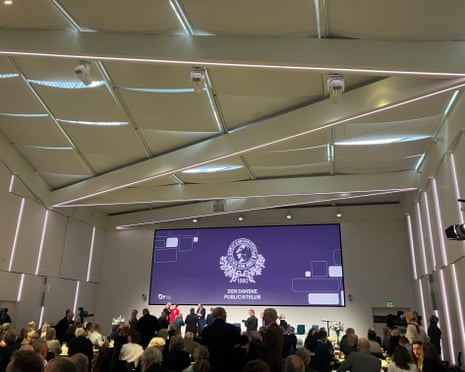
We will be bringing you news as it comes.
Frederiksen resigns after meeting with king to set government formation process in motion
And we are just getting a word from the Danish Royal Palace that following last night’s results, Mette Frederiksen has handed in her resignation from the post during her meeting with King Frederik.
Now, this sounds a bit dramatic, but is not really: it is pretty customary as it sets in motion the new government formation process, particularly as the outgoing three-party government clearly does not have a majority required to continue in office (with 70 seats, well short of 90 required for a majority).
But Frederiksen will be expected to remain in post as a caretaker until a new administration is formed – and still remains one of the favourites to get the top job.
A meeting of political parties at which they will explore a potential way forward – and who could be appointed the “royal investigator” to work on forming the new majority - has been called for 1pm local time (midday UK).
Aaaaand Frederiksen is out after meeting the king, and doesn’t speak to reporters on her way out.
But I am sure we will hear from her later today.
Frederiksen arrives at Amalienborg to inform King about election results
Back to Copenhagen, Mette Frederiksen has now arrived at Amalienborg to meet King Frederik and inform him about the results of the election.
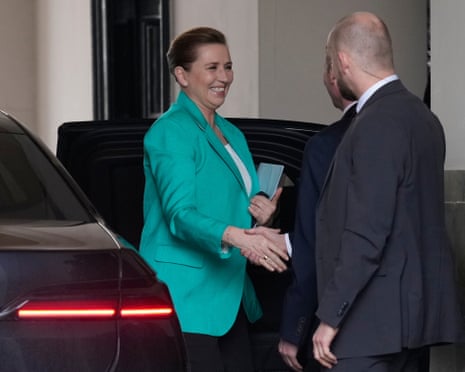
It’s worth keeping an eye on what comes out of that meeting.
Hungary to stop gas flows to Ukraine amid escalating row over Druzhba pipeline
Elsewhere, Hungarian prime minister Viktor Orbán has just announced that Hungary will stop gas flows to Ukraine until oil flows through the Druzhba pipeline resume, further escalating his conflict with Kyiv and Volodymyr Zelenskyy.
In a post on Facebook, he vowed to “protect” Hungary’s energy security, saying:
“As long as Ukraine does not provide oil, it will not receive gas from Hungary.”
The move follows a prolonged dispute over gas supplies, in which Hungary and Slovakia have accused Kyiv of deliberately stalling on repairs to an oil pipeline after it was hit in an apparent Russian drone attack. In response, Orbán vetoed further EU sanctions on Russia as well as an additional €90bn loan for Ukraine.
It all comes just weeks before a crucial parliamentary election in Hungary on 12 April, with Orbán is at risk of losing after 16 years in power.
Miranda Bryant
in Copenhagen
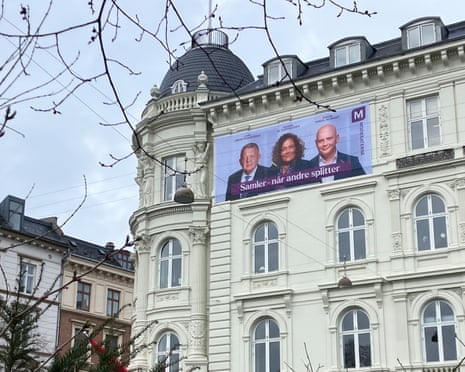
Good morning from Copenhagen, where there is no left or right majority and the Moderates’ Lars Løkke Rasmussen is expected to hold the key to coalition discussions.
The morning after the night before, his party’s message, “Gathers when others divide”, feeling a little prescient.
Latvia and Estonia report drone incursions overnight
Meanwhile, Latvia and Estonia have both reported drone incursions overnight amid continuing Russian attacks against Ukraine.
In Estonia, a drone flew into Estonian airspace and slammed into a chimney at a local power station, the Internal Security Service told the broadcaster ERR.
The country’s state prosecutor said that its early inquiries established that the drone was not intended to target Estonia, but the investigation is under way to find out more about the circumstances.
The plant’s operator, Enefit Power, said the drone did not cause significant damage to the plant, and it expected no disruption to the country’s energy system.
Two drones also crossed into Latvia’s airspace, Latvian authorities said.
Reuters noted that it was not immediately clear where the drones originated from, but the incidents occurred at about the same time that a Ukrainian drone attack set fire to oil facilities at Russia’s Baltic Sea port of Ust-Luga, a major petroleum export hub about 25km (15 miles) from the border with Estonia.
The Latvian public broadcaster LSM reported that the drone found in Latvia was most likely Ukrainian and “was part of a coordinated Ukrainian operation against Russian targets.”
PM Frederiksen to meet King Frederik to brief him on election results
Denmark’s King Frederik will meet the outgoing prime minister Mette Frederiksen in about half an hour so she can brief him on the results and the political aftermath of the vote, the Palace just said.
Morning opening: Now for the tough bit
Jakub Krupa
Denmark’s prime minister Mette Frederiksen hinted she wanted to stay in office after last night’s inconclusive parliamentary election, which will leave the country with lengthy coalition talks.
Speaking after midnight local time, she told supporters she was “ready to take on the responsibility of serving as Denmark’s prime minister again for the next four years.”
Despite losing ground, her party remains the largest in the new parliament, putting her in a strong position to form the next administration.
She conceded to supporters that she would have liked a better result, but “there is nothing today that can make me sad about the fact that the Social Democrats are once again the Danes’ absolute favourite political party.”
But she will need to engage in tricky coalition talks with other parties, including the Moderates of former prime minister and current foreign minister, Lars Løkke Rasmussen, who holds the key to any future majority.
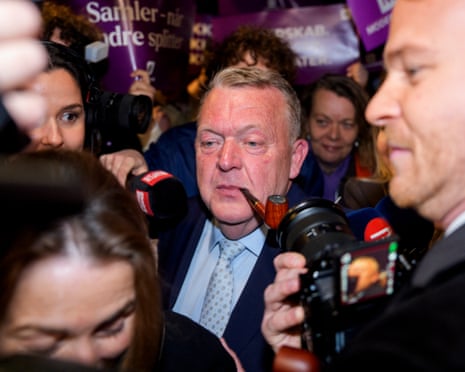
These conversations will no doubt start this morning.
I will keep an eye on this for you, as well as all other updates from across Europe.
It’s Wednesday, 25 March 2026, it’s Jakub Krupa here, and this is Europe Live.
Good morning.