 2 hours ago
2
2 hours ago
2
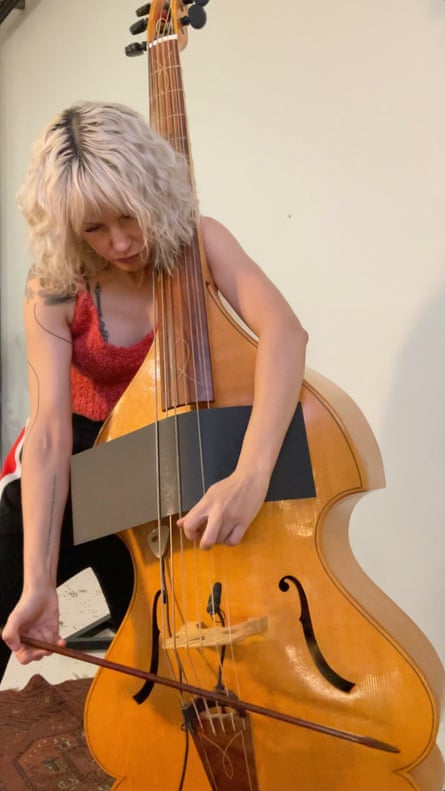
Chloë Sobek is a Melbourne musician who plays the violone, a Renaissance precursor to the double bass. But instead of playing it in the traditional manner, she puts wobbling bits of cardboard between its strings or uses a sheep’s bone as a bow, and these weird interventions have become catnip for Instagram’s algorithm, getting her tens of thousands – sometimes hundreds of thousands – of views for each of her self-made performance videos. “Despite how it might appear, I’m a reasonably shy person,” she says.
When Laurie Anderson’s robo-minimalist masterwork O Superman hit No 2 in the UK charts in 1981, thanks to incessant airplay on John Peel’s radio show, it was a signal of a media outlet’s power to propel experimental music into the mainstream. That’s now happening again as prepared-instrument players such as Sobek, plus experimental pianists, microtonal singers and numerous other boundary-pushing solo performers, are routinely breaking out of underground circles thanks to videos – generally self-recorded at home – going viral on TikTok and Instagram.
You may have come across a cover of a Mitski song played on a sinister microtonal scale, or a piano piece where the player frantically draws a circle across the keys of a piano, or in the case of Brad Barr, a strained drone made by Barr pulling a long piece of polyester through his guitar strings. It all suggests that the general public are actually a lot more receptive to weird music than many assume – but why is it all resonating quite so strongly?
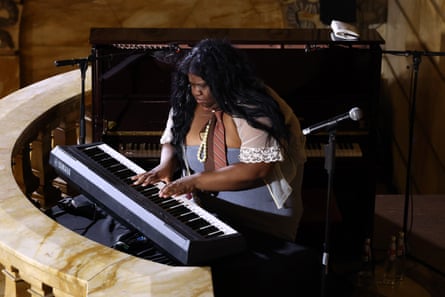
The success of these bedroom virtuosos is already moving into the real world: after getting millions of viewers of her expressionist solo piano and synth performances, Arkansas musician (and part-time piano teacher) Precious Renee Tucker was recently invited to perform for her hero Solange Knowles. “I’m definitely still processing everything,” she says. Her TikTok is a chaotic digital sketchbook of her lifelong friendship with the piano, captioned with enthusiastic exclamations such as “i don’t know!!!!!!!!!!!!!!!!!!!!!!!!!!!!!!!” and “music is fabric!!!!!!!!!!!!!!!!!!”. “I’m always releasing things without thinking too hard about the need to comprehend them,” she says. “It’s really these fragments of myself.”
Other experimental artists, such as Maddie Ashman and Bryan Deister, are captivating TikTok scrollers with microtonal music, which is essentially a great wilderness of dissonant notes hidden between the standardised western scale. “This blows my mind, it’s like we’ve been living in a musical matrix of prescribed noises that are ‘OK’,” reads one comment under one of Ashman’s songs.
“I’m led by questions,” says Ashman, a British musician who makes microtonal pop filled with freakish harmonies and unpredictable vocal hocketing – a technique with interlocking melodic lines – reminiscent of that great hero of the avant garde, Meredith Monk. “I’m happiest when I’m moving between places, and approaching one instrument in the way I would approach another instrument.” During her four-year rise on short-form video platforms, culminating in the release of her debut EP last week, she’s embraced microtonality because it’s something few artists can do. “For a lot of people, their experience of microtonal music is them not being able to play it, and it hurts.”
Ashman bases her videos around the element of surprise, starting with a playthrough of the raw microtonal scale, then pulling a beguiling song from it. “I suppose that works well for the algorithm,” she hypothesises, “because people have an expectation of what it’s going to be. Then we’re defying those expectations, and people feel something.”
However, like Anderson’s chart success, these musicians are as divisive as they are prominent; each video is guaranteed to have a share of detractors, questioning the validity of the music. “People start having arguments on the comment threads,” Sobek says and, in her case, people often show concern for her instrument. “Because it’s this beautiful Renaissance instrument and I look like I’m bashing it, people are like, ‘How can you do that?’ But the way I play is actually quite gentle if you saw it in person. I’m saying that these old instruments don’t have to be behind glass. In a way, I’m bringing them to life more than someone who’s stuck trying to replicate history.”
That provocation means Sobek stands out on social media, an attention economy where every comment – positive or negative – is registered as engagement; mainstream musicians such as Rosalía and Jacob Collier have meanwhile driven interest in classical performance and music theory in recent years. But the success of Sobek, Ashman et al. is mostly down to genuine excitement from people who have become numbed by boring influencer culture and AI slop. “We are genuinely desiring something brand new, or at least to be inspired to have that perspective,” says Tucker. “To let go of the past and detach from what we’ve seen before, and have the courage to do something creative that hasn’t existed yet.”
In a roundabout way, it’s a re-engagement with experimental art’s purpose: to provoke and gauge reaction by bending invisible rules. “That is my favourite part about the experimental realm,” Tucker says with a smile. “I’m not necessarily saying the way that I play is correct or the standard. I really love the conversations that come up: Is this acceptable? Does this sound good? What is this?” She compares the process to a lab full of scientists comparing notes.
However, some comments underneath female artists’ videos veer into misogyny. “There’s definitely an element of me being a woman doing something that’s confronting,” Sobek says. “I get a lot of men having strong reactions, and I do wonder, would it be different if I was a guy? Whether it would be slightly more accepted?” Ashman sees a similar pattern of male self-elected experts questioning how “truly microtonal” her music is, but says that “we’re now in a society where the majority of people can laugh at them rather than being hurt too much, which is amazing to be able to say”.
For all their online success, these artists are also anxious about appeasing the social media algorithms that promoted their videos in the first place. “Can I keep the same mindset of doing this for fun? Can I take a break, or do I need to keep making and push it out regardless?” questions Tucker.
“There’s always been gatekeepers,” Sobek argues. “We think that the internet has democratised things, but it’s still defined by this gatekeeping algorithm. It’s all the same thing.”
Not only does this create pressure to post regularly, but short-form video could warp the idea of what experimental art actually is, in the eyes of those who have just discovered it via an algorithm. “It’s pushing this idea of spectacle, and I don’t think art is just about spectacle,” Sobek says. “I’ll post a video that’s more ‘musically serious’ and it won’t get anywhere near as much interest as the fun and crazy stuff.”
But short-form video also offers new ways to express oneself – you can see it in the superimposed lyrics descending down the stairs behind Ashman in her videos, or how each of Tucker’s lo-fi, impulsive clips adds up to a singular body of work – and this is art in a uniquely public dialogue with its audience. “It is surprising,” Tucker says, “that this many people are willing to be in this place of the unknown, and not having such an immediate answer in such an immediate digital space where you can have every kind of stimulant you’d like. I’m proud of all of us for having the bravery to go there.”