 3 months ago
66
3 months ago
66
It was a claim uttered repeatedly on the 2024 campaign trail: “I’m the only president in 72 years that didn’t start a war,” Donald Trump said in Sioux City, Iowa.
Fact checkers cried foul and pointed out that Jimmy Carter, president from 1977 to 1981, did not start any wars either. But Trump won the election anyway.
The winner of the Fifa peace prize, the chair of the Board of Peace and the self-declared “president of PEACE” just bypassed Congress to start a war on Iran that killed Ayatollah Ali Khamenei and is spreading across the Middle East.
It is the most severe test yet of the oft-articulated theory that Trump, who as a young man received five deferments from the Vietnam draft – four for university and one for “heel spurs” – has a deep-seated allergy to war and represents a break from hawkish presidents of the past.
In a New York Times column about the 2016 election, Maureen Dowd wrote that on foreign policy “it’s Hillary the Hawk against Donald the Quasi-Dove”, arguing that “like Obama, he thought the invasion of Iraq was a stupid idea”. She observed that Trump “says that in most cases he would rather do the art of the deal than shock and awe”.
Others have also taken the view that the first commander-in-chief elected with no prior political or military experience is more a creature of New York boardrooms and Florida soirees than the army mess hall and that his appetite for the kinetic would end with his golf swing.
Add to that the politically expedient ideology of America First with its promise that there would be no more imperialist ambitions or forever wars. When he entered politics, Trump was supposed to be the disrupter, the swamp-drainer, the repudiation of an establishment that had cost the US so much blood and treasure.
In 2011 he wrote on social media: “In order to get elected, @BarackObama will start a war with Iran.” In 2016 he called George W Bush’s invasion of Iraq a “big, fat mistake” and said “regime change is a proven, absolute failure”.
During his first term he held talks with everyone from Kim Jong Un to Vladimir Putin to the Taliban, suggesting that he could make deals where others would use brute force. In 2023 JD Vance, a Marine Corps veteran who served in Iraq, endorsed Trump in a Wall Street Journal article headlined, “Trump’s Best Foreign Policy? Not Starting Any Wars”.
All of that now looks like wishful thinking. Trump, it transpires, was always a hawk in dove’s clothing. Back in 1980, when 52 US diplomats and citizens were held hostage in Iran, Trump was asked if the US should send in troops. “I absolutely feel that, yes,” he said. “I don’t think there’s any question.”
His fabled criticism of the Iraq war was about convenience. When Howard Stern, the radio host, asked him in September 2002 if he was “for invading Iraq”, Trump replied: “Yeah, I guess so. I wish the first time it was done correctly.” Like many other observers, it was only when the war turned sour that he turned against it, telling Stern in April 2004 that “Iraq is a terrible mistake”.
During his first term he significantly increased the use of drones for targeted killings compared to Barack Obama, while relaxing the rules of engagement and transparency requirements. He also ordered a risky strike in 2020 that killed Iranian commander Qassim Suleimani.
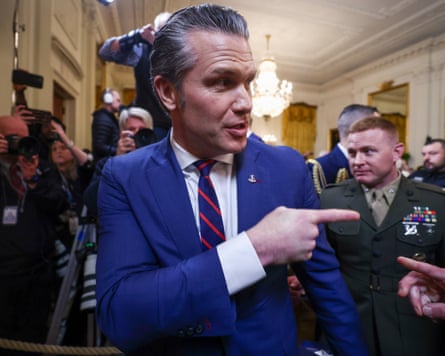
Now Trump is seeking to leave his mark on history and, like many second term presidents, finding there is more leeway in foreign policy than haggling with a divided Congress. The national security professionals who used to restrain his impulses – such as John Kelly, Jim Mattis and Mark Milley – have been replaced by loyalists, such as Pete Hegseth and Stephen Miller, who actively encourage them.
That means grand gestures like his Board of Peace, a spurious claim to have ended eight wars and a threat to seize Greenland. It also means deploying the world’s powerful military, which now seems to exert an almost erotic fascination for Trump.
He rebranded the Department of Defense as the “Department of War”. He often cites the Hollywood film Patton (1970) and the documentary series Victory at Sea. He also frequently praises military men for their looks. He once said of F-35 stealth fighter pilots: “Honestly, they’re better looking than Tom Cruise. The face is equal, maybe slightly better. The body’s bigger and stronger.” He described pilots who reported seeing UFOs as “handsome, perfect people” and “like beautiful Tom Cruise but taller”.
So far he still has no interest in neocon nation-building or putting troops on the ground to plant seeds of democracy. But he does revel in the fireworks, spectacle and “powerful” (one of his favourite words) demonstrations of American might. If they knock the Jeffrey Epstein files out of the headlines, even better.
When the US captured Venezuelan leader Nicolás Maduro in a dramatic raid, he said: “If you would have seen what happened, I mean, I watched it literally like I was watching a television show. And if you would’ve seen the speed, the violence.”
That raid helped convince Trump he’s on a winning streak with military operations. Journalist Jon Karl said after speaking to the president by phone: “He sounded, to me, like a president that feels invincible.”
The Pentagon named Trump’s offensive in Iran “Operation Epic Fury” and it’s the ninth time that he has ordered the military into action since he returned to the White House. The administration has offered a grab bag of different explanations for why it went to war, including Marco Rubio’s implication that the timing was forced by Israel.
What is the price of Trump’s war fetish? A strike on Shajareh Tayyebeh school killed up to 168 people, including dozens of seven to 12-year-old girls. Retaliation by Iran has killed six US troops so far. The state department has urged all American citizens to leave more than a dozen Middle Eastern countries as the conflict spirals in a widening gyre.
In short, Trump is less Board of Peace than bored of peace. The voters should have paid attention when he told a rally in Iowa in 2015: “I’m really good at war. I love war, in a certain way. But only when we win.”