 3 months ago
65
3 months ago
65
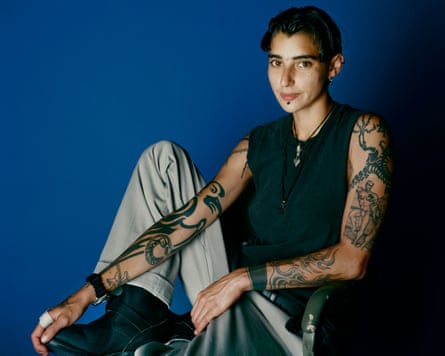
Catherine Opie has done for butches what Hans Holbein the Younger did for the Tudor nobility. Since she graduated in the late 1980s, amid the Aids crisis, Opie has made portraits of her community, friends and family, adopting unflinching realism, saturated colours, and dramatic tonal contrasts from the 16th-century portrait painters. Many of Opie’s most famous portraits – included in her new exhibition at the National Portrait Gallery – use these devices deliberately, a declaration that these people deserve, as the title of the show underlines, to be seen.
Opie has always been interested in construction – how we can be transformed by costume, posture, pose, role-play. This show is a testament to that, and her love of tattoos, piercings and body modifications (she does live in LA, after all). She’s especially drawn to the performance and presentation of masculinity – in the 1991 series Being and Having, one of the earliest bodies of work in the show and still one of Opie’s best known. She has 13 lesbian friends dress up as their masculine alter egos – Opie also appears as her own, Bo. They don a range of fake moustaches and are photographed close, so their faces fill the frame against an egg-yolk yellow background, the glue attaching the hair to their faces clearly visible. Their nicknames are engraved into name tags, like they’re trophies.
It’s fun, but your view of the pictures is sharpened by the sense that this was the height of the Aids crisis that ravaged the queer community. More than a decade later, she photographed high-school footballers after practice in cities across the US, their armature-like uniforms and exaggerated projections of power and strength contrasting with their equivocal adolescence.
The drama is amped up in her larger-scale baroque-inflected portraits, here gathered in a room painted carmine, black velvet drapes in the background giving gravitas to her subjects (including fellow artists Mary Kelly and John Baldessari) in solemn, classical poses. They look grand and historical, timeless – like the paintings that hang throughout this gallery. They look as if they belong here. Beyond the exhibition, Opie’s photographic portraits are installed among the 19th and 20th oil paintings of “inspiring people” of importance and influence: her luscious, elegant portraits of Isaac Julien, Gillian Wearing, Lynette Yiadom-Boakye and tattoo artist Alistair Fate fit so well, you could almost miss them.
The tension underlying Opie’s work around fitting in continually plays out in this show. In one portrait, another friend, Raven, stands naked and chained, Christ-like, to a barbed-wire fence at the top of a hill, a photograph that conveys audacity, courage and a sense of being on the precipice. In another photograph, uncharacteristically soft, natural light comes in through a bathroom window and casts its glow over Pam, a figure in a bathtub with her back to the viewer, slightly hunched, looking down – shaving, as the title tells us. There’s this constant push-pull between subterfuge and reveal, between tradition and subversion, the collective and the individual, fixity and fluidity, flattery and provocation.
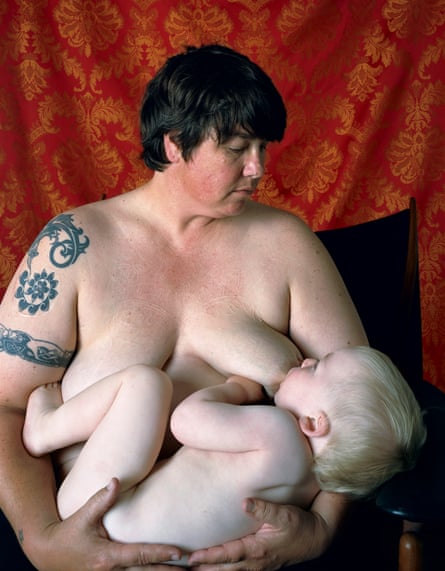
Two self-portrait works from the 1990s, hung facing each other across the space, perfectly embody these opposing forces: Opie’s Self-Portrait/Cutting (1993) and Self Portrait/Nursing (2004). In the first, we see only the pink flesh of Opie’s back, torn and bleeding, a childlike image of a couple and a house scratched into her skin. In the later portrait, we see Opie’s embodiment of that image, her own version of the Madonna and child. She looks down at her son Oliver as he breastfeeds. Seeing this familiar work again, it feels radical and brave, in its unapologetic rawness. Every detail of Opie’s scarred, tattooed skin is exposed and laid bare. Opie’s desire to tear, rip and rebel coexists with her desire for quiet domesticity, care and comfort. And why shouldn’t it?
The show moves in various sidesteps, through small rooms that allow intimate, close encounters with the works, into the different strands of Opie’s practice, from her semi-abstract landscape of the cliffs of Dover made during the Brexit referendum, to portraits of lesbian couples and families at home, taken during a road trip across America. We see her documents of protests and rallies, including the dozens of handwritten posters pasted to a wall on campus at USC after the protests over reports of sexual assault and drugging at the Sigma Nu fraternity. “Will I ever feel safe?” one poster reads.
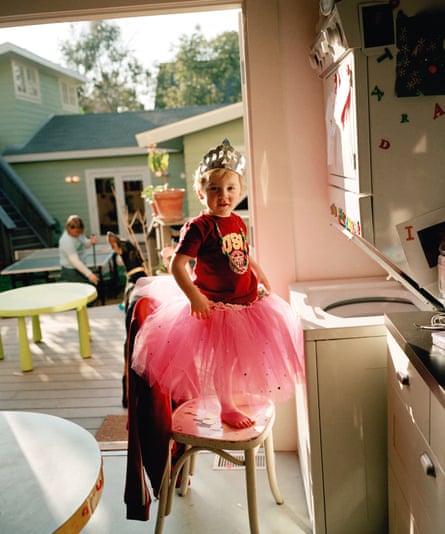
In another series, surfers emerge from the water, revived and ardently alive; in a single image, Opie captures her son, Oliver, still a toddler, wearing a tutu in the kitchen at the family home in LA. It was the Bush era when she took the picture, but what we see is a young person, playful, full of possibility, safe. To Be Seen is more about what’s necessary than what’s visible: family, love, care. Protecting the private world that remains untouched, at least in the picture, by the violence and violations of the outside world.