 1 month ago
39
1 month ago
39
Oman has mediated high-stakes, indirect talks between Iran and the US over Tehran’s nuclear programme, seen as one of the last chances to prevent a new US attack.
Envoys for the two countries arrived for separate meetings with the sultanate’s top diplomat, Badr al-Busaidi. The negotiations are the first since the US struck Iranian nuclear targets in June, joining in the final stages of a 12-day Israeli bombing campaign.
Washington wanted to expand the talks to cover Iran’s ballistic missiles, support for armed groups in the region and “treatment of their own people” – as the US secretary of state, Marco Rubio, said on Wednesday. But, after days of speculation, Iranian negotiators were satisfied that only the nuclear dispute would be discussed, at least initially.
Oman’s foreign ministry published a statement saying al-Busaidi separately met the Iranian foreign minister, Abbas Araghchi, and then the US special envoy, Steve Witkoff, and Jared Kushner, Donald Trump’s son-in-law.
“The consultations focused on preparing the appropriate circumstances for resuming the diplomatic and technical negotiations by ensuring the importance of these negotiations, in light of the parties’ determination to ensure their success in achieving sustainable security and stability,” the Omani announcement said.
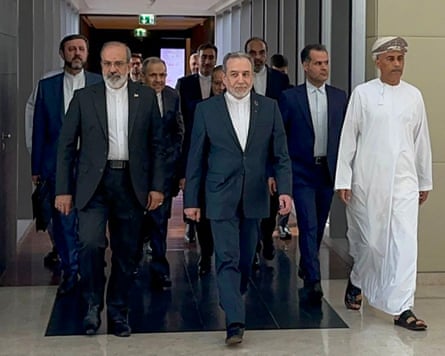
It was not immediately clear if that was the end of the talks for the day, though Omani officials left the palace immediately after the US delegation. The talks are being held against the backdrop of repeated warnings by Trump that he will strike Iran militarily from the US carrier strike group Abraham Lincoln if no progress is made. The US has been building up its naval presence in the region after a bloody Iranian government crackdown on nationwide protests last month, heightening tensions between Washington and Tehran.
Iran is seeking assurances that the US is not using the talks as a smokescreen to impose regime change. The last set of talks between the two sides were brought to a halt in June when Israel launched its surprise attack, which ended with at least 1,000 Iranians dead and three of its nuclear sites destroyed.
Before the talks, Tehran said the US had to drop its request for the negotiations to be held in Turkey in the presence of foreign ministers from Qatar, Turkey, the United Arab Emirates, Egypt and Saudi Arabia.
The planned attendance by the Muslim foreign ministers underlined the extent to which they fear their national security is wrapped up in agreement between the US and Iran.
Tehran has said it will not hesitate to attack Israel or US military bases in the region if it is attacked.
Iran says its right to enrich uranium on Iranian soil – a right it was granted in the now-defunct 2015 nuclear deal negotiated by Barack Obama – is not negotiable. The best source of compromise is that Iran agrees to suspend plans to enrich uranium for a fixed number of years, and a regional consortium is formed that enriches uranium, taking the region closer to an integrated civil nuclear programme.
Iran is also seeking sanctions relief in return for a new inspections regime at its nuclear sites. The value of the rial against the dollar has halved since the Israeli attacks in June, and Iran’s plummeting standard of living, made worse by runaway food inflation close to more than 100%, was the spark for the demonstrations that broke out in late December. The security services responded with a brutal crackdown.
Trump at one point encouraged the protestrs, promising “help is on its way”, but the US held back from attacking Iran partly because Israel and the US military did not feel they were fully prepared to withstand the likely Iranian reprisals.