 1 month ago
38
1 month ago
38
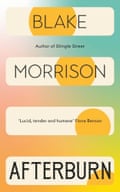
Afterburn by Blake Morrison (Chatto & Windus, £12.99)
Best known as a memoirist, Morrison returns to poetry after 11 years with a masterclass of lyric distillation and charged observation, demonstrating that nothing is beneath poetic deliberation. His subjects range from social and political justice to meditations on poetic heroes such as Elizabeth Bishop and sonnet sequences elegising the writer’s sister. The interwoven specificity and occasional nature of the poems is captivating: one feels their movement, “in the flesh, / in his memory / and in the words”, as they unspool with control and purpose. “I’m still capable of being in love.” This is a poet clearly still in love with life.
Into the Hush by Arthur Sze (Penguin, £12.99)
This first UK publication introduces readers to the current US poet laureate’s bold vision of the world’s fragility: one of unceasing iridescence and glimmer, even in the face of ecological destruction and dilapidation. While the title suggests a sonic organisation, it may be more apt to understand the poems as painterly brushstrokes. “When you’ve / worked this long your art is no longer art / but a wand that wakes your eyes to what is.” Single-line stanzas that decrescendo to em dashes recur, illustrating the silence into which Sze feels both world and body disappearing: “you have loved, hated, imagined, despaired, and the fugitive colours of existence have quickened in your body -”. Even in its continual replenishing beauty, the collection is eerie, as though these poems were a last attempt to bring order to the disorder of living. “What in this dawn is yours?” asks one. Perhaps nothing, because “once lines converge, lines diverge”.
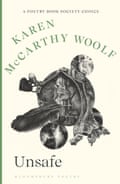
Unsafe by Karen McCarthy Woolf (Bloomsbury, £12.99)
“This is how you learn to stay alive – / sunlight streaming / through branches – / all young girls must remain / alert.” McCarthy Woolf’s taut new book reflects both the semblance of wholeness and the opacities of erasure. Alongside the poems, which broadly meditate on the capitalistic impressionability of bodies and landscapes, are photographs of blasted doll heads, metallic and shattered borders, surveillance cameras sutured to palm trees. “How do we claim / the nothing / that is space?” Photography, maybe. Poetry, most definitely – though the collection also contains essayistic explorations of tattoos: “I started to think a tattoo was a way to reclaim agency over the body…” Juliana Spahr encouraged poets to pay attention to the bulldozer as well as the beautiful bird; McCarthy Woolf extends this ecological ethic to the human and the architectural in this playfully sparse and hypnotic collection.
Only Sing by John Berryman, edited by Shane McCrae (Faber, £12.99)
Babe, wake up – 152 new Dream Songs just dropped! Readers meeting Berryman via Only Sing are not encountering the poems that weren’t good enough to make the first cut in his 60s classic; rather, they’ll discover a poetics of fierce vernacular, meticulous sonics, a consciousness unwilling to partition the demotic from the highly conceptual. “Let’s think of his nature as a kind of mist.” The “he” here is Henry, anthero of the Dream Songs, a prejudiced, nervy, white American man who, beyond the idiosyncrasy of situation, wholly resists classification. Berryman is a master of the line and like no other poet produces a page with variable technical tectonics that can stun or quake, often both: “Drink & sing seems all our fate obliges, / sleep feed make love between whiles, till we die, / & what does then our fate oblige?” A treasure trove for Berryman fanatics and new readers alike.
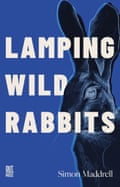
Lamping Wild Rabbits by Simon Maddrell (Out-Spoken, £11.99)
Loss and candour categorise Maddrell’s debut collection. The speakers feverishly recall desires often accompanied by the contrapositive of shame: “how their smooth twigs age and develop warts / there I go again talking about shame”. While the subjects include memory, life with HIV and the transformation of innocence, the language is steeped in a poetics of interpenetration, observed with a rich descriptive eye: “Polaroid of people gone, re-faced for posterity, / white-powdered cheeks, dust marks death on my pants.” The prize of age is wisdom – “the captive live longer than the wild” – and moments here silence the reader to introspection.
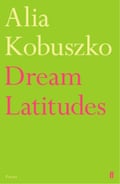
Dream Latitudes by Alia Kobuszko (Faber, £12.99)
“Often, I felt I was / on the precipice of some great / feeling,” declares one of 11 poems titled “X”. The letter X? The Roman numeral? Or have the titles been cut away? Approximating a climax that never arrives, Dream Latitudes is a strange debut – strange like waking up in the afternoon’s “armfuls of light”. Kobuszko’s poems are songs littered with accidentals, changing the timbre of their music, sometimes line by line. “There is nothing to do but sleep. There is nothing but sleep. How to exhaust the inexhaustible?” Fields, dreams, songs, birds, green, light, horses, pain – a poet can save these words from cliche if, like Kobuszko, they “unspool” them in a haunting music that neither entices nor repulses. “Tell me you can hear me when I say / in the fields of our dreams I will find you.” This collection breaks many rules, and is all the better for it.