 1 month ago
34
1 month ago
34
Heavy rains and strong winds continued to batter parts of Spain and Portugal on Friday, causing at least one death, forcing the evacuation of more than 7,000 people and prompting calls to postpone the second-round of Portugal’s presidential election.
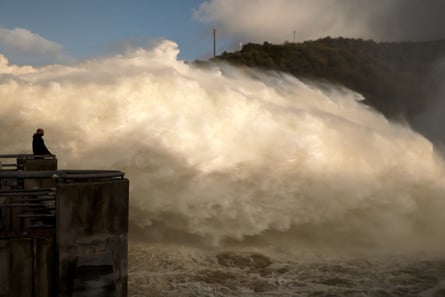
Storm Leonardo, which has lashed the Iberian peninsula this week, has led the Portuguese government to extend the current state of calamity in 69 municipalities until the middle of February.
The storm has killed one man in Portugal, while a young girl is missing in the southern Spanish region of Andalucía. It is the latest in a series of deadly storms to have hit Portugal and Spain in recent weeks, killing several people.
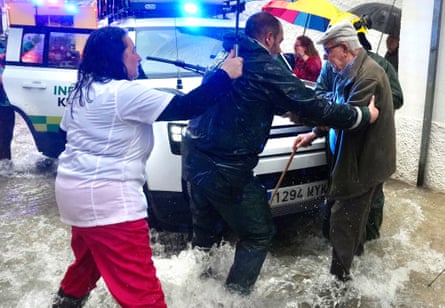
Authorities in Andalucía, where more than 7,000 people have been forced to leave their homes, evacuated residential areas near the Guadalquivir River in Córdoba overnight because the dramatic rise in water levels.
About 1,500 residents have been ordered to leave their homes in Grazalema, a mountain village popular with hikers, as water seeped through the walls of houses and cascaded along steep cobbled streets.
Andalucía’s regional president, Juan Manuel Moreno, told Cadena Ser radio that aquifers in the Grazalema mountains were full and could provoke landslides owing to pent-up pressure. “This could cause large holes or ditches. If this happens under a house or street, the result could be dramatic,” Moreno said.
He added geologists were assessing the situation in Grazalema to determine when residents would be able to return to their homes.
Spain’s prime minister, Pedro Sánchez, was due to visit the hardest-hit areas of Andalucía later on Friday.
The heavy rains are also affecting the olive harvest. Francisco Elvira, who leads the Coag farmers’ association in Jaén province, put losses so far at €200m (£174m).
Spain’s state meteorological office, Aemet, issued orange weather alerts on Friday for coastal areas of the north-western region of Galicia and yellow alerts for other parts of the northern coast, and for southern and eastern coastal areas, as well as for the Balearic islands.
Rubén del Campo, an Aemet spokesperson, said more heavy rain would fall on Saturday. “Following a slight letup on Friday, Storm Marta will arrive, bringing heavy rain and very strong winds on Saturday to areas that have already been very adversely affected by the heavy rains of recent days,” he said.
“Once Storm Marta moves off on Sunday, further weather fronts will arrive bringing less intense, but still significant, rainfall to most parts of the peninsula apart from Mediterranean areas.”
In Portugal’s second-biggest city, Porto, the River Douro overflowed in the early hours on Friday, causing minor flooding at riverside cafe terraces. In the country’s south, large parts of the town of Alcácer do Sal, by the River Sado, remained semi-submerged for a third day.
The commander of Portugal’s ANEPC civil protection service, Mario Silvestre, said six rivers, including the Tagus, were at risk of significant flooding, adding that Portugal was facing the worst flood threat along the Tagus in nearly three decades.
The damage and uncertainty brought by the storm has given rise to calls to postpone Sunday’s second round of the presidential election.
André Ventura, the leader of the far-right Chega party, said the vote should be delayed by a week as the poll was “a matter of equality among all Portuguese”.
But the national electoral authority said the vote would go ahead as scheduled. “A state of emergency, weather alerts or overall unfavourable situations are not in themselves a sufficient reason to postpone voting in a town or region,” it said.
Scientists say human-driven climate breakdown is increasing the length, intensity and frequency of extreme weather events such as the floods and heatwaves that have struck both countries in recent years.
Reuters, Associated Press and Agence France-Presse contributed to this report