 1 month ago
32
1 month ago
32
How do you follow up a show about girls in Derry? With one about women in Belfast, obviously. That’s what Lisa McGee has done. Her new eight-parter, How to Get to Heaven from Belfast, is as far away from Derry Girls as you can get when the distance between the worlds amounts to 70 miles along the A6.
Or as she puts it: “I wanted a shit, female, Northern Irish A-Team!”
Part thriller, part surrealist comedy, How to Get to Heaven from Belfast follows Saoirse (Roisin Gallagher), Robyn (Sinéad Keenan) and Dara (Caoilfhionn Dunne), who have been pals since their teenage years at the accurately named Our Lady of the Sorrows school – and who get dragged into a Knives Out-style mystery after the shocking death of their school friend, Greta.
Although the show is billed as a mystery comedy thriller – McGee also took heavy inspiration from Columbo and Scooby-Doo – it is at heart, like Derry Girls before it, a story about friendship. More specifically, about female friendships that span decades, the shared memories and the pressure to edit those shared memories to suit our ideas of ourselves.
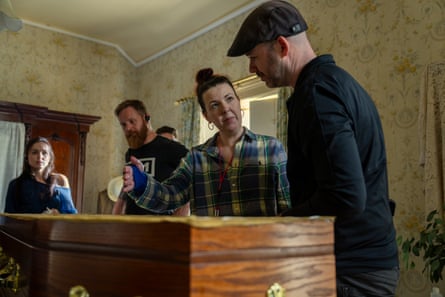
“The problem with a group of friends that have known each other since they were kids,” says McGee, “is that you know everything. And sometimes you don’t want that thing from your past being brought up again. Or you don’t want to talk about that story because it doesn’t represent you as you see yourself now. So it can get quite spiky. You’re living this agreed lie. But in a more comical way, you get away with nothing. I remember starting to eat sushi when I was in my 20s and my friends being like: ‘Who the hell do you think you are?’”
How to Get to Heaven from Belfast comes on the heels of three seasons of Derry Girls, a smash hit for McGee. But it actually precedes it by decades. “I wrote it as a play when I was at Queen’s University here in Belfast, and it was about a reunion,” says McGee.
She took the name from flyers thrust into her hands by Christian societies during freshers week. “I hadn’t done anything yet, and it wasn’t very good,” she jokes of the original How to Get to Heaven from Belfast. “But then during Derry Girls, a lot of my schoolfriends started coming to the premieres …” It was seeing those old pals again that made her go back to the play she’d written 20 years prior.
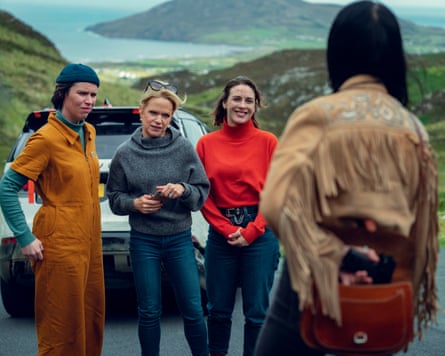
Like the teen survivalist thriller Yellowjackets, the story jumps back and forwards in time, showing the gang as adults but also as their teenage selves. The flashbacks are mysterious, all satanic symbols etched on walls and burning sheds in the woods. At other times it’s as explosive as a show like The White Lotus … if it were set in Ballycastle (there is somehow a yacht and a car chase, both of which blow up).
Before they go on a madcap sleuthing adventure to get to the bottom of Greta’s death, the women’s circumstances are sobering. Dara lives at home, caring for her overbearing mother after a terrible breakup; Saoirse is a TV writer in London engaged to a man she doesn’t really like; and Robyn, a glamorous but harried mum of four, is married to one she’s not fond of either. Greta’s death unmoors them, but it also offers an escape from the humdrum and lets them embrace the uncanny elements of their own lives. It’s inevitable, really, in a place like the north-west. “Derry people,” Robyn muses, “are always such weirdos.”
Together, the three travel to Greta’s wake, where they encounter her strange family. Her mother lies about Greta’s childhood, her daughter, wide-eyed and ghostly in a frog hat, freaks them all out. Worst of all is her widower, Garda officer Owen (Emmett J Scanlan), who is determined to cast himself as a grieving husband while seemingly hiding more sinister secrets.
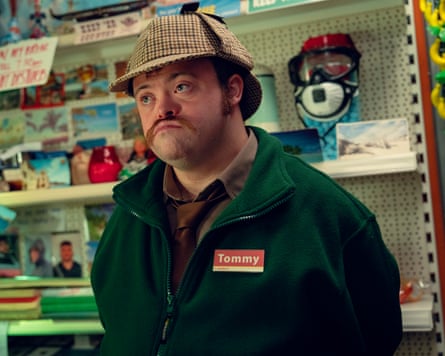
The show is a mystery within a mystery. While trying to uncover the truth about Greta’s death, Robyn, Saoirse and Dara confront the dark secret from their teenage years none of them want to look back on. The trio have matching tribal tattoos (Greta had one too), the meaning of which is never explained. They’re adamant they “didn’t do anything wrong” with the “thing we never talk about”, but the audience is only teased with what that thing could be – and whether the women are lying to us, and themselves, about their guilt.
Like Scooby-Doo’s Mystery Gang running riot in the hills and villages of the west of Northern Ireland, Saoirse, Dara and Robyn are far more likely to stumble through their murder mystery than solve it. They storm the wrong funeral wearing Disney princess masks, scandalising a church full of mourners. A twister (bad weather, even for Ireland) forces them to take refuge in the attic of eccentric innkeeper Seamus (Ardal O’Hanlon), who wears a spinning bow tie and spends his evenings hosting a series of ever more wacky themed discos. Dara extracts information from a local funeral director by staging her own – very alive – mother’s wake.
The craic may be deadly, in other words, but it’s still craic. The crimes and tragedies here are offbeat and fantastical – a boy from Fermanagh has been raised by chickens, a Kenny Rogers impersonator from Ballybunion has been killed by being thrown off a bucking bronco during country song Boot Scootin’ Boogie.
“I always loved the mystery genre, and I wanted to put my voice on something new,” says McGee. “I really, really want people to like it, but I don’t feel that pressure I had [with Derry Girls], certainly when the third series was coming out. I felt like such a huge responsibility for that to land in a way that everyone at home was happy with. Now I feel like I’m just telling a story and it happens to be set in Northern Ireland. I just hope people enjoy the ride. I hope they like the friendship group. I hope they laugh.”
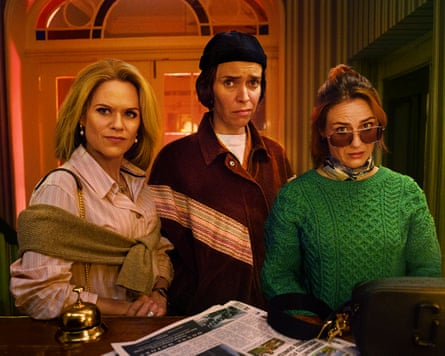
McGee lives in Belfast with her husband, English actor Tobias Beer, and their two sons, after 12 years in London. “I was really frustrated with London,” she says. “But I was also frustrated when I came home, because I didn’t feel like I was part of that.” Those experiences are mirrored in Saoirse, who won’t commit to a life in either place, and endures the indignity of having her colleagues explain away her brusqueness as a cultural trait. “I’m so sorry,” one says, “she’s Irish.” Saoirse’s name is frequently shortened to “Seersh”, which is arguably only slightly less torturous than being an Irish writer in London named “Róisín” and having your name constantly shortened to “Rowsh”.
“That’s the really interesting thing about identity,” says McGee. “You don’t quite know where you fit. Your job takes you to this place, but there’s stuff about this place that frustrates the hell out of you. And then you come home and people are like: ‘I don’t care about your stupid London job.’”
There are elements of the Derry Girls in all the How to Get to Heaven from Belfast characters. McGee says Dara is similar to Orla, while Robyn shares much of the same DNA as Michelle, and is based on the same real-life friend, who grew up to become a similarly glam mum of four. But there’s an edge to the friendships that feels truer to the experience of navigating relationships in adulthood. “It’s the same group of girls,” she says, “only we’ve grown up now and we still don’t know what we’re doing!”
Although How to Get to Heaven deals with inalienable truths of life – fashion is circular, friendship is complicated, you never get a crowd for a closed casket at a wake, obviously don’t marry a police officer, although it might be grand to ride one occasionally – it feels quintessentially Northern Irish in tone, a dark comedy odyssey through the Lynchian bleakness of Ireland’s rural north-west.
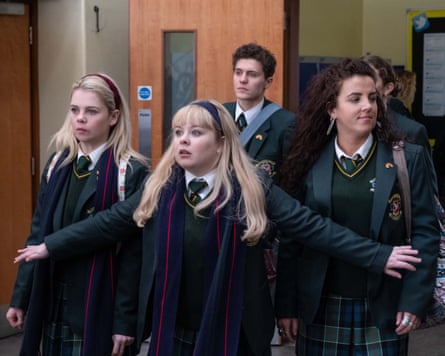
“When you think about the history of Northern Ireland, the people and the landscape, there’s something so charming and beautiful, but it can turn really quickly,” says McGee. “Something that was the most picturesque, gorgeous thing [can become] suddenly really dangerous. There are so many layers to the place with the history and what we’ve been through. The landscape is so wild and gorgeous and in the dark so scary. There’s all the ingredients you need for a very scary story.”
If there’s misery in How to Get to Heaven from Belfast, it’s short-lived. “I don’t believe you can sustain that level of depression,” says McGee. “Really bad stuff was happening here for quite a long time, but it’s like, you can’t stay at that. Someone will say something ridiculous or do something inappropriate and then the conversation changes. I think comedy is way more truthful than drama at times because people are just ridiculous, particularly somewhere like Northern Ireland.”
That doesn’t mean they’re not amazing to watch. As with Derry Girls, the women are active protagonists, not passive characters watching their lives pass them by. “They needed to feel badass,” says McGee. “They don’t make it better a lot of the time, and a lot of the time they’re making it worse. I wanted any woman watching this to think: ‘Oh, that looks a bit sticky, but I’d love to do that with my friends. I’d love to solve something like that.’ That was always my driving force … that and sometimes you need to blow a few things up.”
How to Get to Heaven from Belfast is on Netflix on 12 February.