 3 months ago
83
3 months ago
83
A decade ago, when Iran signed an agreement with the Obama administration and five other countries to give up its ambitions for a nuclear weapon, Alaleh Kamran was staunchly on the political left and welcomed the prospect of peace in the country of her birth.
Now, though, as Israel and the United States launched punishing airstrikes on Iran, she finds herself in a dramatically different headspace.
“It’s not an invasion, it’s a liberation,” she says. “My support is behind this 100% .”
Kamran, a criminal defense lawyer in Los Angeles, which boasts the largest Iranian community in the world outside Iran, used to be at loggerheads with more conservative members of the Iranian Jewish community here who opposed the nuclear deal from the outset.
Now she agrees with them when they say there can be no negotiating with an authoritarian government they view as no better than murderers. She and other community members the Guardian spoke with believe that a majority of Iranians agree, too, particularly in the wake of last month’s killing of thousands, possibly tens of thousands, of street protesters seeking to overthrow the regime. In the run-up to the US and Israeli bombardments, some in the protest movement called openly for help from the outside world.
“This is unprecedented, to have a nation take to the streets and ask a foreign country to bomb them so they can be liberated,” Kamran said. “They’ve been incarcerated and dominated for the last 47 years by an occupying regime… This is a cancer, and Trump is doing what Trump needs to be doing. As a Jew, I am standing behind him and behind Bibi [Israeli prime minister Benjamin Netanyahu]. Oh my God, I cannot believe I am supporting Bibi, but here I am.”
The desire to see an increasingly ruthless Iranian regime collapse has intensified in both Iranian expat communities like the one in Los Angeles, and in the country itself, Kamran and other community members said. In online forums, family discussions, and in street demonstrations, opinion has been moving towards a plan that not so long ago would have seemed fanciful, perhaps even absurd: that the Americans and the Israelis need to end the Islamic Republic once and for all – and that Reza Pahlavi, the exiled crown prince and son of the Shah overthrown during the Islamic Revolution of 1979, should take over as a stopgap leader.
In the absence of polling it is difficult to quantify numbers or the degree of support for Pahlavi. But Iran experts, including staunch opponents of the war, say that the dominant tenor of the community conversations online – both in the country and in the diaspora – is about forging unity at a moment of maximum despair. Even Iranians who in the past might have objected to an unprovoked attack on a sovereign state are quietly telling their friends that something needs to be done to stop the government slaughtering its own people.
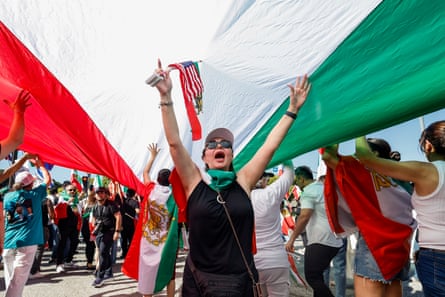
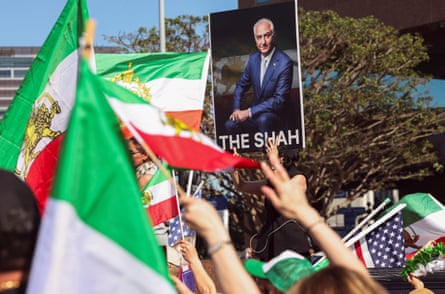
In mid-February, a protest in favor of outside military intervention attracted thousands of people to downtown Los Angeles and featured extraordinary giant posters reading “Reza Pahlavi is our choice” and, beneath an image of Donald Trump: “We are locked and loaded.” Any memory of how much Iranians loathed the Shah when he was in power or how notorious he was for widespread human rights abuses, including his own violent crackdowns on street protesters, appeared to have been set to one side or forgotten.
A similar crowd gathered on Saturday afternoon in Westwood, the heart of the Iranian Jewish community in Los Angeles, to celebrate the news that Ayatollah Ali Khamenei had been killed in an airstrike. They waved imperial flags from the Pahlavi era in the street and from their cars, honked horns, and shouted “Javid Shah!” (Long live the king!)
“I have increasingly seen people who don’t support the monarchy and don’t like Pahlavi come under that banner for the sake of unity,” said Melody Mohebi, a Los Angeles-based expert on Iranian civil society with the pro-democracy group Democracy 2076. And the thinking, she reported, has become very black-and-white: “The mindset now is that anyone who does not support this one vision is now supporting the regime.”
Mohebi and others say the community has not forgotten that past US military incursions to bring about regime change – in Iraq in 2003 and Libya in 2011 – did not go well, but those supporting the war argue that this time will be different because, in their view, Iranian society is more united and less likely to fragment. Like Kamran, people are talking about the Iranian government as an occupying force – in part to justify the notion of a different outside force coming in to unseat it.
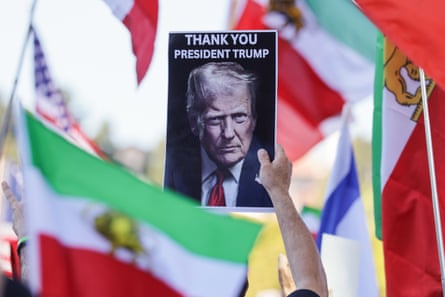
Still, there are grounds to question how broad the push for unity has been outside the confines of the internet. The Iranian community in Los Angeles, or Tehrangeles as it is often called, is known for its multiple fault lines separating conservatives and liberals, Republicans and Democrats, Muslims, Jews and Baha’is. Often divisions appear within the same families, especially between those born in Iran before the revolution and those born after in the United States. “Being Iranian American is like a Facebook relationship status – it’s complicated,” the comedian Maz Jobrani joked recently.
Among Iranian Jews, political sentiment has certainly drifted to the right since the Hamas attacks on Israel on 7 October 2023 and the ensuing war in Gaza. Kamran said she saw similarities between the “existential crisis” facing Jews who endured slaughter at the hands of Hamas – and have felt threatened by antisemitism since – and Iranians who have endured slaughter at the hands of their government. But the political drift of the rest of the community has been far less clear.
Shervin Malekzadeh, who teaches political science at Pitzer College in the suburbs east of Los Angeles and has studied the Iranian protest movement, said he had some skepticism about the way Iranian opinion was being directed online. “It can be very toxic,” he said. “It is driven by a segment of the population that is very strident and often very hostile.”
If the plan was to rely on Trump, Netanyahu and Pahlavi, Malekzadeh saw it as a symptom of people’s desperation, not hope. “This is the nadir, the pit of despair,” he said. “They’re thinking, better to be devoured by a beautiful lion than to be torn apart by a horde of foul wolves.”
Some organizations have spoken out forcefully against outside military action, even at the risk of being branded as pariahs for doing so. The National Iranian American Council, which has a history of defending human rights, said that pursuing regime change would have “a high cost in blood, with no guarantee of a brighter future for Iranians... Ultimately, state collapse, civil war and a reshaping of authoritarian governance in Iran are far more likely to flow from bombing than human rights and democracy.”
Mohebi said she worried about what she saw as a form of groupthink online, not just because it left little room for alternate approaches to opposing the regime in Tehran but also because it portended badly for the prospects of democracy even if the regime is overthrown. “We are leaving an authoritarian system, but that authoritarian mindset has not left us,” she said. “If we’re not imagining something better, we’re leaving the door open for another authoritarian to step in, and that cycle will continue.”