1 month ago
39
1 month ago
39
In the basement of Larry King’s salon in Marylebone, London, stylist and curly hair advocate Jennie Roberts is giving me a much-needed pep talk. “It’s all about education and making everything simplified,” she says, perhaps sensing my apprehension as I stand uneasily before her with a comb in hand.
“It’s not a big effort, it is not going to cost a lot of money. Managing curly hair, once you know how, is easy,” Roberts says. “It really is. It’s easier than trying to hide it anyway.”
The curly hair in question isn’t mine but that of my two daughters, aged three and four-and-a-half. After months of screaming and unsatisfying results, I’ve taken it upon myself to learn the basics of caring for their hair, which is a combination of my mixed-race afro curls and my wife’s straighter Spanish locks.
Roberts, who has styled everyone from Thandiwe Newton to Mel B and now offers courses for handling Black curls, doesn’t have an easy task in front of her as she needs to try to undo decades’ worth of my own hair ignorance.
For me – and many other Black men – hair care begins and ends with the barber shop: a male-only space of unsolicited political opinions, fades and buzzing clippers. Black female hair, however, remains a mystery.
I barely know the difference between 4C curls and a 4B pencil. Hand me a pair of straighteners and I’d probably assume you toss salad with them. Take me to a Pak’s store and I’d be clueless.
My earliest salon experiences are of my sisters having their hair done before we travelled to Nigeria for the first time as four-year-olds. Our auntie would run a comb roughly through their hair, which produced yelps and questionable results. I checked in with them before writing this article and my memories are correct; in fact, there are more horror stories I wasn’t privy to. My older sister also passed out after having her hair braided for hours, and both of them are emotionally scarred after having their hair “thinned” by a white stylist.
For many Black and mixed-race people, hair trauma is very real. A 2021 report by Pantene found that 93% of people with afro hair had faced discrimination, while painful experiences at salons are seen as something women with Black hair just have to go through. Roberts says that is rubbish. “I don’t have trauma in my life around my hair,” she tells me. “I’ve always embraced my curls, it’s never occurred to me to straighten my hair, because I love it.”
Roberts is an outlier. Black British women spend £168m a year on hair products, with an average Black woman spending between three and six times more per year on their hair than their white counterparts.
In 2026 there is a growing movement of Black fathers who are learning to care for their children’s hair. Jamelia Donaldson is the founder of Black beauty company Treasure Tress. She’s been running crash courses for Black men who want to learn how to care for Black hair for a couple of years now. Despite there also being hair-braiding courses for Black women, Donaldson says it’s the Black men who always get attention on social media. “I think it is the juxtaposition of being dad and hair,” she says. “People don’t associate the two, they feel like the mums will just do it.”
The poet and author Yomi Ṣode took part in a workshop to lighten the load on his partner, who was caring for her own hair, Ṣode’s and their two children’s. He signed up for a class and was soon learning how to plait and do partings. “I wanted to learn, so I can cover and step in and have this skill,” he says. “Also, if I can do a bad boy hairstyle, if I do the wickedest parting, I feel so proud. Even though it takes me 45 minutes to do what my partner can do in five minutes.”
Ṣode sees hair care as a vital part of connecting with his daughter, and Donaldson says that sentiment is widespread among attenders. “A lot of them understood the significance of hair and the fact that it is an opportunity for bonding and they just wanted to be more involved,” she says. Black women have told her that their fondest memories are of their fathers doing their hair. “It’s not celebrated enough,” Donaldson adds.
Now it’s my turn (we’re mainly focusing on my eldest daughter, who has the longest hair at present, although the tips are applicable to both of them). Roberts starts by asking me how I look after the girls’ hair. It’s a mix of a Tresemmé shampoo for curly hair and then a hair mask, which is applied and rinsed out. Then the combing begins, which usually results in our eldest daughter screaming as any knots are detangled. It’s a laborious process that often results in both parents and children on edge and sometimes in tears. Afterwards, I apply a leave-in moisturiser from Black British brand Jim + Henry and plait or put her hair up in bunches using hair ties.
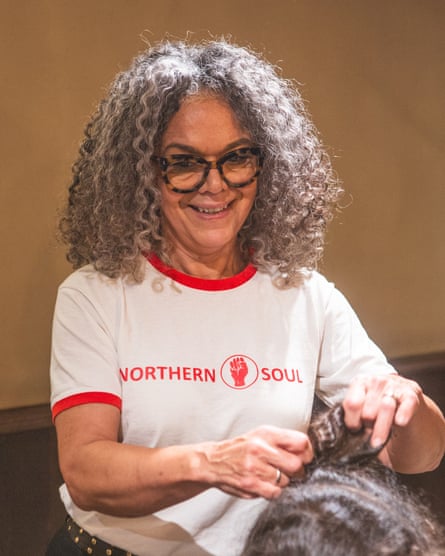
Turns out I’m making some fundamental mistakes. First, the hair ties I’m using are far too unforgiving. The tight, elasticated ones we favour are a nightmare to remove. They cling to hair, meaning that when I attempt to extract them they pull, causing pain as the hair catches. The solution is to replace them with silky, looser hair ties that are cheap and, more importantly, slide off hair rather than clinging to every strand (Roberts doesn’t even try to take out the old ties, opting to cut them off so as not to cause pain).
The other obvious flaw in my hair game is my brushing technique and the equipment I’m using. At present I’m applying detangler, then combing from the scalp down to the end of the hair. That causes yelps of pain from my eldest daughter, and is – as Roberts tells me – a terrible approach.
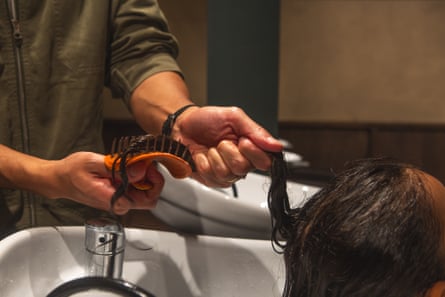
The brush I’m using is a non-starter: with hard short teeth, it is fine on my wife’s straight hair, but far too inflexible on my daughters’ curls. Jennie recommends a manta comb, which featured on Dragons’ Den and has far fewer teeth, which are longer and spaced out.
Technique-wise, I need to start at the bottom of the hair, identify tangles, then use the longer teeth to gently unpick them and then comb the hair. Roberts shows me how to slowly move methodically up the hair as you go. Our eldest daughter, who usually screams the house down when she has her hair combed, is sitting quietly and seems to be enjoying the process. I have a go, and the unpicking technique needs meticulous attention, but 1) produces no screams from my daughter and 2) delivers untangled hair more quickly.
Some of the advice seems to come from left-field, such as not using a towel to dry my daughters’ hair. “Use an old T-shirt,” Roberts says. What’s the thinking behind that? “The T-shirt doesn’t have a pile on it, which can cause friction and ruin the curls. All you’re doing is damaging the hair and undoing all the good you’ve done.” Hard to argue with that one, and the one thing I do have in this life is old T-shirts.
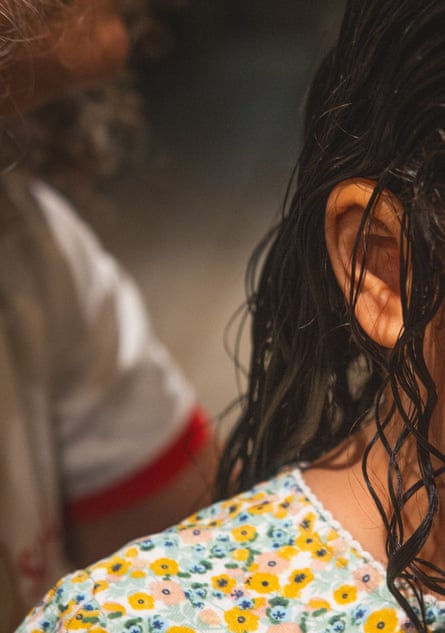
The hair products I’m using are also far too heavy for my daughter’s hair. They’re great products but just meant for much tighter curls. They need to be replaced by lighter serums (Roberts recommends the Curly Ellie range) that will accentuate the curls and gels if I’m looking for more hold.
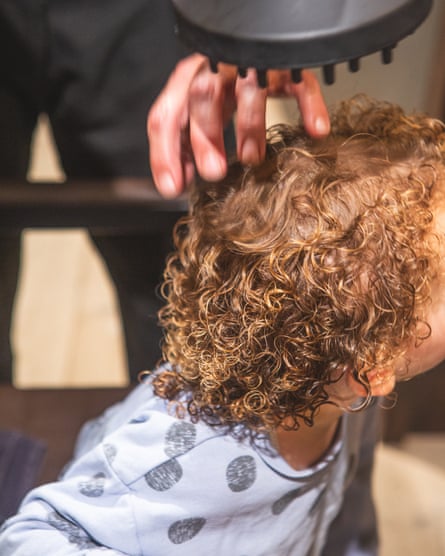
While the T-shirt towel is a nice money-saver, something worth spending on is a diffuser. After the T-shirt pat-down (or “plump”, to use the technical term) and an application of leave-in moisturiser, I need to get comfortable, put the dryer on a low setting and allow it to work its magic and bring out the curls.
Roberts gently places the hair on her massive diffuser, which looks as if it could double as a satellite dish, and patiently lets the heat move through the hair. Rather than the quick two-minute blast I usually apply, this takes almost 10 minutes.
In the hour or so the tutorial takes, there’s a lot of information to take in. I’m certainly not an expert but the key takeaways are patience, technique and jettisoning my current methods that often make things worse.
We leave with some silk pillows to protect the girls’ hair at bedtime, and the next time we do “salon night” I’m armed with my new skills. Combing takes longer, I need to use several episodes of Jo Jo & Gran Gran to keep the girls still, but it’s far less painful for everyone. There’s also that pang of satisfaction Ṣode talked about when it’s all done. I won’t be opening Salon Bakare any time soon, but hair day just got a little easier.