 2 months ago
54
2 months ago
54
In her first print interview since release, the Palestinian immigrant says after year in custody, she sees it as her duty to denounce ICE detention in the US
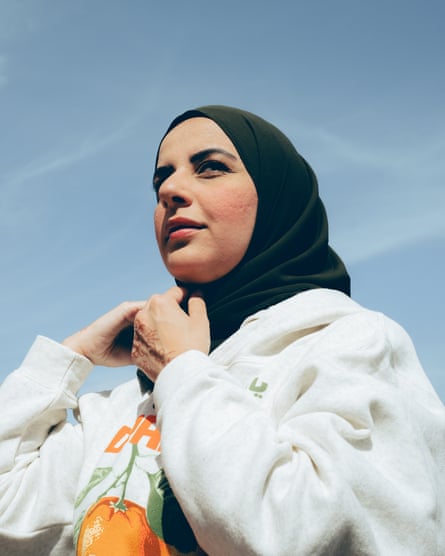
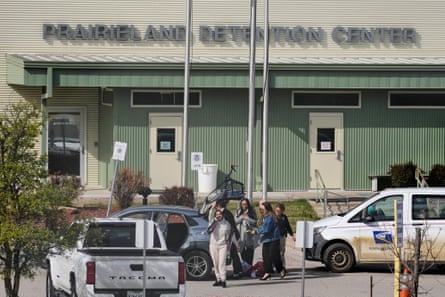
A Palestinian woman who was released last month after spending a year in a Texas immigration detention center told the Guardian in an exclusive interview that she sees “a lot of similarities” between the treatment of people in Immigration and Customs Enforcement (ICE) custody and that of Palestinians living under Israeli occupation.
Leqaa Kordia, who was detained by ICE following her arrest at a protest against Israel’s war in Gaza, says that she will continue to speak up about the rights of Palestinians, but that she now also sees it as her duty to denounce the “human tragedy” of immigration detention in the US.
“When I took to the streets, I was defending my rights, and my family’s rights, and calling for freedom for myself and freedom for my family,” Kordia said of her participation in an April 2024 pro-Palestinian protest outside Columbia University, where she was arrested along with dozens of others. The charges against her were dropped the following day. More than 200 members of her extended family were killed by Israeli strikes in Gaza and Kordia didn’t see herself as an activist, she says, but rather “just a Palestinian girl, protesting her family being killed”.
“Now, I’ll advocate on behalf of the ladies I left behind,” she said, referring to the women with whom she shared an overcrowded dorm at the Prairieland detention center in Alvarado, Texas. “I was advocating on behalf of my family in Palestine, and now I’m advocating on behalf of my family here in America … Now I have a bigger family.”
Kordia spoke with the Guardian at a Palestinian cafe in Paterson, New Jersey, home to one of the largest Palestinian-American communities in the country, two weeks after returning home – after an immigration judge for the third time ruled that she posed no threat and ordered her release on bond. Her release followed mounting pressure from legislators and human rights groups, and came after her 6 February hospitalisation for a seizure she had while in detention.
Kordia has been living in the US for nearly a decade after leaving the West Bank, where she grew up with her father, to reunite with her mother, who is a US citizen. She has a pending green card application via her mother and no criminal record.
She was arrested around the same time as Mahmoud Khalil and Mohsen Mahdawi – both Palestinian and Columbia University students – whose detention a federal judge in Boston ruled was unconstitutional and intentionally designed to chill speech.
Her time in ICE custody has brought back many memories of her childhood in Palestine, Kordia says.
When she was nine years old, during the second intifada, she woke up one day to a group of Israeli soldiers in her bedroom, pointing guns at her.
Palestinians in the occupied territory were living under curfew, and snipers had been stationed on the family’s rooftop for days, while tanks lined the streets outside their home. Like many children there, she was used to checkpoints, raids, and daily humiliations. Once, she had watched soldiers knock her brother unconscious. But the night soldiers barged into her bedroom was uniquely terrifying. “As soon as I opened my eyes I saw that soldier laughing – literally laughing – and pointing his rifle in my face,” she said.
She found echoes of that moment in Texas, where she said guards would ignore detainees when they asked for help, told them to “shut up” – and frequently laughed at them.
Describing the indignities of life in detention would take “days”, she said, before rattling off a list of them, from the fact that she spent weeks sleeping on a “paper-thin” mattress on the floor as too many women crowded into the center, to the complete disregard of her religious rights, to the medical neglect that led to her hospitalization.
DHS did not respond to a request for comment
The detention center was always cold, she said, and when she and others complained, guards told them it was to protect them from “germs”. Women who asked for water during hours-long intake processing were directed to a water fountain attached to a toilet seat. When the showers in the center broke down, guards responded to complaints by saying, “It is what it is,” Kordia recalled. Drinking water would sometimes have “things swimming in it”. The food – served at 4am, 10am, and 4pm – was often uneatable. Detainees referred to it as “dog food”, but those who refused it risked being put on “suicide watch” in isolation.
“People can literally grow crazy in those places,” she said. She described women breaking down and experiencing panic attacks under the eyes of indifferent guards.
There were pregnant women at the center as well as sick and elderly ones – guards were equally dismissive of their requests for help. “They just didn’t care,” Kordia said. She described the frequent shuffling of detainees from one center to the other – often causing them to miss their court hearings – as “human trafficking”.
“The word ‘detention center’ sounds nice,” she added. “It’s not nice. It’s a jail.”
For all the current talk about ICE, Kordia believes that the general public doesn’t have an understanding of what conditions in immigration detention are like. She herself thought she was an informed person – “It turns out I didn’t know,” she said.
But despite their harrowing experiences, women in detention built deep bonds across life experiences and language barriers.
They exchanged relatives’ numbers so that if someone was transferred or deported they could notify each other’s families. When Kordia was hospitalized, her family only learned of it from a fellow detainee; they spent three days trying to get ICE to tell them where they had taken her. Kordia described countless other gestures of solidarity in detention. When she was sick, other women would cook with the centre’s microwave and bring it to her; when someone had a birthday, they celebrated with items from the commissary. When she collapsed and had a seizure in February, a fellow detainee insisted with guards that they take her hijab with her to the hospital.
“I was sent far away from my community in New Jersey, all the way to Texas, for them to isolate me,” she said. Instead, she found a tight-knit community. “When somebody cries, everybody cries, when somebody laughs, everybody laughs.”
She also took her detention as an “opportunity” to talk to fellow detainees and any guards who would listen about the plight of Palestinians. Some already knew about it; others learned of it from her for the first time. She had a copy of a book by the Palestinian poet Refaat Alareer, who was killed early in the war in an Israeli strike, that detainees who spoke English passed around and eagerly read.
“We all came from countries where we know what war is. We know what struggle is, we know what poverty is, so it wasn’t hard for them to relate,” she said.
Kordia said the daily “humiliation” and “stripping people of their dignity” she had known in Palestine was an experience anyone in immigration detention could understand. “They don’t call you by name, they call you ‘subject’, or by number,” she said of ICE guards and Israeli soldiers alike.
When she left Palestine for the US in 2016, Kordia thought that America was all about “freedom”. “Everybody can say whatever they want and do whatever they want,” she recalled thinking. “I really used to believe that.”
Before her detention, she was working as a server at a Palestinian restaurant in Paterson, with dreams of opening a cafe of her own. Now she’s not sure what she’ll do; an immigration court has granted her temporary protection but the administration is continuing to seek her deportation.
But while she still doesn’t see herself as an activist, she now sees “no choice” but to speak about her experience.
“The least I can do is talk about what those I left behind are facing every day,” she said.