 2 hours ago
6
2 hours ago
6
Next month, Christopher Nolan’s blockbuster version of The Odyssey is set to storm cinemas around the globe. Auguries suggest the almost three-hour drama will repeat the success of Nolan’s previous film both at the box office (Oppenheimer took nearly a billion dollars) and the Academy Awards (it won seven Oscars).
But before that, a new audiobook version of Homer’s tale has been released starring one of Nolan’s most frequent collaborators: Michael Caine, with whom he has worked on eight films, including the Dark Knight trilogy.
Caine, now 93, announced his retirement at the Red Sea film festival in Saudi Arabia last December. It was the fourth time he has done so, and seems as unlikely to be binding as the previous three times, particularly thanks to a deal the actor struck shortly beforehand to license an AI version of his voice.
In November 2025, Caine and Matthew McConaughey became the highest-profile stars to sign on with ElevenLabs, the $11bn AI audio generation and voice cloning company that enables brands, studios and creators to rent celebrity voices from its Iconic Voice Marketplace.
Such tools mean even death will not wither A-listers’ abilities to appear in new adverts, films or on GPS devices, as the licensing can continue – pending estate approval – for eternity.
The 13-hour Odyssey audiobook is ElevenLabs’ inaugural in-house production and billed as “the company’s first cinematic multicast audiobook, combining Sir Michael Caine’s™ official AI voice replica, a full cast performance, original music and immersive sound design”.
While Nolan’s screenplay draws on Emily Wilson’s revisionist 2017 translation for inspiration, ElevenLabs used the text translated by William Cullen Bryant in the 1870s. No academics were involved, they confirmed, but ensuring the correct pronunciation of characters’ names was “a painstaking process”.
In a statement, Caine described the poem as “one of the greatest stories ever told. For nearly three millennia, its themes of perseverance, loyalty, temptation and the enduring call of home have resonated across cultures and generations.
“By bridging classical storytelling with digital innovation, this timeless epic is reimagined for modern audiences, brought vividly to life through ElevenReader’s cutting-edge technology. It was a pleasure to be a part of ElevenProductions’ retelling of The Odyssey.”
Caine’s involvement was mostly confined to his consultancy last year, perfecting iterations of his AI voice. Dustin Blank, who leads partnerships at ElevenLabs, applauded the actor’s foresight in signing the deal with the company. “Bravo to him for recognising this is where technology is going,” Blank told the Guardian. “He’s a leader in this space because he’s been a part of crafting the first steps and his own legacy.”
The other voice artists featured in the audiobook are uncredited, and only learned of their involvement in the project after its completion, when they were remunerated according to the number of letters of the alphabet their voice spoke. So far, some 22 million people have been paid in this way. Members of the company’s Iconic range, however, have power of veto over the projects their voices appear in.
Supporting cast members were “auditioned” from the library, says Blank. For Athena, for instance, the producers were looking for a voice that was “wise, but subtly emotive”. Once one had been identified, “we could really hear that person. And they made the words come alive on the page”.
In the opening chapter – which is available to listen to for free – Caine narrates in strikingly lifelike if remarkably uniform tones: calm, respectful and respectable. His intonation is more homogenous than might perhaps have come with a traditional performance, and more even than that of some of the other voices used (in particular a fruity Zeus).
Blank points to the vernacular origins of the epic poem – originally written down around 725–675BC – as offering further validation for their decision to produce a new version using code-prompting.
“This story has been around for thousands of years,” he says. “It has already travelled through all different types of technology and retelling. So we view this as a continuation of that.”
The production took four producers six weeks, which ElevenLabs says represents a considerable acceleration of the traditional “months of casting, recording, sound design, and post-production”.
Those criticising the company for minimising creative roles and imperilling jobs are missing the point. “Human ingenuity is creating these prompts and putting the pieces together,” Blank says, “and we’re hiring new types of jobs to support this.”
He continued: “It will also allow for more things to go into production and more money to go into this space. The goal is, with this type of technology being in the hands of more people, that there will be more product out there and more opportunity for people to get through the door.”
Future projects are still in discussion, with further audiobook versions of canonical texts released before landmark new movies – such as the forthcoming Dune 3 and Netflix’s Pride & Prejudice – likely to provide a model. “We’ve toyed around with some of those and we’re thinking about who we would want to cast in them,” said Blank.
“It has to be something that pushes the ball forward, not AI for AI’s sake.”
Blank also said the company would be open to collaborating with big-name directors who would take control of the decision-making and mix, as well as productions with unconventional casting, such as gender-flipped versions of classics: “I love that idea – and we should.”
Caine is a six-time Oscar nominee and two-time winner, whose roles in films including Alfie, Get Carter, Zulu, The Man Who Would Be King, Sleuth, Educating Rita, Hannah and Her Sister, Miss Congeniality, The Cider House Rules, Youth and A Muppet Christmas Carol have made him one of one of the world’s best-loved – and most prolific – stars.
A veteran of more than 150 movies, he has long been frank about prizing commercial pragmatism over creative fulfilment. Of his involvement in the critically panned Jaws: The Revenge (1987), for which he received $1m for a fortnight’s work, he famously said: “I have never seen the film, but by all accounts it is terrible. However I have seen the house that it built, and it is terrific.”
Caine first retired in 2009, after gang crime drama Harry Brown, then again, 24 films later, in 2021, after starring as a novelist in Best Sellers. He returned for the little seen Czech historical drama Medieval in 2022, and the following year starred in The Great Escaper as a D-day veteran who travels to Normandy solo from his care home for the 70th anniversary, for which he won rave reviews.
Although Caine told Radio 4 that would be his last film, he suggested to the Guardian he would shortly shoot a biopic of Charles Darwin. “And that’ll be it. I won’t do another one after.” When questioned whether he was certain, Caine said: “No! But the point is, can you do it? Can you remember all the lines? I’ve got used to not working and staying in bed till 11am and staying out late at night. I love it.”
Anthony Hopkins has since been announced as the star of the Darwin film, which is currently in production, while Caine’s mooted return as a priest in The Last Witch Hunter 2, aiding Vin Diesel’s immortal warrior, also seems unlikely to materialise.
While Caine provided narration for the audio versions of his 2010 and 2018 memoirs, Eddie Marsden took over for 2024’s Don’t Look Back, You’ll Trip Over: My Guide to Life, as well as for the audio version of Caine’s first novel, a thriller called Deadly Game, in 2023.
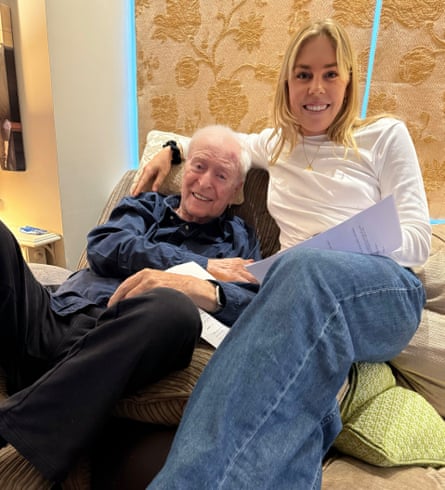
However, Caine did lend non-AI vocals to a short film, Bobby, which is likely to premiere this autumn. The writer-director of that film, Isabella Webber, told the Guardian that Caine recorded narration with her in his London flat the month before he signed the ElevenLabs deal.
Caine reads aloud a poem written especially for the film, which is based on the story of a man moved to paddle in his own canoe to Dunkirk in an attempt to help rescue troops.
Webber said that she decided to ask Caine having heard him speak about his own father’s experiences of Dunkirk on a podcast. After connecting with Caine’s wife, Shakira, Webber was told that Caine was keen, but due to his age and health, they couldn’t pin down a day.
“I had the script and a microphone in my bag and just didn’t leave Chelsea Harbour [where Caine lives] for about three weeks,” said Webber. “Then one day I got a phone call and went to his flat.” After a spell sitting on his sofa watching Sky Sports, Webber showed him the script. “And the minute I got it in front of him, he just lit up. We spent a good hour together while he read the poem. He’d read a line and then ask my opinion, and I was like: ‘I don’t need to be directing you, Michael!’”
Allowing the actor free rein paid dividends, says Webber. “He gave me so many different versions and tones. The inflection and pacing of a performance can convey so many different things. When actors do stuff that you weren’t expecting, and in a way that you weren’t expecting, it elevates the script to another league. It isn’t just a voice; it’s a lifetime of experience.”
Allow Instagram content?
This article includes content provided by Instagram. We ask for your permission before anything is loaded, as they may be using cookies and other technologies. To view this content, click 'Allow and continue'.
In between takes, Caine would recount stories his father had told him about the war, which ended up shaping some of the rest of the film’s narrative. Webber hopes it will become a full-length feature.
The trailer features a snippet of Caine’s voiceover: slow, gravelly, imperfect and immensely characterful. “The humanity and the happy accidents give you things you’d never be able to predict,” says Webber. “Whereas the thing with AI is that everything’s predictable.”