 3 hours ago
3
3 hours ago
3
Vous or Tu? It says a lot about Habib Diarra that his joy at being promoted from Strasbourg’s Under-17s to the first team was tempered by anxiety over the two French words for “you.”
Would addressing new, senior teammates by using “tu” be regarded as disrespectful? Ultimately, the young midfielder played safe and opted for the more formal “vous”. Cue wholesale laughter from the older players who told him not to be so silly; he was one of them now.
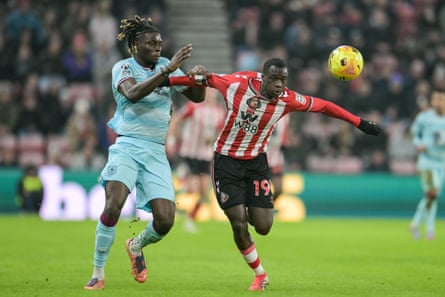
Almost five years later, Diarra is sitting in an office at Sunderland’s Academy of Light explaining why he ignored overtures from, among others, Milan, Atlético Madrid, Eintracht Frankfurt, Aston Villa and Leeds in order to play for Régis Le Bris’ side. His natural politeness endures but it is clear that the 22-year-old Senegal international and uncertainty are virtual strangers. Diarra carries himself with the confidence befitting a player who captained Strasbourg at the age of 20 and, only last month, returned from Morocco clutching an Africa Cup of Nations winners’ medal.
With the groin injury that sidelined him for much of the first half of the domestic season healed, Diarra is on a mission to demonstrate precisely why he agreed to become Sunderland’s record £30m signing last summer, after promotion to the Premier League. “After I had the first call with the coach , I sat down and said to my parents: ‘Sunderland’s where I want to be; that’s where I want to play.’ The Premier League was always a dream of mine and the coach presented me with a clear and interesting project.”
Pundits in France and Senegal queried Diarra’s unfashionable choice but he knew all about Le Bris’s reputation as a gifted youth coach and, later, first-team manager at Lorient. “I haven’t been surprised by the coach’s ability because I already knew what he’s capable of,” says Diarra. “Playing against his teams I realised he was very good, very strong tactically. He’s someone I know is helping my game progress. And although our first objective is reaching 40 points, European qualification is certainly a realistic target this season.”
Outside the Academy of Light’s ranch-style interior, the chilly February wind and driving rain makes Wearside look as bleak as it is often stereotyped. Inside, things are considerably warmer. Players from the men’s and women’s first teams put their heads round doors and catch up with office workers before training and tactics meetings. The atmosphere is free of the type of tension notable at certain clubs where administrative staff and women’s teams are deliberately segregated from Premier League squads and coaching staff. Diarra describes the environment as “really natural” and praises Le Bris’s role in its creation. “The coach always says to us that we’re like a family here and we all fight for each other,” he says. “We’re all proud of each other.”
If the organisation, discipline and sheer hard yards underpinning Sunderland’s out-of-possession shape and collective pressing are a testament to the head coach’s meticulous eye for detail, Le Bris also likes his players to think for themselves. He offers Enzo Le Fée, Granit Xhaka, Noah Sadiki, Diarra and his other midfielders complete licence to improvise and interchange positions. This is no over-coached, painting-by-numbers side.
“The coach sets his tactics out within a framework but we have freedom to play within it,” says Diarra, who can play across midfield but prefers to be deployed as a box-to-box No 8. “Out on the pitch that feels good. That freedom is so important. There’s a lot of hard work behind it but I think we show a lot of personality in our play, in our passing. It’s something we try to bring to the fore. Our captain, Granit, helps us a lot. He’s a really big player and a fantastic example. On or off the pitch, physically or mentally, he never lets anyone down.”
Diarra is speaking through a French interpreter but his English has progressed to the point where he can understand most questions. He is now concentrating on acquiring the vocabulary to also answer them in what would be his third language. He is fluent in Wolof, the language he spoke as a small boy growing up in the town of Guédiawaye on the Atlantic coast near the Senegalese capital, Dakar.
His father, Samba, was also a footballer who played professionally in Saudi Arabia and briefly led Senegal’s attack. The family relocated to Mulhouse, close to France’s borders with Switzerland and Germany, when Diarra was five and he and his three brothers enjoyed happy childhoods in Alsace where, until the age of 15, he was a free-scoring striker.
The move to midfield prefaced his first-team debut under Julien Stéphan, now managing QPR, before Stephan’s successors, Patrick Vieira and Liam Rosenior, made him centrepieces of their Strasbourg sides. “When you first meet Patrick Vieira you’re impressed by who he is, a legend,” says Diarra. “But then, when you get to know his human side, you’re impressed by just how very nice a person he is. He was really good to me; before and after every match, every training session, he gave me so many tips.”
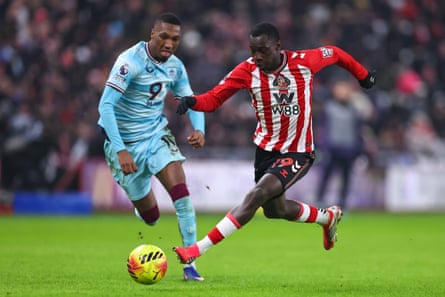
And Rosenior? “He was really important,” Diarra says. “Being from Alsace, becoming captain was an honour for me. Tactically Liam was very, very good. I learned a lot from him technically, about game intelligence and as a person. Seeing him at Chelsea now is just confirmation of how good he is.”
The precocious maturity identified by Rosenior helped Diarra combat the disappointment of needing to undergo groin surgery followed by four months on the Sunderland sidelines last autumn. Ditto sitting out the Afcon final after he collected an arguably harsh yellow card in the semi-final win against Egypt. “Being injured so soon after arriving here was frustrating, for sure and, of course, you want to be involved in something as important as the final,” he says. “But it was up to me to manage myself in the semi-final; that experience is something I hope I can learn from.”
Not that Diarra is entirely unwilling to challenge authority. He defends the decision of Senegal’s coach, Pape Thiaw, to lead his players off the pitch for 17 minutes of the final in protest at a couple of contentious refereeing calls. “There was a sense of injustice,” says Diarra. “The coach wanted to protect us, like we were his own kids.”
Diarra is now looking forward to playing in this summer’s World Cup. Given Senegal have been drawn in the same group as France, a poignant reunion awaits the former Les Bleus under-21 midfielder who was asked by, among others, Thierry Henry not to switch allegiance to Senegal. “I loved playing for France but my heart spoke,” says Diarra. “There’s no regrets at all. I was born in Senegal; it fills me with pride to play for them.”
Similar emotions apply to Sunderland. “I’ve adapted very well,” he says. “I feel really comfortable here.”