 2 hours ago
3
2 hours ago
3
It is a fiercely competitive market, and one of the toughest physical jobs in Madagascar’s Antsirabe, but over the past five years cycle rickshaw driver Haja Nirina has honed his athletic prowess alongside his business.
In this city, about 100 miles (160km) south of the capital, Antananarivo, there are more than 4,000 rickshaws for a population of 265,000, the cheapest transport available for people and goods. Some are pulled by cycles, others by hand. Each day, Nirina makes between 10 and 15 trips, making 10,000 to 15,000 ariary (£1.70 to £2.60). Unlike 99% of drivers, Nirina doesn’t lose 5,000 ariary of his income paying a daily rental fee for the rickshaw. For the past three years, he has owned his, thanks to a programme run by his local athletic club.
Crown Athletics Club has its roots in Antsirabe’s first rickshaw race in 1997, when Tsiry Rakotomalala organised prizes of rice, chickens and other food items.
-
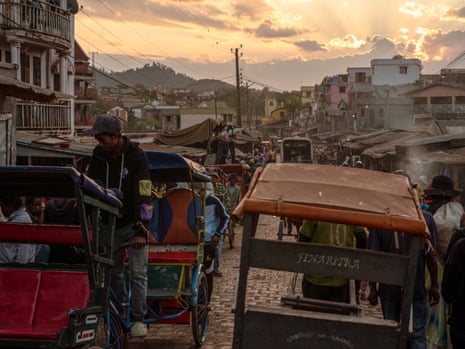
The chaotic streets of Antsirabe, where the rickshaw drivers vie for trade
-
Jean-Claude Rakotonirina, known as Diry, 33, who pulls his rickshaw by hand, is one of Crown Athletics’ rising stars. In the job for 10 years, he runs 20-25km every day around Antsirabe, mostly transporting goods
The race was so popular that afterwards Rakotomalala recruited about 10 of the drivers to launch Crown, the city’s first athletics club, which gained new momentum with the arrival of Yann Mayette as president in 2017. Convinced that Madagascar’s athletes had the potential to compete internationally, Mayette encouraged the runners by offering a microcredit plan through the club, enabling them to buy their rickshaw cycles.
As a result, Nirina has only 500 ariary in expenses to pay for the overnight and Sunday storage of his bicycle, meaning he can focus more on his training and races.
Mayette, who moved to the city from France 10 years ago, has motivated the athletes to participate in competitions locally, some of which he organises himself around Antsirabe. Mayette remembers with a smile an “expedition” to the capital: “Any trip, even 150km, can feel like a real expedition here!” The Crown runners swept the board that day, returning with handfuls of medals and trophies. “On the way back, one of the athletes suggested selling the trophies, as they didn’t know what to do with them, and a few ariary would certainly be more worthwhile than all that metal,” he says.
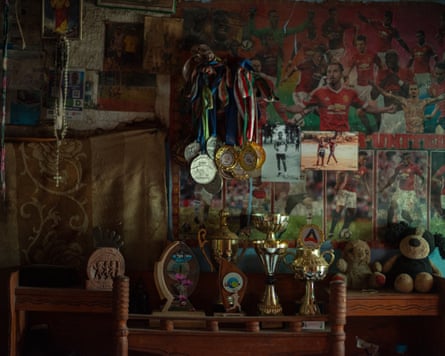
But like his fellow rickshaw runner Diry, Nirina has kept his trophies; at his modest brick and mud home, the table is covered with cups and medals. “I don’t run for the money; anyway, in Madagascar, nobody can make a living from sports. I run because I love it.”
-
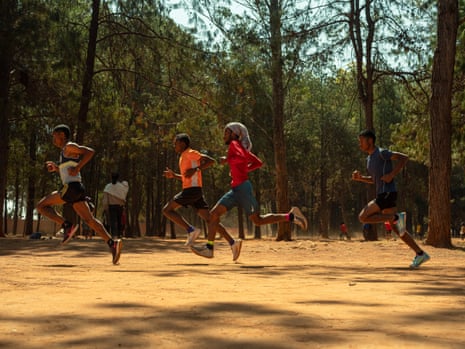
The Crown club’s runners meet twice a week for training
-
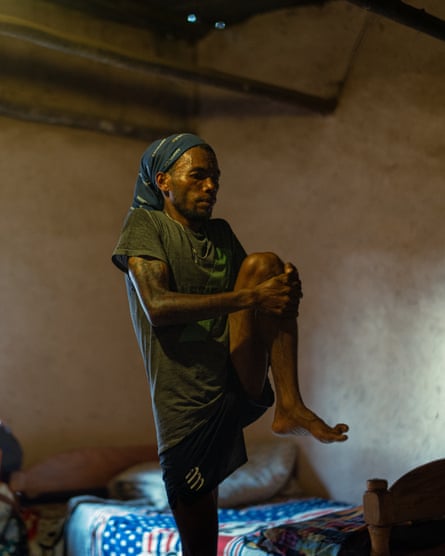
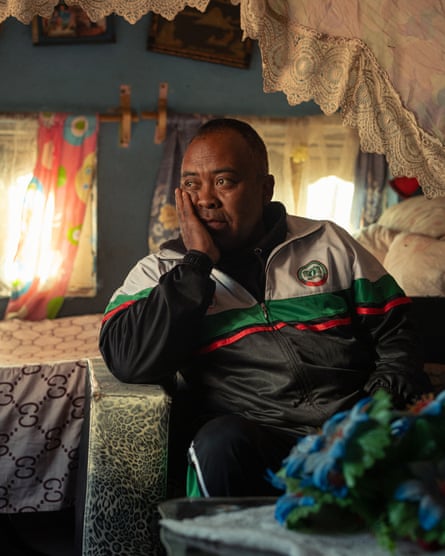
From left: Haja Nirina stretches after his run home from the city; Tsiry Rakotomalala, the club’s founder, was formerly a coach of Madagascar’s London and Tokyo Olympics teams. Despite his athletes’ impressive results, he is disillusioned by the lack of interest shown by the authorities
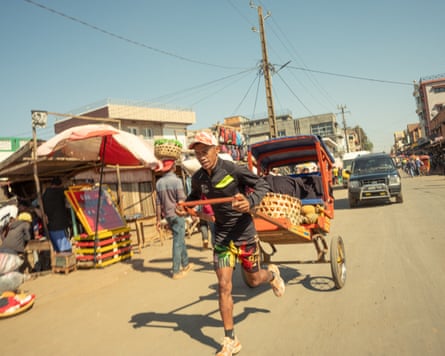
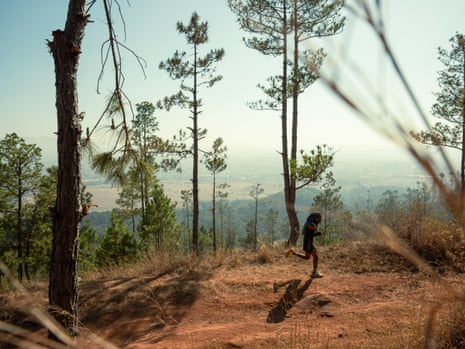
Nirina’s home, surrounded by paddy fields, is about 10km from the centre of Antsirabe. Every day, morning and evening, he runs the route, sometimes adding an uphill detour by way of Mount Ivohitra to his workout. “Every day, I ride about 60km on my cycle rickshaw,” he says during a coffee break in one of the city’s many dusty outlets.
On Sundays, his day off, he trains with the club. This week, Rakotomalala has them run eight 3km segments along the main road. “It’s simpler, because there are kilometre markers to calculate our distances,” the coach says.
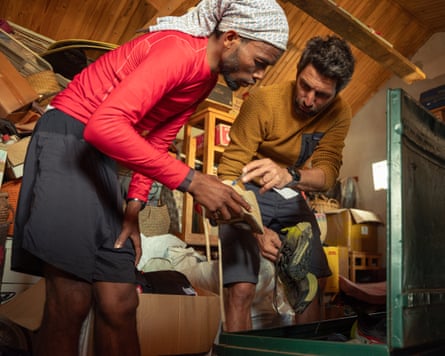
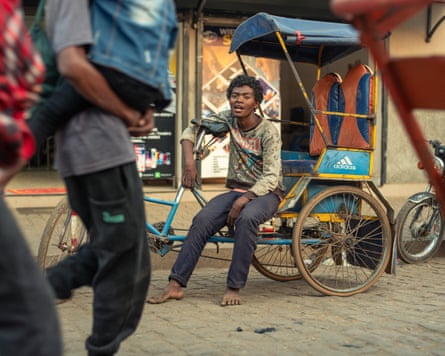
The athletes’ equipment remains woefully inadequate, there are no high-performance watches to measure distances, or even new trainers – the club president collects used running shoes from donors in France. “People sometimes send us things that are only fit for landfill, thinking they’ll be useful to us. But even though you still see many rickshaw drivers barefoot in Madagascar, how can you even consider participating in an international race with shoes full of holes?” says Mayette.
-
From left: Yann Mayette offers Nirina a pair of secondhand shoes. All of the club’s equipment comes from donations; despite the limited space in his house, Diry reserves a special place for his athletics trophies
And that is his goal: for his runners to compete outside Madagascar and test themselves against professional athletes. Last year, he managed to register Nirina and Mamie Andrianirina – a runner from Antananarivo – for the Mascareignes, one of the races in the celebrated Grand Raid, an ultra-trail event on the Indian Ocean island of Réunion. Speaking at the time, he was worried: “The problem is, we’re never sure we’ll be able to go. Getting visas is complicated.”
But in October, thanks to the help of friends, Nirina was at the Mascareignes starting line with more than 1,400 participants from all over the world. In 8 hours, 46 minutes, and 7 seconds, he finished second, three minutes behind the winner and just ahead of his compatriot Andrianirina, who was third.
“It was incredible,” says Mayette. “They were the ones everyone made fun of when we started racing, who were always reminded of their status as rickshaw drivers. Today, they’re proving they’re among the best athletes in Madagascar.”
-
Many rickshaw pullers still work barefoot. The hand-rickshaw puller is at the bottom of the social ladder in Madagascar. Originally, it was a job for peasants who had moved to the city
Nirina returned home with a €350 (£300) bonus – his offer to donate it to the club was refused. “These guys could probably achieve results that would quickly propel them to the professional level,” says Mayette.
“But today, the world of trail running has become demanding. Results hinge on details: nutrition, equipment, training.” Will a sponsor be interested in the remarkable story of this small club from Antsirabe? “It’s not a big budget, but for the moment, my wife and I are financing all the club’s expenses. When we leave Antsirabe, I don’t know what will happen.”
-
Rickshaw driver Nirina on his daily run to work