 2 hours ago
3
2 hours ago
3
The world’s largest pencil maker has accused the Costa Rican government of misusing an old factory that the German manufacturer donated for humanitarian purposes – by detaining asylum seekers there who were deported from the US by the Trump administration last year.
Faber-Castell produces more than 2bn wooden pencils a year worldwide and used to have a factory in the southern part of Costa Rica, bordering Panama and supplied by trees cultivated in the region.
But it closed it down in 2013 because of adverse economic factors, and in 2018 the facility was gifted to Costa Rica by Faber-Castell. In a contract between the company and the ministry of public security, shared with the Guardian, Faber-Castell specified that the premises would be used as a shelter to offer refuge and humanitarian assistance for people migrating through the region.
However, last year it appears conditions at the facility changed and people were locked up, with Faber-Castell unaware of this until contacted by the Guardian last month.
The German pencil maker’s donation of the buildings in 2018 was in response to an increase in Nicaraguans fleeing across the border to Costa Rica amid a violent crackdown on protesters by Nicaragua’s government.
The company said in the contract that the property was to be used to “house a shelter for the care of migrants … without the possibility of changing the purpose of the property”.
There are no reports that Nicaraguans or others accommodated at the disused factory were kept in detention – until Costa Rica accepted 200 deportees from the US and locked them up at the former factory, since named Centro de Atención Temporal para Migrantes, or Catem.
When the Guardian approached Faber-Castell for comment, the company said it had not realized anyone had been detained at Catem.
“We agreed and stipulated in the contract that the building was to be transformed into a humanitarian refugee center, and under no circumstances was it agreed to be used as a prison,” representatives of Faber-Castell’s large subsidiary in Brazil said in a statement.
Costa Rica had agreed to receive the 200 people deported from the US in late February 2025 after Donald Trump returned to the White House and began his promised anti-immigration crackdown.
The deportees were not Costa Rican, they had migrated to the US from as far afield as Russia and parts of Asia and Africa but found themselves deported and flown in chains to the Central American country, despite not being criminals. Upon arrival they were escorted to Catem, in Puntarenas, six hours south of the capital, San José.
The people, including more than 70 children, were detained there for at least two months. Amid legal challenges, Costa Rica’s constitutional branch of the supreme court later ruled they were “deprived of their right to liberty”. The Costa Rican ministry of public security told the Guardian it “categorically” denied this.
Faber-Castell emailed a statement to the Guardian: “We are deeply concerned that people are reportedly being detained on our former factory site of ‘Maderin Eco’ in Costa Rica, an operation which we closed in 2013. We were not aware of this misuse until we were contacted by the Guardian.” Maderin Eco refers to the subsidiary of Faber-Castell that had operated in Costa Rica.
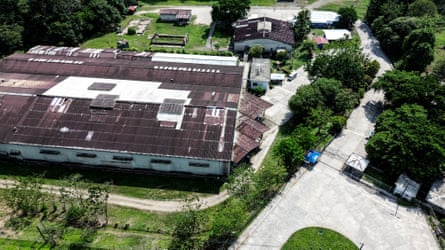
Human Rights Watch (HRW), the New York-based watchdog group, visited the facility last spring and interviewed some of the deportees. HRW concluded in a subsequent report that migrants were held at the center for months, despite the facility being “clearly intended for stays of just a few days” and that there was “no legal basis for their detention”.
The report also acknowledged that “the Costa Rican government denies that they were in detention”.
Asked for comment last week, the ministry of public security said in an emailed statement: “The migrants deported by the United States were of nationalities that require visas to enter Costa Rica. Due to human rights considerations, they were granted entry into the country without this requirement and were therefore transferred to CATEM, as their stay was temporary and humanitarian.”
It added: “The immigration measures taken were based on the same humanitarian grounds, as it is well known that vulnerable individuals are susceptible to migrant smuggling and human trafficking networks. Costa Rica is an unfamiliar destination for them, with a new climate, cuisine, and other aspects. The General Directorate of Migration and Foreign Affairs has always sought to protect these individuals. Therefore, we categorically reject the claim of a violation of their right to freedom.”
However, in December 2025, the Guardian spoke with Alexander, a 37-year-old Russian man who asked to use a pseudonym for his family’s safety because he said they had fled threats from the Putin regime. He, his wife and their young son ended up in Catem after Trump canceled their US asylum appointment at the last minute and then deported them to Costa Rica.
“In the first weeks I lost 15 kilos and my family was sick, so I started asking questions like ‘why didn’t we have freedom?’,” Alexander said.
“We were detained there without our passports. Some people wanted to leave and they didn’t allow us to leave. And after this, we understood that they put us into this prison without any reason.”
Last June, the court ruled of the deportees locked up in the Catem shelter that their “detention in a center not intended for these purposes, combined with an unlawful deprivation of liberty by immigration authorities, in addition to the lack of access to information and legal assistance, constitutes a violation of fundamental human rights”.
The court’s decision added that the “arbitrary deprivation of liberty of the individuals…without access to information, without judicial oversight…creates a risk of enforced disappearance”.
It also ruled that Alexander and the other deportees from the US should be entitled to compensation.
The Catem facility has capacity for 300 people. In 2026 so far, 60 people have been accommodated there. The last data the Guardian received from the Costa Rican government, on 28 January, showed that there were no migrants at the site then.
Faber-Castell did not answer questions about whether it intended to take any further action.