 1 month ago
33
1 month ago
33
Few competitions in the world have the capacity to turn wine into water quicker than the Six Nations. Only a few days ago players, coaches and fans of Ireland, Scotland and Wales were poring over the championship fixture list with their customary annual relish. Now, after just one round, they are having to deal with the most sobering Celtic wake‑up call for more than a quarter of a century.
Take your pick from the following trio of chastening outcomes. On Thursday night in Paris, as France dazzled in defiance of the damp conditions, Ireland were outclassed in every respect. In Rome, where the second half might as well have been played in the Trevi fountain, a below-par Scotland were flushed away. As for the quality of Wales’s first-half performance in south-west London the less said the better.
Remarkably this was the first time since 2000 that all three Celtic nations have lost on the opening Six Nations weekend. Partly that has been a byproduct of how the fixtures have fallen but, even so, it should prompt alarm bells. It would be typical of Scotland to rebound and beat England this Saturday and Ireland could easily do likewise at home to Italy. But the less cosy longer-term outlook is that the Six Nations once more risks becoming a two-tier tournament.
We have been down this road to perdition before. In the early 2000s England or France topped the table for five consecutive years. These were still the early days of professionalism and, fitness-wise, some nations adjusted quicker than others. The first weekend of the 2000 tournament underlined that reality. Ireland were blown away 50-18 by England at Twickenham, Wales were thumped 36-3 by France in Cardiff and Italy, new to the competition, scored a famous 34‑20 home win against the Scots.
Admittedly there were sporadic exceptions to the general rule that season – Ireland beating France in Paris, Scotland beating England at Murrayfield – but it was nine years before the Irish claimed another title. Wales, out of virtually nowhere, did secure grand slams in 2005 and 2008 but otherwise France and England won nine of the first 12 editions of the Six Nations.
A not-dissimilar scenario now threatens. Clearly Ireland have injuries but they have not been consistently the same force since Johnny Sexton’s retirement. Several other key pillars are getting on and, over the weekend, England’s A team stuck 52 points on their Irish counterparts while Ireland’s under-20s also shipped a half‑century against the all-powerful French. Andy Farrell’s side were the top-ranked nation in the world not long ago; suddenly the wheels on the green machine are wobbling.
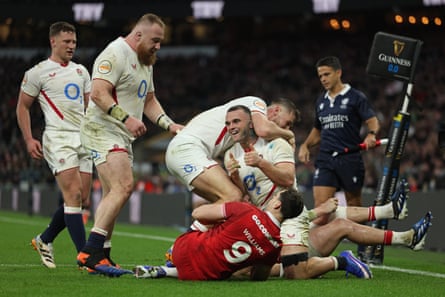
Talk to people in Scotland, meanwhile, with a good knowledge of their talent pipeline and, with a couple of notable exceptions, there is not a huge amount coming through once the current generation disappear. Everyone already knows about the off-field situation in Wales and the neglected player pathways contributing to the national side’s sharp decline.
None of this is chronicled with a scintilla of pleasure. The whole beauty of the Six Nations revolves around uncertainty of outcome, intense rivalries and last‑quarter tension. There was plenty of that in Rome but, sadly, it was obvious who would win in Paris and Twickenham within about 15 minutes of the games kicking off.
Even more ominously the depth of the player pool in English and French rugby, for various reasons, is growing. The shimmering class of Louis Bielle-Biarrey, Mickaël Guillard and Théo Attissogbe on Thursday night, for example, was impossible to ignore. France’s Top 14 is a formidable proving ground and the national side, finally, is beginning to maximise its potential.
Ditto England who, in certain positions, have good players coming out of their cauliflower ears. Take the back row where Ben Earl, among the standouts of the opening round, is having to fight like hell to start ahead of Henry Pollock, Tom Curry and others. “You look at that England A game on Friday night and think: ‘God, they could all play for this team.’ That’s how good the English sphere is at the moment,” Earl said. “It’s only making us better.”
More generally the international game is also increasingly drifting away from smaller nations and smaller bodies. If you are making nil headway up front, as was the case for Ireland and Wales, there is little escape if you are also second‑best in the air. Ireland’s fly-half Sam Prendergast divides opinion – his creative vision is obvious, his physical suitability for the Test arena less so – but no No 10 in the world would have prospered with so little forward momentum in front of him and such a static midfield alongside him.
These clearly remain early days. Scotland and Ireland surely cannot stay as flat as they were made to look in round one. A short, sharp initial shock can galvanise a squad. And let’s not underplay the more uplifting aspects of the opening weekend: Thomas Ramos’s outside-of-the-boot assist for Bielle-Biarrey, Henry Arundell’s dagger-sharp hat-trick, George Ford’s ringmaster calm and Italy’s final‑whistle euphoria.
But if you were to predict now who will win the title this year on the available evidence there would already seem to be just two realistic contenders. A vintage Six Nations season needs more jeopardy than that.
And if there is not a rapid reaction from Ireland, Scotland and Wales this weekend, a deeply dispiriting tournament will await for Farrell, Gregor Townsend, Steve Tandy and everyone else of a Celtic persuasion.