 3 months ago
71
3 months ago
71
A joint US-Israeli operation that appeared to use nuclear negotiations as cover. Gulf leaders courting Donald Trump as he decided to launch a major Middle Eastern intervention. Europe boxed out and a G7 defence minister caught so off-guard that he was grounded in Dubai as the bombs fell. And from Moscow, a strongly worded condemnation of the missile strikes against a fellow member of the anti-US “axis of upheaval” – and little else.
The war unleashed by the US and Israel on Saturday has exposed the new rules of geopolitics in Trump’s second presidency, with strained alliances, unfettered militaries and a Washington that has regained its appetite for regime change.
Despite an administration that claimed it would pull back from the Middle East and Europe in order to focus instead on the growing threat from China, the White House has toppled one leader in Latin America and has launched another war – that could easily become a regional conflict – with no clear plan for a transfer of power in Iran.
The US’s closest European allies have been effectively pushed out of the decision-making – unable to influence Trump or even understand his future designs for Iran, allied leaders have walked a tightrope between condemning and condoning the attacks.
Keir Starmer, who had said that the US would not be permitted to use a base at Diego Garcia for the strikes, has been criticised both by the left and right in the UK for his lukewarm support for Trump’s intervention. Emmanuel Macron claimed France was “neither informed nor involved” in the strikes. The EU’s first emergency security meeting will be held on Monday – more than 48 hours after the bombing began.
Italy’s defence minister, Guido Crosetto, was on holiday with his family in Dubai when the US and Israel struck Iran, killing Ayatollah Ali Khamenei and other senior political and military officials in an unprecedented attack. He had taken a day off to join his family there when the missiles struck.
He claimed he had not taken by surprise, but that “the attack on Dubai … wasn’t considered among the hypotheses of Iranian response, in the timings and ways in which it occurred and materialised … because in the last crisis, more violent than this one, the emirates were excluded from the reaction and Dubai’s airport remained open.”
The US had previously said it was engaged in negotiations with Tehran, but the strikes appear to have been a foregone conclusion. Senior US officials claimed they were prompted by the threat of Iran firing its ballistic missiles first. An Israeli defence spokesperson said the military campaign had taken advantage of an “operational opportunity” – people briefed on the operation said Khamenei had been at one of several meetings that were all targeted – but had been months in the planning. Israel’s prime minister, Benjamin Netanyahu, had lobbied for months for the strikes, and as he called Trump on Saturday shortly after the bombs began falling, he had a hardcover title on his desk helpfully turned toward the camera: Allies at War.
The Gulf countries had publicly warned against a strike, and Saudi Arabia and the United Arab Emirates had told the US that they would not allow their airspace to be used for the attacks. But the Washington Post reported that Riyadh had been playing a double game: publicly opposing military action while privately Mohammed bin Salman called Trump several times in the last month to advocate for the strikes.
“The US has developed new allies now – if they are allies at all – which is the Gulf,” said Fiona Hill, a former member of Trump’s national security council and now a senior fellow at the Brookings Institution, a US thinktank. “The US was saying it’s no longer really interested in the Middle East – and that’s what the national security strategy was making clear as well. [But] it’s actually rooting itself in the Middle East even more.”
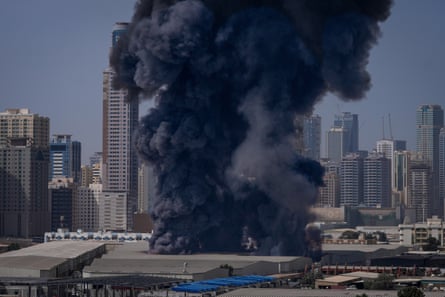
Iranian missiles or drones have hit airports, luxury hotels and other civilian targets across the Gulf, with strikes reported in Bahrain, Iraq, Jordan, Kuwait, Oman, Qatar, Saudi Arabia and the United Arab Emirates. The attacks have sparked outrage among Gulf governments, which are convening a meeting of foreign ministers on Sunday to discuss the crisis. Saudi Arabia has said it reserves the right to defend itself, raising the spectre of the conflict engulfing the region.
“We are responsible and accountable for [the attacks], and so if we’ve done all we can in our defence and minimise the risk of damage from that, then I think we’re positioned for much stronger relationship and much stronger stability,” said Robert Harward, a retired vice-admiral who was at one point Trump’s choice for national security adviser, from Abu Dhabi. “It’s a gamble, but I think it’s a calculated gamble with the numbers in our favour.”
After Khamenei was apparently killed in the opening salvoes of the war, Iran’s foreign minister, Abbas Araghchi, called his Russian counterpart, Sergei Lavrov, hoping to find support in restraining the US-Israeli attack. In response, Lavrov issued a strongly worded statement condemning the attacks and calling for a “peaceful solution based in international law, mutual respect and balance of interests”. But Moscow could do little else to influence the Trump administration.
Khamenei’s death is the latest setback for Russian allies across the world. Venezuela’s Nicolás Maduro was allied with Moscow before the US captured him, and Bashar al-Assad, a Russian client, was forced to flee Syria after his military collapsed last year. Trump has also signalled that the US may seek to carry out a “friendly takeover” of Cuba, another Russian ally.
The war in Ukraine has taxed Russia’s resources, but the Kremlin has also found that the Trump administration’s rejection of the old rules of geopolitics have not necessarily played into its favour.
“A Trump administration and the United States that is, in terms of military power, so much more powerful than Russia, and can do much more to go rogue and just act as it pleases is not good for Russia,” said Hanna Notte, a foreign policy analyst and the author of the upcoming We Shall Outlast Them: Putin’s Global Campaign to Defeat the West.
“In the Middle East, Trump had rebuffed Putin’s offers to mediate and said ‘you settle your own war because you’re engaged elsewhere’,” she said.
“And that has been kind of the theme of this administration vis a vis Russia. The hope that Russia might have had a year ago that it could work together with the United States in the Middle East hasn’t really panned out.”