 2 months ago
79
2 months ago
79
A high-profile German TV star’s allegations that her ex-husband spread AI-generated pornographic images of her have triggered a national debate and put pressure on the government to tighten laws around digital violence against women.
In an interview with the news magazine Der Spiegel last week, Collien Fernandes accused her former husband Christian Ulmen, a prominent TV presenter and producer, of impersonating her online for years and sharing sexually explicit deepfake images.
Fernandes told Der Spiegel of her shock at discovering that hundreds of fake pornographic images of her had been circulating on the internet. It was only more recently that she started to suspect they had been created and shared by Ulmen via fake social media accounts that appeared to be hers, she said.
Ulmen has denied the allegations. His lawyer, Christian Schertz, said the actor would take legal action against Spiegel over what he described as “inadmissible coverage based on suspicions”, accusing the magazine of spreading “fake facts” based on the claims of one person.
He argued that Fernandes and Ulmen’s dispute was unrelated to the wide-ranging German debate that has gathered momentum in recent weeks over explicitly sexual and physical violence against women in the digital world.
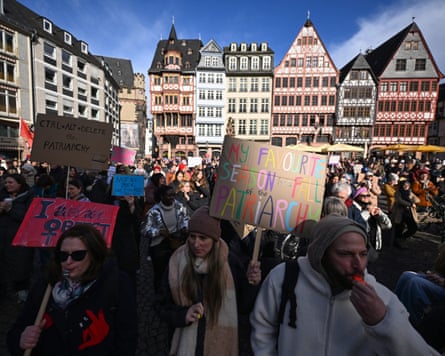
Campaigners, keen to highlight the extent to which German law has failed to keep up with the online world, voiced their concerns at rallies and demonstrations in several German cities. They urged the government of the chancellor Friedrich Merz to close a range of legal loopholes and make it easier for violations to be reported to police and taken up by lawyers.
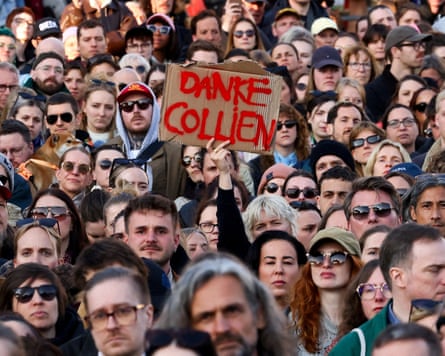
A prominent group of 250 women from the worlds of politics, business and culture have published 10 specific demands, calling on the government to more explicitly criminalise the production and distribution of non-consensual sexualised deepfakes. The group includes a prominent rapper, the government’s labour minister, Bärbel Bas of the Social Democrats, and climate activists.
Just over a week ago, more than 10,000 protesters gathered at the Brandenburg Gate in Berlin to call for an end to violence against women and show support for Fernandes. Among the placards, one stated: “AI won’t make our bodies yours.”
Many protesters held placards bearing the words “Shame has to change sides”, a phrase used by Gisèle Pelicot, the French woman whose husband was convicted of bringing dozens of men to rape her while she was unconscious and drugged.
The justice minister, Stefanie Hubig, said her ministry recognised the anger and was drafting a bill to make it a criminal offence to create pornographic deepfake images and recordings made in secret, punishable with up to two years in prison.
“The technology is new, but the underlying motive is age-old,” Hubig said, speaking to parliament last week during two days of heated debate on violence against women, in which most of the speakers were women. “It is about power, humiliation and control.”
In Germany, only the dissemination of deepfakes is explicitly illegal. But under the new legislation, victims would be more easily able to identify the people behind illegal content. They would also be able to access damages and get accounts behind the illegal content blocked.
Hubig said social media platforms had to be made more accountable for content, citing Elon Musk’s X, where the use of AI chatbot Grok led to an explosion of manipulated sexualised images on the site.
“Digital violence cannot be a business model,” Hubig told parliament. She also urged men to speak out more to ensure that “shame truly shifts”.
Fernandes called Germany “a total refuge for perpetrators”. Addressing a demonstration in her home city of Hamburg last week, she told the crowd she was wearing a bulletproof vest and was under police protection “because I’m getting death threats”.
The prosecutor’s office in the northern city of Itzehoe said it was reopening an investigation into Ulmen after evaluating Spiegel’s reporting. Police said that an earlier investigation was suspended in June last year due to insufficient information.
Fernandes has also filed a legal complaint against him in Spain, where the couple lived together on the island of Mallorca before they separated in 2025, citing the stronger legal protection it gives women compared with Germany.
Spain has courts that are specialised in dealing with gender-based violence cases, and since last year these have included digital violence such as cyberstalking and non-consensual distribution of private images.