 2 months ago
71
2 months ago
71
Most performers want attention when they’re on stage. Tamm Reynolds, however, gets it all the time – even when not dressed in fishnets and push-up bra as their alter ego, Midgitte Bardot. “I also like having my bush and ass out,” Reynolds adds. Before we meet at Woolwich station in London, where the artist has kindly agreed to pick me up in their car, they send me a text: “I’m assuming you know what I look like.” Sure enough, they are hard to miss. As a non-binary trans drag queen with dwarfism, Reynolds must be in a minority of one.
Yet to define Reynolds purely in those terms would be to do them a massive disservice, since they are also a writing and performance powerhouse. Three years ago, in Travis Alabanza’s queer cabaret revue Sound of the Underground, Midgitte climbed aboard a cherry-picker in order to sing a filthy blues rock tune called Hot Piss, brandishing a jug of frothy yellow liquid. The climax can’t adequately be described in a family newspaper, but it resulted in the loudest cheer I’ve ever heard at the Royal Court. Eat your heart out, Jerusalem.
Now Midgitte is back in another august performance space, London’s Southbank Centre, with Shooting From Below. It’s their first show since recovering from spinal surgery last year, after a near-miss with a condition that could have seen them paralysed from the waist down. “A lot of people with dwarfism have spinal issues,” Reynolds says. “You lot are like dairy milk and we’re condensed. I have a spine that kind of curves at the bottom which gives me a phenomenal ass, but it comes at a price.”
After offering me lunch, Reynolds, who has also been generously endowed with the gift of the gab, sits in their living room and talks. “I’ve been radicalised by the existence I have and the way I’m treated,” they say. “If I was somebody without dwarfism, I’d probably be quite normcore. Because deep down, I’m a grandpa. I like my crossword puzzles.” On the sofa sits a cushion with Danny De Vito’s face on it. “I love him,” Reynolds explains. “I don’t know if he’s got a form of dwarfism, but I call him a closet dwarf. I have a list of them.” Who else is on it? “Elton John’s height is way above the standard, but he’s got dwarf energy. Miriam Margolyes. Dawn French. Elliott Page.”
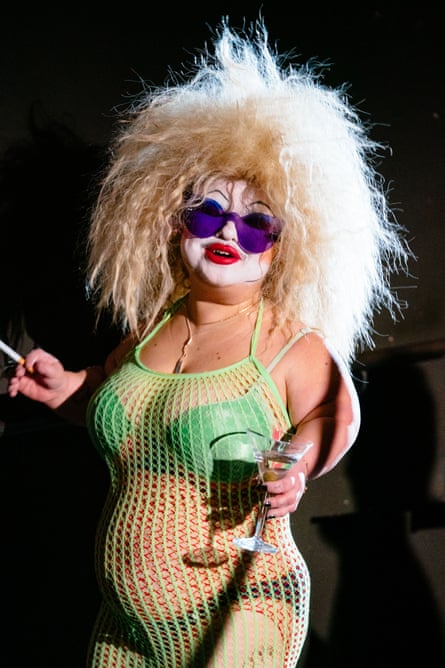
Shooting From Below sees Midgitte (who Reynolds says is “she/her, she’s a bit behind the times”) justifying a dreadful act that she’s committed. “She’s got an audience in a room and she’s finally going to tell them exactly what she what she thinks of them,” Reynolds says. “Because big people have done terrible things. People with dwarfism have been kept as slaves. In the show, I talk about Princess Eugenie – she rented out seven dwarves for her 25th birthday party and no one could dance with them unless they had her permission. So there’s still a culture of, we are objects.”
It’s something that Reynolds has to contend with every time they step outside their front door. “I would happily take you round Woolwich and you’d experience people staring and stopping to say things to me and filming me,” the performer says. “They’ll ask if they can have sex with me, if it’s possible. They’ll ask me why I’m so small, was I born that way? They’ll ask if my family look like me. And on trains, I get very paranoid about people’s phones because the angle they’re held at is already on me anyway.” A case study in a book Reynolds read called Midgetism struck a chord, in which a woman with dwarfism asked a man not to film her and was told: “I’m filming you because we send people like you to our group chat.”
Reynolds describes such interactions as “the horrors of the lived experience of being a freak. And I say freak with pride.” They add: “I would love to be able to chat to a random person on the bus. That’s very much my personality. But if I do that, I end up getting followed home. That happens to me a lot. The entitlement is very perplexing. It’s mostly men. But I’ve had women decide that I’m a child and hold my hand and follow me home. And it’s mostly women who ask whether I can have children.”
The artist stresses that while this attention is incessant, “it’s never the majority – I’d say that to anyone who experiences street harassment”. It sounds as though some people project their anxieties on to those with dwarfism. “I think we represent an otherness that disrupts everything,” Reynolds says. “In films we’re symbolic of dreams, freakish hallucinations. You get those frat-boy comedies where there’s a dwarf and they’re just kicking the shit out of him for fun.” Performers with dwarfism, Reynolds says, are in a double bind – they can get gigs, but only if they’re prepared to be humiliated. “The world of work is not accessible to us, but the world of performance is darkly accessible to us.”
The history of dwarfism in the entertainment industry is, Reynolds says, “abominable”. They tell me about an eastern European family of performers with dwarfism, who were taken to Auschwitz. “They got taken out of the queue for the gas chamber because Joseph Mengele, the bastard Nazi scientist, wanted to experiment on them. And they survived. They didn’t get exterminated purely because of their dwarfism. That’s the absurd relationship people have with us – they’re desperate to keep us at the same time as exclude us.”
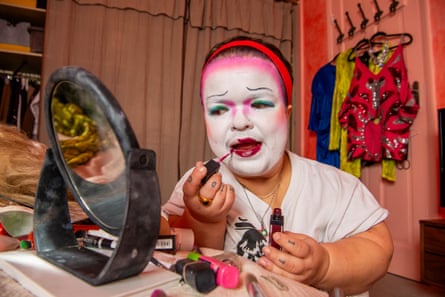
Performing as Midgitte is a way of turning the tables. First, there’s that jaw-dropping name, which reclaims an offensive slur. “I know what word you’re thinking about when you see me, so I’m going to say it for you,” says Reynolds, who dreamed it up while getting stoned with a pal. “But I’ll say it with a French twist, because I’m classy.” Then there’s the way experiences of ableism can be turned into gags, like the woman Reynolds kissed in a club, who then declared: “I can’t take you home with me because I don’t want to sleep with a dwarf.” Finally, there’s hard-won self-acceptance and pride. “My younger self was desperate to fit in in some way,” Reynolds says. “But I know I’m special and so I might as well embrace that. And I’m also queer, so that lends itself to deviant-ness. I find it a lot more liberating and comforting.”
Reynolds is a big believer in talking back to people who harass them. “If I had a kid like me, I don’t think I would tell them to ignore the bullies, because it disempowers you,” they say. “If someone is staring, I’ll ask, ‘Do I know you? Are you staring at me?’ And they’ll always say, ‘No.’ And I’ll go, ‘OK, sorry – because you were.’” If abusers aren’t called out, Reynolds says, they keep doing it. Furthermore, they add, it’s not helpful for people with dwarfism to be told that they’re too physically vulnerable to stand up for themselves. “Maybe those people [doing it] are more scared of me because they don’t know what I’m capable of. They’re obsessed with this curious thing in front of them. But what if I bit them, or exposed myself to them?”
Reynolds is 32. They were born in Gloucester, then brought up in Cheltenham, which was “brutal to me”. No one else in their family had dwarfism, and they started writing a diary aged eight. “I had a lot of questions other people couldn’t really answer,” says Reynolds, who still keeps a diary today. “Everyone’s growing bigger around me and I’m not, and I’m getting noticed in a different way and I don’t know why. So I just needed to write and get the feelings out there, and that’s where I developed writing as a skill.”
They went to John Moores University in Liverpool and got a first in creative writing, despite only reading “a couple of Frank O’Hara poems”. In their final year, they hosted literary open mic nights with some friends, which put them on the road to performance. One of their friends, who performed as the drag queen Auntie Climax, suggested that Reynolds’s performance chops and wicked humour made them an ideal candidate to do drag too, and Midgitte Bardot then rapidly made her name. So much so, that Reynolds decided to leave Liverpool because “I was a bit too famous. I was a local celebrity where I couldn’t get a cup of coffee without someone recognising me. And because I’m quite a talkative Susan, I’d lean into it and then I’d feel exhausted.” They moved to London in 2021 and played the queer performance circuit, which led to Sound of the Underground.
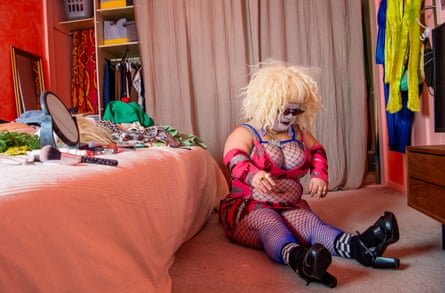
They realised they were non-binary trans while doing drag. “I would get jealous of the cis gay men I’d be sharing dressing rooms with who would get all dolled up, then they’d leave and be a boy and people wouldn’t bother them, whereas I would get non-stop attention.” When Reynolds used to pass children in the street, they would ask: “Why is that lady so small?” “Now I get, ‘Why is that man so small?’ which is very gender-affirming, even though I do not want to be a man. Once this woman just said, ‘It’s a dwarf.’ And of course it hurt, but I don’t feel like a woman, I don’t feel like a man. I don’t necessarily feel like an it, but I do feel more power in not having that pronoun attached to it. A dwarf kind of transcends gender.”
Reynolds says that their biggest hope for Shooting From Below is that other people with dwarfism see it, and that they can form a community who will figure out more positive ways of using the fascination that people have with them. “I’m under the Southbank’s roof,” Reynolds says. “I’m always going to be in someone else’s building. I’m always going to be on someone else’s stage, and I will be the only one who looks like me every time. There’s a constant loneliness. I want to make work where I can change that experience for myself. Let’s fuck with people like they fuck with us.”