 2 months ago
57
2 months ago
57
Rob Reiner’s film, adapted by screenwriters Raynold Gideon and Bruce Evans from Stephen King’s novella The Body, transformed King’s story into a glorious, mainstream American classic like something by Mark Twain. The film was released in 1986; since 1993 its added poignancy had resided in the fact that one of its actors, River Phoenix, died of a drug overdose. But now there is a terrible new layer of sadness superimposed on the film’s themes of innocence and death: the murder in 2025 of Reiner and his wife Michele Singer Reiner.
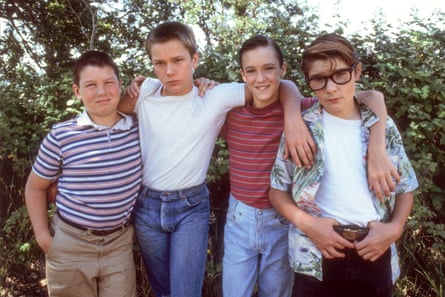
One hot summer day in the late 50s, remembered in flashback with narrative voiceover, four boys go on what amounts to a secret, secular pilgrimage in search of the corpse of a missing kid their own age rumoured to lie next to some distant railway tracks, having been hit by a train. The resulting adventure – bizarre, mysterious and moving – is about lost youth and the recovery of innocence through writing and memory. It is also one of those vanishingly rare films where child actors have to carry almost the entire drama.
A gang of four chipmunk-faced boys live in the fictional Oregon small town of Castle Rock; they are all 12 years old and given to roaming endlessly through the great outdoors as children did in that foreign country of the past. They are led by the tough Chris (River Phoenix); there are also the bespectacled Teddy (Corey Feldman), whose ear has been burnt from being held to the stove by his abusive dad who is experiencing wartime PTSD, and clumsy Vern (Jerry O’Connell). Most importantly there is the quieter and more thoughtful Gordie (Wil Wheaton), a would-be writer who tells us the story looking back, traumatised by the accidental death of his elder brother and high-school football star Denny (John Cusack), who was his dad’s favourite.
Their hot, dusty and dangerous trek along the railway lines almost gets them killed in exactly the same way as the boy whose death they morbidly want to confront. Death is not, in fact, the unknowable and implausible idea that it might be for different generations; Gordie knows what death is, as they all do, and a gloomy storekeeper tells Gordie his own brother was killed in Korea. The boys do a lot of talking (“The kind of talk that seemed important until you discovered girls”) and, along the way, apart from almost getting hit by that locomotive, they almost drown and almost get savaged by a junkyard dog.
What they are doing is near fatally dangerous – something to bear in mind when people moan about modern kids staying indoors with their devices – but this is no Lord of the Flies situation where they turn on each other. They are hardly innocent; part of the film’s unstated moral is about the importance of bringing a gun to a knife-fight. But their essential decency survives. Perhaps it is the fact of that grisly corpse just over the horizon that pre-empts violence and treachery. The kid’s death has already redeemed them.
The most unexpectedly complex and metatextual part of the film comes when the talented Gordie regales his three pals with a fireside story of his own composition, The Revenge of Lard-Ass Hogan, about a pie-eating competition and an overweight kid getting spectacular payback on the people who bullied him. (In fact, the film removes from the King original a second, darker story by Gordie.) Reiner dramatises the story as a miniature film-within-a-film and it expertly intuits everything that is actually going on in their real lives: cruelty, voyeurism, cynicism and fear.
All of this is recalled by the adult Gordie, played by Richard Dreyfuss, who has grown up to be a successful writer (like his character in George Lucas’s American Graffiti, incidentally, a film it resembles in its use of madeleine chart hits by the Chordettes and Buddy Holly). We finally see the green, glowing letters on his computer screen: this is clearly the work he has been waiting all his life to complete, having been triggered by news of the death of one of his contemporaries.
Perhaps the movie’s narrative isn’t perfect: it glosses over the almighty beating that the kids were surely going to get from the grownup hoodlum Ace (Kiefer Sutherland). But what a sublime film about childhood this is.