4 hours ago
12
4 hours ago
12
It’s the hospital drama that is adored by critics and fans alike, with its hard-hitting, action-packed episodes binged the moment they’re released by HBO Max. The Pitt depicts events in the Pittsburgh trauma medical centre, where the waiting room is always overloaded, cases are more complicated than they first seem and the medical consequences of America’s many ills – fentanyl, shootings, vaccine denial – need urgent attention.
While medical dramas are much loved by the lay viewer, clinicians who are used to seeing fictionalised versions of their daily grind are notoriously hard to please. This, notably, is where The Pitt stands apart. In fact, doctors and nurses in UK A&E units are among some of the show’s most committed devotees.
“The Pitt is the most accurate portrayal of life in an American A&E department I’ve ever seen on television, says Dr Andrew Meyerson, an American-born A&E medic in London. “I grew up in an American healthcare family watching Doogie Howser MD, ER, Scrubs and Grey’s Anatomy. For those of us in the game, The Pitt is something different.
“It feels authentic in a way that other shows that came before it were unable to achieve. That’s why it’s such an extraordinary medical drama, but also why if you work in A&E it’s quite hard to watch. For those of us who like to leave work at work, I had little desire to exorcise those demons in my spare time at home. I only agreed to watch season 1 because my niece Nora and nephew Clyde wanted to talk about it, and I’m glad they did, because watching it has made me a better doctor.”
Meyerson, who as a student shadowed emergency doctors at a New York trauma centre, adds: “It has all the normal stuff you’d expect: the extraordinary heroics of well-trained staff and the cowboy procedures that had all of us shouting ‘whoa!’ at the screen. But where The Pitt diverges, in a great way, is everything else.
“It shows the overflowing waiting rooms, the patients without health insurance, the tension with administrators, the lack of safe staffing, the patients waiting 12 hours to be seen, the other patients waiting days to get a hospital bed, the angry patients, the staff assaults, the constant interruptions and shifting focus non-stop, the humanity of both patients and staff, and what we all take home with us at the end of the day.”
Dr Adrian Boyle, an A&E consultant at Addenbrooke’s hospital in Cambridge, agrees that The Pitt paints a mostly realistic picture of the frontline of emergency medicine. “The attack on healthcare staff, where [the charge nurse] Dana gets hit in the face, is very realistic,” he says.
“Our healthcare system is increasingly frustrating. Many of my patients try very hard not to come to [A&E] but end up coming because they are advised to by risk-averse algorithms on NHS 111 or lack of capacity in general practice. Most people are incredibly understanding. [But] long waits for people who are usually not very ill can be very frustrating and this can boil over into verbal or physical violence.”
Boyle, who until last year was the president of the Royal College of Emergency Medicine, adds: “The Pitt absolutely nails the long waits faced by mental health patients. This is very true to UK practice.” In addition, the drama shows patients stuck on trolleys in corridors running off the central emergency department (ED). “The US call it ‘hallway care’. We call it ‘corridor care’. But it’s the same problem.”
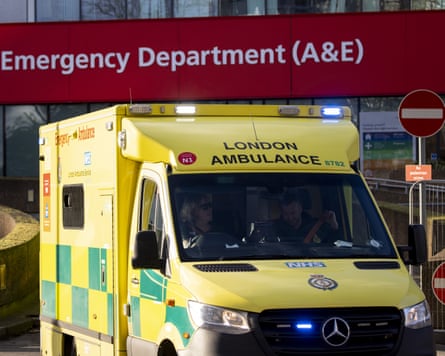
In both series of The Pitt, staff treat elderly patients who arrive soon after 7am from care homes. “They are spot-on about the uneasy interface between care homes and hospitals,” Boyle says. “A&Es here don’t get the same early morning rush. But a lot of care home patients come to the ED when they’re obviously at the end of their lives, and it’s often a failure of planning for a dignified and inevitable death.”
EDs on both sides of the Atlantic perform the role of what Janet*, an A&E nurse in London, calls a “safety net for society”, treating the whole span of those rendered suddenly unwell, from the richest to the most vulnerable, including – in storylines involving rats and maggots – those whom the Pitt personnel refer to as “unhoused”.
“So much of The Pitt resonates with me,” Janet says, “like the safeguarding concerns some cases throw up and the psychological toll working in A&E puts on staff, but also the diversity of the healthcare workforce and the key role played by the worldwide community of Filipino nurses, like Princess and Perlah in The Pitt. That’s the first worldwide TV programme to show that. I loved that.”
Dr Alison Webster, an A&E medic in the capital, says emergency staff everywhere soon become familiar with “regular attender” patients like Louie Cloverfield in The Pitt, who is always smiling despite his chronic alcohol-induced liver disease.
But there are differences between EDs in the UK and US. Webster points out: “While attending Dr Robby does an intubation every two minutes in The Pitt, and we have that in our skill set, in UK A&Es we get the anaesthetics department to come down and ventilate patients. But while doctors in The Pitt work up to 15 hours, the maximum shift time in our A&E is 10 hours. Most of my shifts are eight to nine hours. A 15-hour shift is unsustainable.”
Drama inevitably involves selectivity of events. Boyle says: “In The Pitt there are bits that aren’t realistic. The doctors seem to perform more what we call Halo procedures – high acuity, low occurrence procedures – than we do. They’ve compressed about five years of Halo procedures into five hours. But the medicine is very accurate in a way we don’t often see in TV dramas.”
All three NHS doctors remarked unprompted on another key difference: how few “GSWs” – gunshot wounds – they see compared with their Stateside counterparts. “Most A&E consultants in the UK can count on one hand how many GSWs they’ve treated,” Meyerson says.
The Pitt may have another, less obvious value beyond being compelling television, he adds. “The Pitt can serve as a cautionary tale to all Reform UK voters who may be tempted to support a privatised NHS and help them realise just how lucky we are to have this extraordinary health service.
“Just 10 years ago the NHS was still ranked the number one healthcare system in the world. Among those rich nations, the US was ranked last. There’s very little about the American healthcare system we should emulate. And I hope watching this show can help folks over here in the UK realise that.”
*Name has been changed.