
 3 hours ago
7
3 hours ago
7
You could mistake Mina the Hollower for something found on the liquid-crystal display of a Game Boy Color around the turn of the millennium. Like the pocketable Zelda and Pokémon games of the time, it presents a kind of snow-globe reality that you peer into from above, relying on imagination to decipher each two-colour clump of pixels into a tree, or a skeleton, or a cloaked mouse wielding a hammer twice her size.
This is Mina, our hero: she jumps, she moves at a clip, and she can delve downward into the soil or floorboards, tunnelling underfoot for a moment or two before popping back up, like an inflatable forcibly submerged in a swimming pool. This is her signature move, perfectly elastic in sensation – the way the released button springs back against your thumb! – and in application. The burrow-jump is an excavation tool, unearthing any treasure you happen to dig through, and a navigational one, used to hop over gaps, reach high-up spots and nose into tiny hidden spaces, where more treasure almost invariably awaits.
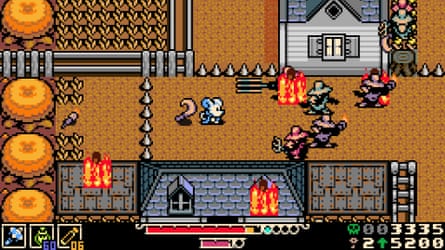
In combat, it’s an essential evasive manoeuvre – but before tucking you away in the safety of the earth, it leaves you even more exposed to attacks. You hang in midair for just a fraction of a second, but it feels like an eternity. It’s certainly long enough to cause Mina to perish, hundreds of times over, before the credits roll.
As well as embracing their aesthetic, Mina the Hollower harks back to the stiff challenge so often presented by games of old. Modern versions of this challenging breed of game are in the mix here, too: there’s a touch of Dark Souls and Hollow Knight in the gothic setting, the expansive map that links up in unexpected ways, and the specific way that it handles failure. Dying here causes you to drop a marker; you’ll respawn at the last checkpoint and must fight your way back to that spot, or else lose all the precious upgrade currency you’ve been collecting. There are smart tweaks to this system (eventually you’ll earn a second and third chance before losing it all), but the effect is the same. With a lot of currency on the line, even the most well-trodden routes can become unbearably tense to traverse.
This is most brutal early on, when enemies can carve off half Mina’s health bar with each hit. Survival is reliant on mastering that burrow-jump manoeuvre. But it’s worth pushing on. With progress comes a variety of ways to muddle through – more health, equippable gadgets that can be combined in some very sneaky ways to soften the challenge – and many joys await you ahead.
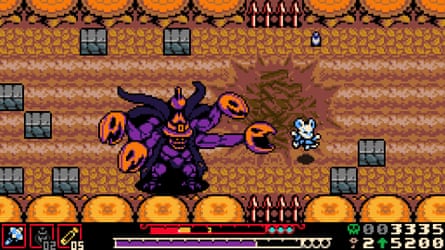
You’ll be pulled underground by a creepy skeletal figure that just wants to dance, and find your way into a secret subspace realm that gleams like Mario Kart’s Rainbow Road. There are heart-in-mouth chase segments where an unstoppable predator chases you through thunderstorms, and fights that actually made me laugh out loud. Meanwhile, the game is constantly finding fresh uses for Mina’s signature move, from channelling lava to scooping up bombs (and brains!) and controlling a giant variation on a pachinko board.
Mina the Hollower doesn’t only trade in nostalgia; it’s a game that could only have been made today. But if you’re looking for vintage Sega or Nintendo-alike magic, here it is. A simple, perfectly satisfying move, spun out into 20 hours’ worth of fun, squeezing out every possible surprise and delight along the way. As links to the past go, this is hard to beat.