4 hours ago
6
4 hours ago
6
There were several big endings for Rufus Norris in 2025, all crammed into the same few seismic months. Firstly, the close of his tenure as director of the National Theatre after a decade at the helm. That planned ending collided with the loss of his mother, who died three weeks before he left the NT. On top of that, a significant birthday concluding his 50s.
So what did Norris do after turning 60, on the other side of the Big Job, alongside the grief of losing a parent? DIY, plenty of kayaking and a house move, it turns out: “It felt important to have a complete break,” he says. “I’m a bit of a workaholic, but I’m also a bird of simple brain so I can as easily lose myself in how to build a shed or do up a place.”
But now it’s back to work with a first post-NT gig in Istanbul to direct a Turkish-language version of Arthur Miller’s Death of a Salesman. It is a quirky move, born of serendipity rather than design, he explains. He was teaching a workshop at the Turkish capital’s Zorlu Performing Arts Centre (PAC), a gargantuan cultural complex which comprises eight stages, when the venue’s general manager, Filiz Ova, asked him to direct this show in its largest space. “We had been thinking of doing this play for several years and it had never been done at Zorlu PAC,” she says, adding that she was impressed with the way Norris connected with people.
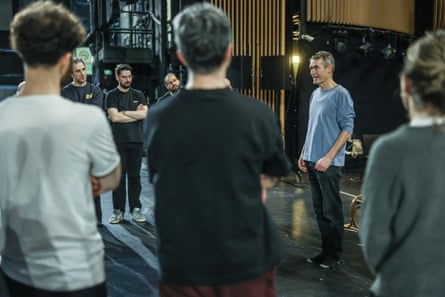
She approached him around six weeks before rehearsals were set to begin and Norris had to scramble to assemble a creative team, which is a hybrid cultural mix including celebrated set designer Es Devlin alongside Olivier award-winning choreographer Javier de Frutos, renowned Turkish composer Oğuz Kaplangı and Turkish deputy director Balım Kar.
Freshly translated by Hira Tekindor, the play (accompanied by English surtitles) is a blockbuster in terms of casting, with several national mega-stars playing the central roles: Halit Ergenç, known for his role as Sultan Suleiman in the Ottoman-era TV drama Magnificent Century, plays Willy Loman, Zerrin Tekindor, as Linda Loman, is one of Turkey’s top actors too along with Fatih Artman and Kerem Arslanoğlu who play the couple’s sons.
With plenty of Turkish and English speakers in the cast, the rehearsal process was smooth. The cast sing Norris’s praises – his collegiate spirit, his expertise, his famed informality. For his part, Norris saw it as an adventure, albeit a terrifying one given the size of the auditorium, which fits 2,300 people. “It’s an enormous theatre, in many ways too big for that intimate play, so the challenge is that you’ve got to somehow draw audiences in and find a way to celebrate the epic scale of the space from the content of the play.”
He seems to have done a good job of it. It is a haunting show that would not look out of place on the NT’s Olivier stage, intimate in its family story with actors giving psychologically intense performances, their vulnerabilities all the more pronounced against the large-scale backdrop, with hallucinatory scenes unravelling around their flesh-and-blood world.
Sitting in a central London rehearsal room, Norris certainly bears the aura of a liberated man, embracing adventure and exulting in the fact that he can return to being himself rather than the figurehead of a revered institution. There is the freedom to articulate his politics in a way he couldn’t before.
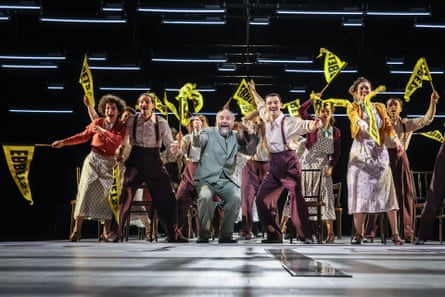
So why this specific play, about a family failed by the American dream? “Approaching any play as a director, for me, you have to ask: what’s the relevance of this story now? Then the question of your own connection to it because if I can find what’s personal for me in the play then the chances are everyone else will as well. In this case, you can write a PhD about the American dream, but really this is about a man who was abandoned when he was three years old, has striven all of his life to be liked, and he’s suffering the early stages of what we would now call dementia.”
That last part most definitely chimes for Norris, whose mother lived with vascular dementia for years. “My mum went through a very long process of decline. She hadn’t recognised me for three years before she died.” For him, the play presents the tragedy of that human condition alongside the toxic illusions of America’s capitalist dream.
This gig comes almost a year after his exit from the NT on 1 April 2025. In its direct aftermath, he took an emphatic step away from the world he had known for decades including a departure from London, downsizing to Scotland. “We’re right on the sea, in Fife. It’s partly where my partner [playwright Tanya Ronder] is from and we’ve been going there for as long as we’ve been together, which is about 38 years.”
He’s still finding his way “with what this new life is,” he says, and re-evaluating what he wants. “There’s nowhere like the National so you can’t go beyond that. I don’t have any ambition to run another building. On a personal level, there’s no point in thinking ‘Where’s my PA?’, ‘Why aren’t I important any more?’ The culture moves on and it has to move on. That’s how it stays healthy and relevant. Whether I can continue to contribute or not doesn’t really matter from the culture’s point of view. It’s really about what’s going to make me feel alive and engaged and content.”
He’s giving himself time and reading widely with an aim, one senses, to be creatively inspired. “I’ve only really read plays in the last 20 years so it’s nice to get back to broadening that out. Now I can read all sorts of things, novels and history books … I’ve got time and space finally to think, ‘Oh that looks interesting.’ You have to train yourself to actually lose yourself in a novel or nonfiction work when every 45 minutes your brain goes ‘Oh surely I should be having a meeting or doing something else’.”
So he likes it? “I like not having that focus on me. It’s a relief … I’m irrelevant. It’s nice to have the freedom to just be able to make my own decisions, crack on and enjoy the creative aspect. If I want to go to Istanbul and do a show I can and I did, and it was just great without the level of scrutiny that happens when you’re in the position I was in before.”
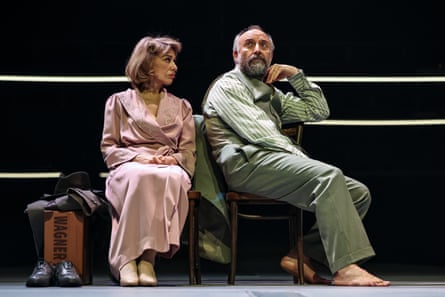
Of course he grapples with the voices in his head that question where he stands in his industry now. “But the nature of theatre-making is that we create something people watch, and then they go home. And at the end of a run, it’s finished. I know we’ve expanded the digital capture but there’s an in-built obsolescence in the form which is why it’s wonderful. You need to be in there, in the moment. When you’re not in that job, the world keeps spinning forward, as Tony Kushner says.”
Does he feel the need for reinvention, or some kind of new peer pressure? “The only important pressure is recognising how much of it is coming from inside yourself. There’s no set path. My predecessors have done different things. Some of them have gone into freelancing [Trevor Nunn], some have gone to another building [Nicholas Hytner at the Bridge theatre]. Some have turned to writing [Richard Eyre, with his first play, The Snail House, staged at the Hampstead theatre].”
Norris is already trying his hand at the latter, as the principal writer of a one-man play, with an actor already cast, he confirms, though he won’t say who. He’s working on a film script too and perhaps a book further down the line. He says he’d welcome any other international projects that come his way. “I’m British, I’ll always be British but I didn’t grow up here” – he was raised in Africa and Malaysia. “Everyone’s in a bubble, but our theatre bubble is one of its own and it’s a real privilege to be invited to step out of that and find, lo and behold, great storytelling is great storytelling everywhere, and the audience is just as intelligent, just as informed, just as discerning.”
Is the drive to do more work abroad a way to fend off what feels like a bleak moment in Britain, in the light of Reform’s gains and the prevailing view of the nation’s retrospective greatness? “I think there has always been a tendency in this island culture of ours to have a very selective memory about our history, who has built this country, what has made it what it is. When you’ve grown up in places that are former colonies, when you’ve travelled the world to the extent that I have been fortunate enough to do and understand that, essentially, people are people everywhere and they are all influenced by the environment that they have grown up in, you understand the limitations of our own worldview.
“That’s why storytelling is, I think, a valid way to spend your life. Politicians, religious leaders, journalists, snake-oil salesmen – everybody has used storytelling historically as a way to spin their own narrative. By travelling and watching other people spin different narratives you understand the sometimes limited perspectives of the stories we are told at home.”
Is the story that some seem to be pushing – about an original, glorious, British past – dangerous? “Yes of course I’m concerned with that. Look at the Huguenot and the Russian Jews who had a huge impact on this culture … and the Irish, the Jamaican, those of British Asian heritage, the Vikings, the French, the Angles and Saxons … [Even] the River Thames used to be a tributary of the Rhine, so what is this fabled past that we’re going back to? I know enough about the history of this country to know that some of these narratives are absolute bullshit.”
Freedom to speak his mind indeed.