1 month ago
52
1 month ago
52
The vice-captain was taken to hospital for stitches having been laid out by his midfield partner. Another midfielder said he wouldn’t play any more; as if he was going to play anyway. The manager wasn’t asking for much, just that they didn’t swan out there as if wearing tuxedos, and that’s still asking too much. The centre-back hit the left-back. The winger fell out with the last coach. The captain fell out with this coach. And the superstar, already accused of not caring, swanning off to Sardinia, drives out of the training ground, past the cameras and away from the whole sorry mess, laughing his head off. Now here’s Barcelona.
You think things can’t get any worse but things can always get worse. The most painful week anyone could remember, maybe the biggest, most public crisis they have ever had, concludes with Real Madrid travelling to the Camp Nou on Sunday for the clásico. If they don’t win, and few believe they can given the football they play and the faultlines that run through their dressing room, they will watch Barcelona become champions with three games left, going down as the flames go higher and history is made. It would be the first time in 94 years a meeting of sport’s great rivals decides the title – only this title has long been decided, both cause and consequence of the turmoil Madrid are in.
So much has happened, so much is wrong, that it is hard to know where to start or where it will finish. “We are Real Madrid and we will fight to the end,” the head coach, Álvaro Arbeloa, repeatedly vowed as any chance of success slipped away, but he didn’t mean like this. Even in defeat, they were supposed to compete. Even in defeat, there was supposed to be dignity, but there is none. Instead, there is recrimination, division and distrust, suspicion the only thing they share. On Thursday a fight with Aurélien Tchouaméni at Valdebebas left Fede Valverde bleeding and with what a club communique described as “craniofacial trauma”.
Valverde tried to play it down, saying that while people “prefer to think” that the pair had “beaten the crap” out of each other, the “small” cut had been caused by him slipping and hitting his head on a table, as if this was just an unfortunate accident. By then, the story was everywhere and a club statement had landed too, underlining the seriousness and undermining his version, confirming that he and Tchouaméni face disciplinary action. A second statement confirmed that he would not play the clásico, told to stay home for 10 to 14 days per a medical protocol that handily keeps him out of sight. On Friday Valverde and Tchouaméni were fined €500,000 (£432,000) each by the club, who said they had expressed remorse and apologised to each other.
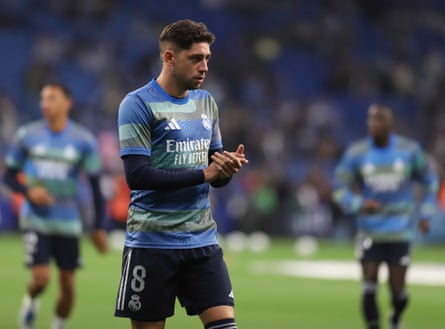
Valverde said the incident was product of the tension of failure, which was true, although it was also part of the explanation for failure at a club where relationships had reached breaking point. Thursday’s fight began with him accusing Tchouaméni of leaking a confrontation the previous day, but it went back further. “There is clearly someone behind this who runs to tell the story,” Valverde wrote. Someone? While talk was of a mole hunt, whack-a-mole might express it better, popping up everywhere at a club where exposure and ego, politics and power, increase the pressure and deepen divides, often played out in public. It is not just what happens that matters, it is that it is told and if you’re searching for a leak, the very top is a good place to start, or a mirror.
This is a crisis that is cultural. When Vinícius Júnior stormed off having been substituted towards the end of the clásico in the autumn, threatening to walk straight out of the team, it brought the disconnect between him and Xabi Alonso into the open and in doing so made it irretrievable. He was not entirely alone in feeling that: Valverde too had made his discontent public. Nor, though, was the feeling unanimous. “It’s not the manager’s fault,” Tchouaméni had insisted, blame instead lying inside the dressing room, sides starting to be taken.
The club did not back Alonso, his authority undone, and as results slipped there was an inescapable sense that he was on borrowed time right until the point he was sacked after losing the Spanish Super Cup final against Barcelona in January. Pep Guardiola had advised him to do it his own way but that was not so easy. Ultimately, Alonso had been beaten by a culture he couldn’t change, a president who rarely believes in any manager, not providing him the authority or time to complete the very task he had been asked to undertake. Not only had a coach gone but an opportunity was lost.
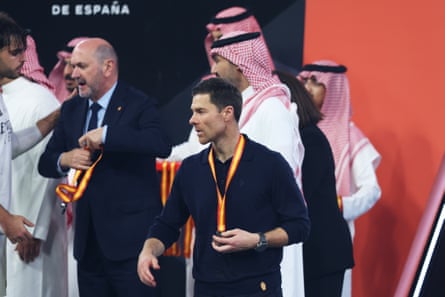
Arbeloa was a club man, the president’s man, which was both an advantage and a disadvantage. Promoted early, he was said to have one job: to keep the players on side. Over-simplistic, sure, unfair on him too, but there was something in it. Eduardo Camavinga even said so. “With these kind of players, all you need to do is make them happy,” the midfielder told ESPN, revealing that some days the coach would bring them doughnuts after training. Arbeloa meanwhile said he had a grey couch in his office where they could come to talk. “I couldn’t connect with Xabi Alonso; I have a special connection with Arbeloa,” Vinícius said.
But that wasn’t unanimous either. The diagnosis was too simplistic. They had to compete too, to commit, to build something that would work. They had to work. “This is Real Madrid,” Arbeloa kept saying but that was part of the problem; “the project is to win, win, win and win again,” he said, but it didn’t happen: he has been beaten seven times. Accommodating everyone was impossible and if keeping them happy was the aim, if satisfying everyone was something to aspire to, that didn’t happen either. Nor was it a guarantee of respect: for the coach or for each other.
In defeat, in the absence of leadership from within a young, indulged dressing room or from above, in the absence of a collective culture of effort and with injuries hurting them as well, the divide deepened. So did the disappointment, which Arbeloa felt too: more even than the players. Maybe he too would have been better following Guardiola’s advice, aware that he won’t continue, a big José Mourinho-sized shadow cast over the club.
“I tell them a lot: ‘It hurts when I see that every team runs more than we do’,” Arbeloa said last week, little doubt that Kylian Mbappé was among the players foremost in his mind. “It’s not just when we don’t have the ball but when we do. We need everyone’s commitment to press, defend, attack. If you want to be a complete team, talent alone is not enough. Those are Real Madrid’s values. Madrid was not created by players dressed in esmoquin [dinner jackets, tuxedos] but by players who ended with their shirts soaked in sweat and mud, effort and sacrifice. This club always brings in the best players; when they realise what Madrid is, when talent and commitment goes together, that’s when we will be the best team in the world.”
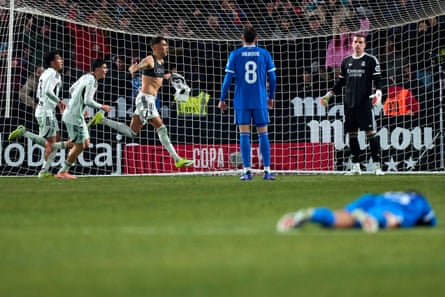
Instead Madrid were knocked out of the cup by second division Albacete on Arbeloa’s debut. There were European moments where it seemed the coach might find some sort of solution – he got the better of Guardiola and Mourinho – but that only heightened the suspicion that some players choose their games, when to try, that failure was at some level a choice. Knocked out of the Champions League in Munich, domestically they won only one of four games in April, all those structural problems unresolved and tensions increasing as the title slipped away, the season done. Amid the collapse came the scramble to safety, the search for someone (else) to blame, the summary justice, the lid coming off the stories.
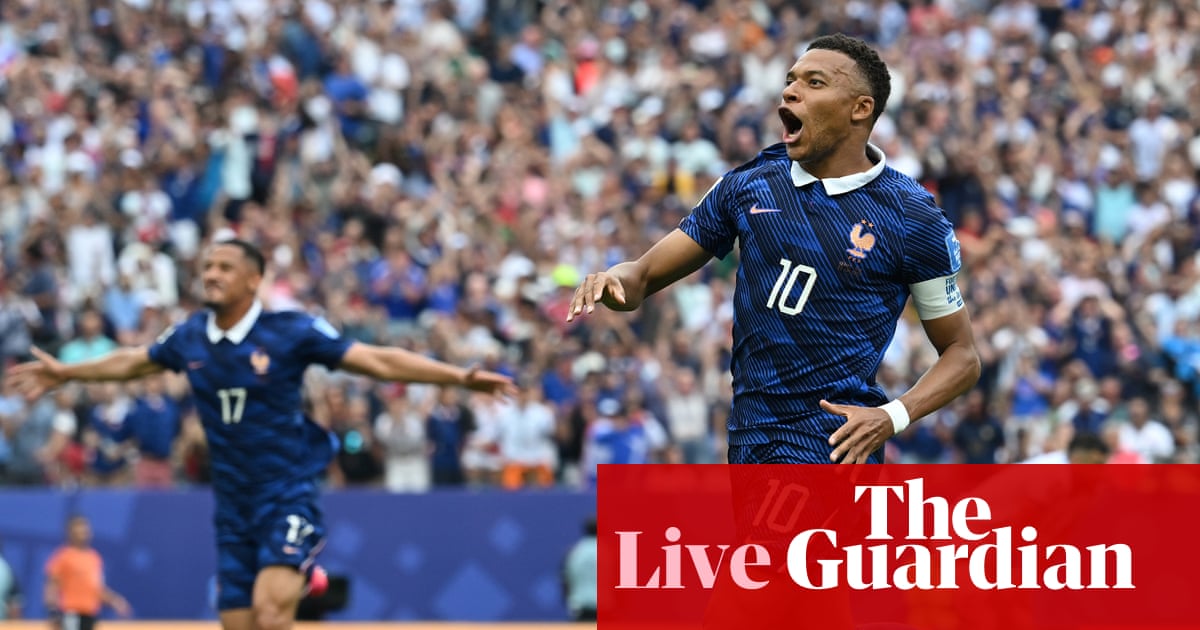
Dani Carvajal and Raúl Asencio fell out with the coach. Dani Ceballos asked not to be considered for selection any more. Then Mbappé, a symbol of this side and gap between expectation and reality, the man who joined European champions and won nothing for two years while his former club swept all before them, headed off to Sardinia with his girlfriend. He was injured and he had been allowed, but the optics weren’t good, more than 30m people signing an online petition to boot him out. Next Álvaro Carreras admitted that the tale of him being hit by Antonio Rüdiger was true. And then came the fight, the nuclear fallout, three days before another clasico.
And so it goes. The last time Madrid and Barcelona met in the league, Madrid won 2-1; they had won nine of 10 league games and were five points clear. This Sunday they meet again and, 11 points ahead, Barcelona are on the edge of winning La Liga. Madrid meanwhile are just on the edge, wanting nothing more for it to be over now but wishing it wasn’t here. “We will fight to the end,” Arbeloa said, and this is it. And it is very, very bitter.