 2 months ago
93
2 months ago
93
Yes, there are big differences between the war of aggression that Russia has now been waging against Ukraine for four years and the war the US and Israel launched against Iran. The biggest difference: the US is still a democracy. Even a president who considers himself all-powerful is not. From scathing press coverage to anger over high oil prices, fear of the midterm elections and – the capitalist form of democracy – falling stock prices, what people think makes a difference. That is why the US president is occasionally forced to change his mind. That is not the case in Russia.
Vladimir Putin had a clear plan: Russia wanted to occupy the whole of Ukraine and turn it into a satellite state or annex its territory. Putin was preparing for this war for years, in my view; this included a cheap energy trap into which he successfully lured Germany through the construction of Nord Stream 2 and the purchase of gas storage facilities and refineries by Gazprom and Rosneft.
Israel may well have had a plan – namely to turn Iran into a country bogged down in civil war, a new Syria. But the US under Donald Trump clearly had no plan as to what its military aims were or how the war would end.
Yet this is where the parallels come into view. Both Putin and Trump clearly acted out of a kind of megalomania. Their behaviour is evil and unlawful, but rational motives are not the decisive factors. Rather, Putin and Trump are primarily concerned with their own greatness. Or what they consider that to be. That is what makes them so unpredictable. Consequently, they couldn’t care less about international law.
Second parallel: their megalomania has led to massive military miscalculation. Both leaders underestimated the resolve of the countries they attacked to make sacrifices. While Ukraine immediately began fighting for its freedom, the people of Iran have apparently seen no chance yet of fighting the regime for theirs, as Trump expected.
The leaders’ miscalculation also includes a dramatic ignorance of the interests of the potential allies of those under attack. Just as Europe (and, at the time, the US under Joe Biden) was not going to simply let Putin have his way in Ukraine, so Russia and China now have an interest in the US remaining tied down in Iran for a long time to come, using up its ammunition and keeping its warships in the region. Thus, the conflict in Iran also threatened to become a Ukraine-style war of attrition. But no one can predict what would happen if the US were, after all, to deploy ground troops.
As cynical as it sounds, Trump’s fickleness, which the world was able to marvel at once again this week, is the second-best hope we have that the war will not escalate. The best hope, of course, is that the people of Iran will secure their freedom.
The impact on energy prices is another parallel. I remember well, from my time in government in Germany, the conference calls with counterparts from the Biden administration after the Russian full-scale invasion in February 2022, when the oil price rose to $130 a barrel. Even then, they wanted Germany to release its national oil reserves. I was reluctant, as I feared that Putin would completely halt oil supplies, which then still accounted for roughly 30% of Germany’s imports. In my view, the high prices were only the second-biggest problem. The biggest was whether there would be enough energy at all.
So far, the Iran war has also been perceived primarily as an energy price shock – with correspondingly gloomy repercussions for economic growth. But the inflationary contagion would not be limited to energy if the conflict were to drag on.
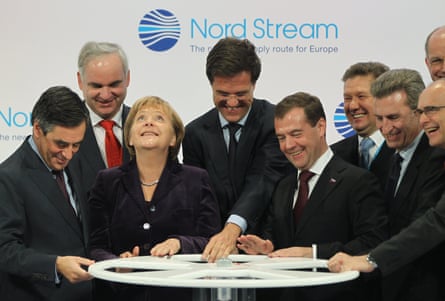
In 2021, the EU imported about 45% of its gas and 27% of its oil from Russia. By 2025, this share had fallen dramatically to 13% for gas and 3% for oil. However, the share of total energy produced by renewable electricity had risen only 3 percentage points by 2024 (from 22% to 25%). In other words, rather than consistently electrifying its energy supply, the EU switched fossil fuel suppliers, primarily to the US. It is doubtful whether swapping Putin for Trump is a gain from a security perspective.
Energy supply is again being used as a weapon to expose Europe’s vulnerability. In September 2022, Putin cut off gas supplies to Europe. In 2026, Iran is blocking the strait of Hormuz. The energy infrastructure itself is an explicit, and in some cases the primary, target of attacks.
A few important lessons can be learned from these parallels. First, in the new geopolitical world order, authoritarian rulers are driven less by ideology than by the intoxication of their own historical grandeur. As important as it is to demand compliance with international law, there is little reason to trust that it will have any effect.
Instead, a European defence capability must prepare for the scenario of a long war. We need stockpiles of interceptor drones, but also new production capacity, which will be incredibly expensive. Defence must encompass supply chains and, above all, an understanding of the requirements of economic security.
All the energy strategies developed for the climate crisis are ready and should be implemented as a matter of urgency. The rapid electrification of industry, transport and the heating and cooling sectors, and the expansion of electricity generation capacity, can be achieved in a relatively straightforward way.
And for all those who say this is too expensive: the EU spends about $450bn a year on fossil fuels – often from countries that are not particularly committed to liberal democracy. Better to use these funds for domestic energy production and the protection of our infrastructure.
The parallels between the wars in Ukraine and Iran offer a stark reminder for future warfare: it won’t be enough to hope for the best or even the second-best outcome. As the saying goes, hope is not a strategy. We must act to prevent the worst outcome.
-
Robert Habeck served as Germany’s vice-chancellor and minister for economic affairs and climate action from 2021 to 2025. His tenure coincided with a severe energy crisis and the sabotage of the Nord Stream 1 and 2 pipelines. He is affiliated with the Danish Institute for International Studies and teaches at UC Berkeley