 2 months ago
66
2 months ago
66
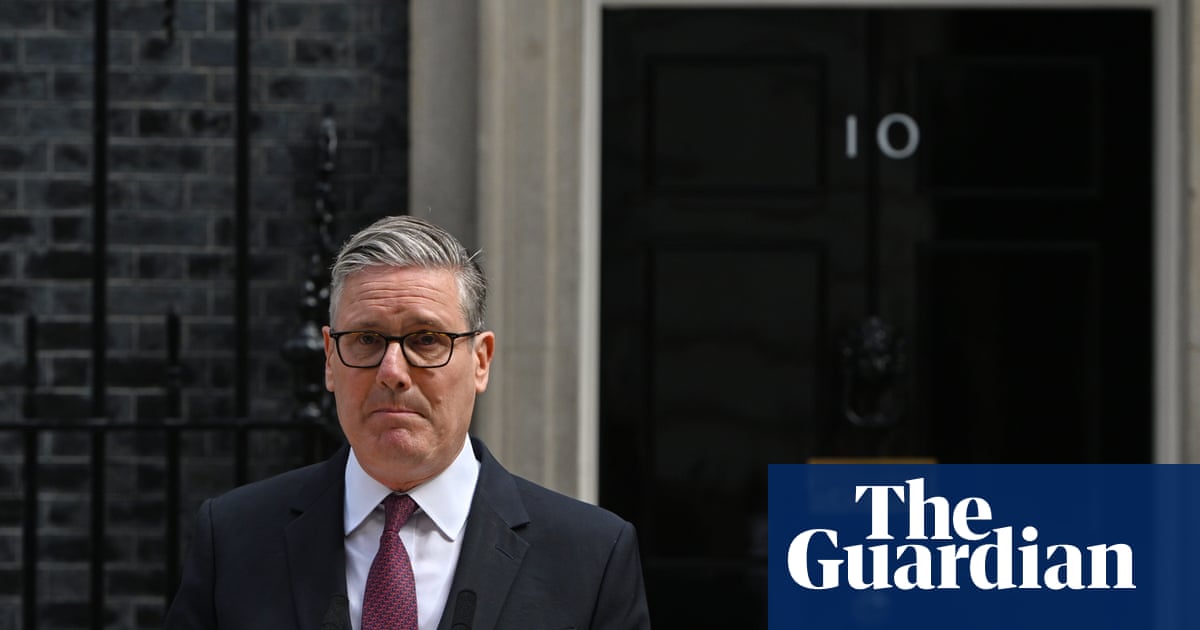
Britain’s long-term national interest requires closer partnership with the EU, Keir Starmer has said, citing war in the Middle East and the increasingly volatile international situation.
The prime minister indicated that the conflict had refocused the government on “ambitious” new ties with Europe, economically and in defence, and said how Britain emerged from the crisis “would define us for a generation”.
Starmer also used the address at Downing Street to announce that the foreign secretary would host a meeting of other countries later this week on how to unblock the vital strait of Hormuz.
“Following that meeting, we will also convene our military planners to look at how we can marshal our capabilities and make the strait accessible and safe after the fighting has stopped. Because I do have to level with people on this. This will not be easy,” he said.
However, in the starkest indication yet that Britain was pivoting away from the US, Starmer also said he saw the UK’s future as being more closely tied to Europe ahead of an summit with the EU after last year’s post-Brexit “reset” meeting.
“Brexit did deep damage to our economy, and the opportunities to strengthen our security and cut the cost of living are simply too big to ignore,” he said, before turning to the forthcoming meeting with the EU.
“At that summit, the UK will not just ratify existing commitments made at last year’s summit. We want to be more ambitious, closer economic cooperation, closer security cooperation, a partnership that recognises our shared values, our shared interest and our shared future. A partnership for the dangerous world that we must navigate together.”
Asked by journalists if the catalyst was his apparently deteriorating relationship with Donald Trump, who has continued to castigate Britain and Starmer personally, the prime minister said that more pan-European security cooperation was in everyone’s interest.
“I actually think that will help strengthen our relationship with the US,” he said.
Asked about Trump saying he was strongly considering pulling the US out of Nato, Starmer said he would act in the UK interest, whatever the “noise”. “Whatever the pressure on me and others, whatever the noise, I’m going to act in the British national interest in the decisions that I make,” he said.
Asked by the Guardian if the words used in his speech meant the government was planning to rejoin the single market, something which Labour committed in its manifesto not to do, the prime minister said he believed Britain should strengthen cooperation on defence, security, energy emissions and on the economy.
He said: “The steps we’ve taken so far have been in relation to the single market and I’m ambitious that we could do more in relation to the single market, because I think that’s hugely in our economic interests.
“Obviously, this is a matter of negotiation and discussion with the EU but the summit we have this year will not be just be a stocktake summit where we look at actually the 10 strands that we put in place last year. It will be a deliberate ambition on our part to go further than that and to cooperate more deeply, including in the economic sphere.”
Labour’s manifesto commitments still stood but they were consistent with building a closer relationship with Europe, he added. “I’m not going to choose, because I think it’s in our interest to have a strong relationship with the US and with Europe. But I do think that when it comes to defence and security, energy emissions and the economy, we need a stronger relationship with Europe.”
Starmer’s speech was criticised by the Conservatives and Reform UK, although it was only the latter who attacked the pro-European aspects of it.
Reform UK’s deputy leader and business spokesperson, Richard Tice, said it was “ludicrous” to suggest Britain should have closer ties to “a failing economic bloc that has also a long track record of failing to invest in defence”. He added: “Let’s remember the EU became way too reliant on Russia for gas so their judgment is not to be trusted.”
It was welcomed by the Liberal Democrats as an “overdue moment of honesty” about the cost of Brexit. Liberal Democrat Europe spokesperson, Al Pinkerton, said: “With Trump waging an illegal war in Iran and threatening to pull the US out of Nato, it is now more important than ever that we strengthen ties with those allies we can rely on. That’s why, ahead of the next UK-EU summit, the government must formally scrap its arbitrary ‘red lines’ on our relationship with the EU, and have the courage to negotiate a customs union as a matter of economic urgency.
“This is a solution which members of the prime minister’s own cabinet openly support, and one which will finally get Britain growing again. We don’t need a government that discusses a problem but is too afraid to implement the solution.”
The Green MP Siân Berry said Starmer was “at last waking up to the need to look to partners across the European Union rather than the US for long-term security”.