 2 hours ago
1
2 hours ago
1
In April 2022, Andreas Graf set off on his bike from his home in Norway. His dream was to cycle to India. A week later, having reached Sweden, it was already becoming more of a nightmare. “It was pouring with rain and I was lying in my tent in my half-wet sleeping bag and I was like, I could be in my very cosy Oslo apartment,” he says. “I had this good life, a career, a partner, and I had left everything behind.”
He was 31. Friends were settling down. Graf had a well-paid job in industrial engineering, but was still renting in a houseshare. “I had started to think about whether to make a financially reasonable and sensible decision, or do something else. I went for option two.”
Opting out of the rat race and going on a big adventure is not unusual in Norway, he says. “I know quite a few people here who took the kids out of school when they were young and went sailing for a year.” He thinks the pandemic unleashed a lot of latent wanderlust: “Coming out of Covid, people had an excitement for going out into the world.”
Graf, too, was “hungry for an adventure”. “I wanted to chase some mountains and meet people. And I’ve always felt drawn to self-propelled ways of travel. I wanted to be independent and free,” he says. He considered walking, inspired by The Longest Walk by George Meegan, who trekked across the Americas in the late 70s. He settled on cycling so he could cover more distance while still travelling slowly.
He thought it would take about nine months to get to India, but he didn’t obsess over routes and times. “I’ve never been much of planner,” he says. And the world seemed so uncertain – some countries were still closed due to Covid and the Russian invasion of Ukraine had begun two months earlier, “so having a plan set in stone was never really an option”. Anyway, Graf was in no rush. He had savings and would be living cheaply. “I was never out to set a world record. It’s not an ambition I have. I had all the time in the world.”
Despite his doubts in Sweden, he cycled on through Denmark, Germany and Poland, then south through central Europe, Greece and Turkey. “The beginning was quite hard. I thought it was loneliness but in retrospect I think it was more of a detachment process,” he says. “We build our identities around jobs and roles we have in the family. You’re slowly stripping yourself of your identity, and at some point you’re like, who actually is Andreas?” After three months of cycling, he says, he was “in a bit more of a peaceful state”.
Leaving Europe behind, he cycled across the United Arab Emirates and Iran, flew over Turkmenistan (which was still closed), then biked on through Uzbekistan, Kyrgyzstan, Kazakhstan and Pakistan. By the time he reached his original goal, India, he had no intention of stopping. Somewhere along the way, he had started to dream about cycling around the world, completing a full circumnavigation. (The first person to do this was Thomas Stevens from 1884 to 1886, but it remains a rare feat. The current world record was set by Mark Beaumont in 2017: 18,000 miles (29,000km) in 78 days.)
After India and Nepal, where he took a month off and volunteered on a coffee farm, he flew across Myanmar – another closed country – and cycled through south-east Asia to Singapore. He took a ferry to Indonesia and cycled its length, followed by Timor-Leste, Australia and New Zealand. He flew to Chile and biked back and forth between it and Argentina – probably his favourite country – then across Bolivia, Peru, Ecuador and Colombia. After a final flight to Senegal, he headed north, all the way back to Norway. Five continents, 50 countries, 55,000km. He reached home on 23 December 2025, his original nine-month trip having stretched to three years and eight months.
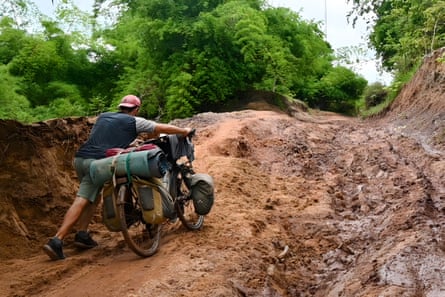
When I speak to him over video, four weeks after his homecoming, he is clean-shaven and smart – a far cry from the bearded adventurer I’d seen on Instagram. “I looked a little bit like Robinson Crusoe,” he agrees. “I’ve now had a haircut and a shave and a good shower.”
Graf grew up in the German countryside with his brother, parents and grandparents. When he was four, his mother died. She was 33. On the day he turned 33, Graf was cycling across the Australian outback. “Most people reach the age their parents were when they died quite late in life. It’s quite weird to get to that point at 33, right?” He was flooded with contradictory emotions. “You have this grief and sadness on one side: I lost out on having a life and a relationship with my mother. And on the other side, I was really grateful to live the life I’ve always dreamed of.” He realised he’d had this date in the back of his mind before he started his journey. “You ask yourself: if you had a year or two left to live, how would you want to spend your time? I took this leap of faith because that’s how I wanted to live my life. I want to be outside. I don’t want to sit in front of a screen all day.”
The moment was a turning point. “I felt really, really at peace with myself. You can sit in the outback for a whole day lost in your own thoughts. And I think most people would experience this as a sort of purgatory. For me, it was just so blissful. And I didn’t know I had it in me, spiritually speaking, to get there.” The journey was changing him. “Change is a constant companion on the road, right? You don’t even realise it’s there, but it’s changing you dramatically one way or the other.” Now, he says, his priorities have shifted. “I used to be someone who was very career-focused, and I think that part of me has disappeared.”
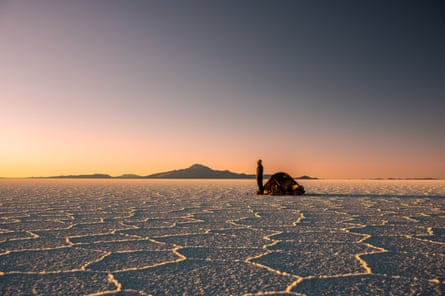
Of course, life in the outback wasn’t all about spiritual epiphanies. There was the small matter of survival. “I don’t know how many people I met in Darwin who told me that I was going to kill myself,” he says. “You’re heading into this massive void – there’s nothing in the Australian interior and you don’t really know if you’re going to make it out the other side. You have to look your fears straight in the eye.”
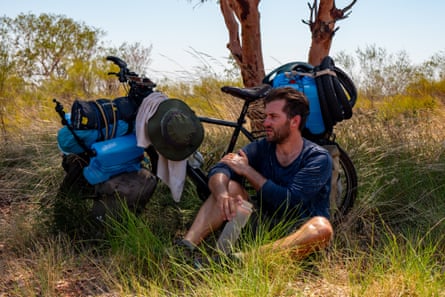
It took him two months to cycle across it, in the middle of summer – there was only one day when the temperature dropped below 40C. He carried up to 38 litres of water, in canisters, bladders and bottles. “It’s brutal. The bike weighed 87kg, significantly heavier than I am. But you drink 10 or 12 litres of water a day, so the first day is the hardest, and then it gets lighter and lighter until you refill everything.”
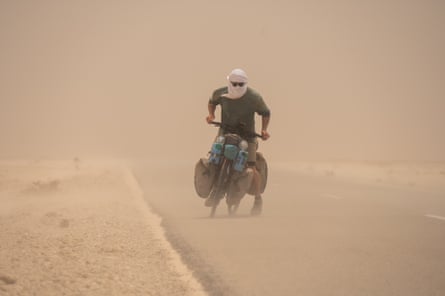
Despite the difficulties, he was drawn to deserts. He ended up cycling through the Sahara in summer too. “In central Mauritania, it was a personal record: I cycled in 51C. I don’t have the words to describe how awful it is. There’s nowhere to hide.” The worst thing was not the sun, but the wind. “You have sand and dust and everything that comes along with it. That was brutal physically, but mostly mentally, because you have the sound of the wind in your ears, day after day after day. It’s torture.” Plus, as the Western Sahara is not a UN-recognised country, there is no diplomatic support in case of emergency. “If you enter that territory between Morocco and Mauritania, you’re by yourself. Nobody is coming to get you.” It took him a month longer to cross the desert than he had expected.
How did he stay positive? “What I always try to do is a bit of a reframing experience. It’s 50C, there’s wind, you’re thirsty, you’re hungry, you haven’t showered in a few days. Instead of saying, ‘This is complete shit, I don’t want to be here, this is too hard,’ I’m saying, ‘You’ve had easier days. You’ve also had worse days. You can do this.’ So you just really have a lot of kindness and self-compassion.”
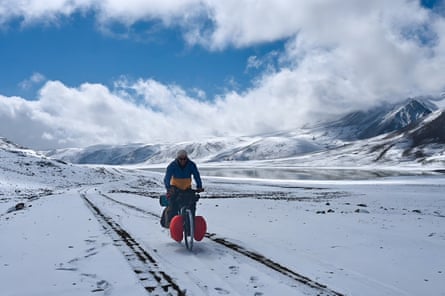
He is definitely a glass-half-full kind of person. He tells a story about crossing the Ak-Baital Pass (4,655 metres) in Tajikistan, close to the Afghanistan border. It was late October and a storm was raging. “I set up the tent behind a boulder in the middle of nowhere. It was pitch black, freezing and miserable. The next morning, I woke up and the storm was gone. I opened the tent and there was this crystal-clear blue sky and snow-covered mountains all around and it was so quiet. I think you could hear a needle drop in that valley.”
He always tried to camp in isolated spots. Didn’t he worry about wild animals? “In the past, I’ve camped next to elephants and rhinos and giraffes. [He spent seven months hitchhiking through Africa after university.] They don’t care about you. The worst animal I’ve met is called human.” One night in a rural part of India, he was woken at 2am. “There was a bunch of guys in front of the tent with knives and machetes and a big flashlight. They were scared – they don’t get a lot of visitors.” One of the men spoke English, so Graf explained what he was doing there. “And he was like: ‘That’s so cool. Do you want to come for breakfast tomorrow?’”
One unexpected aspect of his journey was being “showered in kindness and hospitality and love and friendship” from strangers. People would stop their cars and hand him a cold bottle of water. In southern Australia, one couple gave him the keys to their house. They had seen a picture of him on Facebook. “They sent me a Google Maps link and they were like: ‘We’re going away for the weekend, but enjoy yourself. There’s food in the fridge; just drop the keys in the mailbox.’ I was like: whoa, this is incredible. So in that regard I can say my heart is full.”
As well as kindness, he found humour wherever he went: “I had people making jokes about the trip in Iran as much as I had in Peru. I learned – and maybe this can’t be said often enough – that we’re not so different as we think we are, regardless of where in the world you live or what your religion might be or your culture. I think people try to live life with a little grace and a little dignity and care for families and friends and neighbours.”
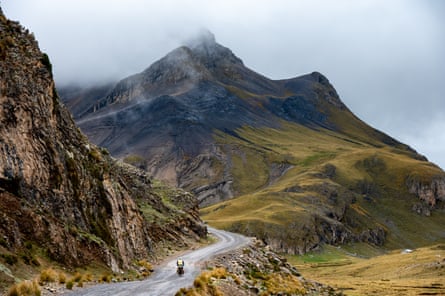
He survived a 7.4-magnitude earthquake in the mountains of northern Chile. “It was quite scary for a moment,” he says, with trademark understatement. “It comes out of nowhere and everything is shaking. On the left-hand side was this giant volcano, and I was like, is that thing going to blow up?” Thankfully, no one was badly injured.
In Peru, all of his equipment broke – bike, tent, mattress, stove – and he had to wait for spare parts to arrive. Was he glad of the rest? “I went ahead and enjoyed my second favourite poison, which was a few weeks’ hiking.”
He had an accident in Colombia and broke his wrist. “I had cycled the length of the Andes, almost 10,000km, and coming down the last mountain I crashed. I came around the corner and there was a pothole and a bit of an oil spill. I just flew over the handlebars.” He cycled to the nearest hospital. “I had split my radius lengthwise into three different parts. I had surgery and ended up with a titanium plate and eight screws in my hand.” He was sanguine about the incident. “I was in a very calm state of mind and I was like: ‘Shit happens. It’s part of the adventure.’”
He attributes his calmness partly to living life “very naturally”, with little technology. In Australia and New Zealand, he didn’t even have a phone. “Quite often I got up with the sun and I went to bed with the sun. There’s no Monday to Friday, no nine to five, no weekends. The greatest gift was having no perception of time, just living for the days under the sun.” Once, a woman wished him happy new year in a petrol station; he had no idea it was January.
He was shocked by the extent of plastic waste and water pollution in Asia and South America. “You get a really amazing understanding of how our pollution circles work,” he says. “A lot of European waste ends up being sold to Asia, and there are no facilities there to take care of the amount of trash, so sooner or later it all ends up in the rivers and in the oceans, and then of course over the next 20 years it’s just all coming back.”
The climate crisis was also unavoidable. “In Vietnam in the monsoon season, it is 45C and humidity is at 95%. And I actually don’t know how people live there. They get up super-early in the morning, but then from noon to 5pm you see people lying on the side of the road under a mango tree, sleeping.”
Now he dwells on the ethics of one day bringing children into such a world. “If they wanted to take a similar trip, I wonder if that would still be possible in 20, 30 years from now. The temperatures are already very extreme. There are a lot of places that I think will be uninhabitable in the next few decades.”
He is “at peace with closing this chapter” of his life. For now, he’s staying with friends, writing a book about his journey, doing some public speaking and hoping to stay self-employed. “There are other adventures I want to go on,” he says. Meanwhile, he’s finding it hard to adjust to such luxuries as sleeping in a bed and using a computer. “I haven’t looked into a computer screen in almost four years, so it just feels so wrong. I want to go out and look at a tree! On the weekend, I’m going to take my tent and disappear in the forest for a little while.”
Above all, he is happy that he finished the journey as he began: on his own terms. “We all face our hardship and troubles. I’m a very firm believer that you can let the circumstances define you – or you can write your own ending to the story.”