 3 hours ago
14
3 hours ago
14
It was April 2002 and Delcy Rodríguez was a woman on a mission.
Venezuela’s then president, Hugo Chávez, had been temporarily toppled by a bungled coup and Rodríguez, a junior diplomat who had been studying at Birkbeck, University of London, decided to act.
Rodríguez, then 32, set about trying to convince two reporters from the BBC programme Newsnight to accompany her to Venezuela’s capital to tell the world about what had happened.
“She desperately wanted to get the story of Chávez and the coup out there on a big platform,” says one of those journalists, Meirion Jones, who engaged Rodríguez as their fixer and flew to Caracas with her.
As the trio travelled around the South American city trying to land an interview with Chávez – who by then had reclaimed the presidency after being briefly detained – Jones had no inkling that his Venezuelan field producer and interpreter might one day become president herself.
“She looked like she was still a student really … it was just impossible to imagine at that point that she would become president of Venezuela,” Jones says.
Yet that is precisely what Rodríguez, now 57, has become, albeit in extraordinary circumstances precipitated by Donald Trump’s decision to abduct Chávez’s authoritarian heir, Nicolás Maduro.
When US special forces snatched the unpopular Maduro on 3 January this year, he was widely expected to be replaced with María Corina Machado, the Nobel-winning opposition leader whose movement beat him in the stolen 2024 election.
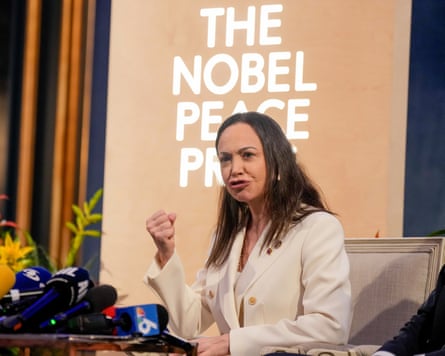
Instead, Trump discarded Machado and backed Maduro’s vice-president, Rodríguez, who became Venezuela’s interim leader two days after the downfall of her boss.
Eight months later, Rodríguez is still in power – despite leading a country many now consider a US protectorate – and looks likely to remain there for the foreseeable future, with scant sign of fresh presidential elections being called.
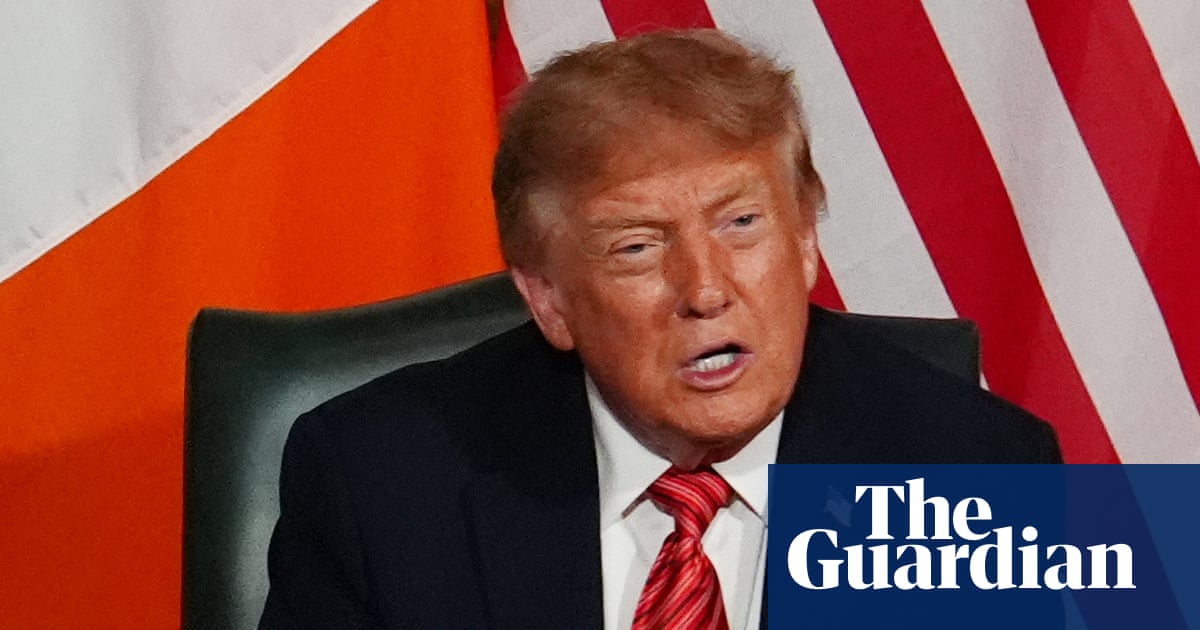
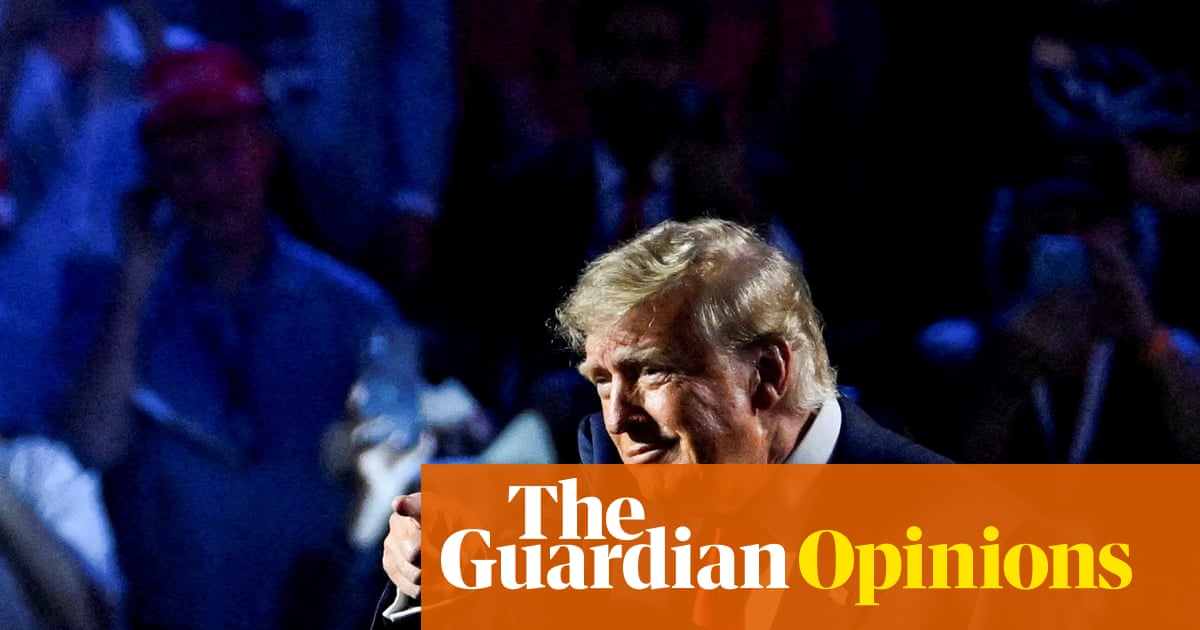
“We are very happy with the president-elect that we have right now,” Trump said of the un-elected Rodríguez after announcing what he called “the biggest oil deal in world history”.
Imdat Oner, a former Turkish diplomat in Caracas, believes the deal has strengthened Rodríguez and dealt a big blow to those hoping for democratic change. “Delcy is winning … I see Delcy Rodríguez staying in the presidency for at least four or five more years,” he says.
The Delcy Rodríguez that Jones flew with to Caracas more than two decades ago was a well-connected but politically insignificant figure known fundamentally because of her father.
Jorge Antonio Rodríguez was a Marxist activist who died in police custody in 1976, when his daughter was seven, reputedly after being tortured while detained over the kidnapping of a US businessman.
“All the Chavistas knew who her father had been – but they didn’t really know who she was,” says Jones, who is now a freelance investigative journalist. “[But during our time in Caracas] she’d made herself known to all these people … and I think by the end of the trip she was starting to think: ‘Maybe there is an opening for me in politics in Venezuela.’”
Soon after, Rodríguez returned to Venezuela, landing jobs with its state oil company, PDVSA, and foreign ministry. By 2006, she had become Chávez’s chief of staff, although she fell out of favour after clashing with Venezuela’s then ambassador to Russia during a visit to Moscow.
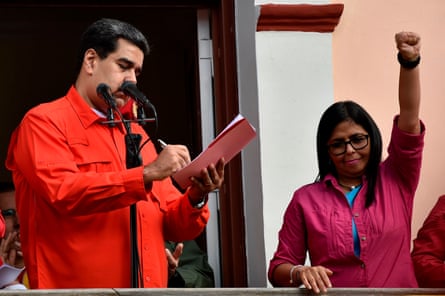
That row interrupted Rodríguez’s rise but she was rehabilitated by Maduro when he became president after Chávez’s 2013 death. In the years that followed, as her country nosedived into hunger and authoritarianism, Rodríguez enjoyed a rapid ascent.
She served as foreign minister before taking charge of the country’s economy as petroleum minister, finance minister and Maduro’s vice-president. Her brother, a psychiatrist turned politician, Jorge Rodríguez, established himself as the head of the national assembly.
After Maduro’s capture, the siblings formed a powerful triumvirate, alongside the feared interior minister, Diosdado Cabello.
“Delcy is not Delcy. Delcy’s Delcy and her brother. They do everything in tandem … they don’t do anything without each other’s approval or consent,” says Andrés Izarra, Chávez’s communication minister who went into exile after falling out with Maduro.
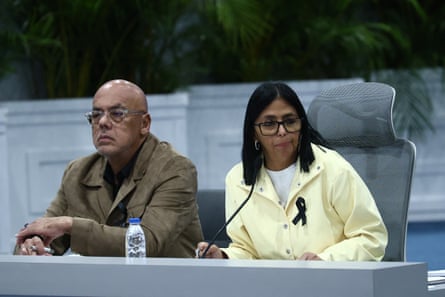
Those who have encountered Rodríguez during her unlikely 25-year rise, from being a leftwing student in the UK to the pinnacle of power in Venezuela, paint her in dramatically different ways.
Admirers describe a pragmatic, witty and intelligent workaholic who they credit with helping Venezuela escape years of hyperinflation and believe can fulfil promises to revive the country’s decaying oil industry and economy.
“Venezuela under Delcy is going to have the best possible kind of technocratic care – and that’s what is needed right now … she’s going to get that oil moving,” says Greg Palast, the other journalist who flew to Caracas with Rodríguez for the BBC in 2002.
Palast believes Venezuela is “way better off” under Rodríguez than the incompetent Maduro, calling her a clever strategist who plays politics “on a four-dimensional chessboard”.
Detractors paint Rodríguez as a belligerent, power-hungry chameleon whose political leanings can change on a dime and who, as a key member of Maduro’s regime, was herself responsible for Venezuela’s slide into poverty and dictatorship.
“They’re evil, they are crazy and they are smart … they’re evil geniuses,” a prominent opposition politician, who asked not to be named, says of the Rodríguez siblings.
Izarra says his former friend is “very machiavellian” and has a taste for luxury.
Tom Shannon, a retired US diplomat who has worked with Venezuela since the 1990s, describes the multilingual Rodríguez as a “very smart, very articulate, very determined” and profoundly ideological person.
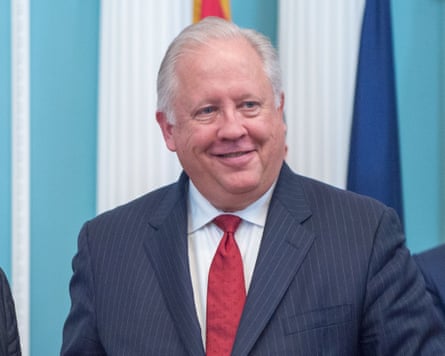
Shannon recalls being “intercepted” by Rodríguez – then foreign minister – after flying to Caracas to meet Maduro during Barack Obama’s second term.
Their conversation was wide-ranging. “But I remember very distinctly, at one point I raised the issue of human rights – our interest in especially seeing the release of certain people from prison,” Shannon says.
“She … turned to me, with a look almost of contempt, not for me, but for the subject I was raising and she said: ‘You might not know my story, but my father was a revolutionary member of an armed revolutionary movement in Venezuela who was arrested [and] tortured during interrogation and killed by the Venezuelan security services when I was a girl.’
“And she said: ‘This interrogation and the killing of my father took place during a time when, from your point of view, Venezuela was a democratic country governed by the rule of law. But I can tell you, the security services weren’t.”
Shannon adds: “It was very striking … it was evident to me that she saw her father as kind of a revolutionary north star, kind of a martyr point of reference – and I believe that’s still the case.”
He thinks Rodríguez’s objective in her new partnership with Washington is political survival “and to make sure that a revanchist, conservative, elitist, democratic opposition does not return to power”.
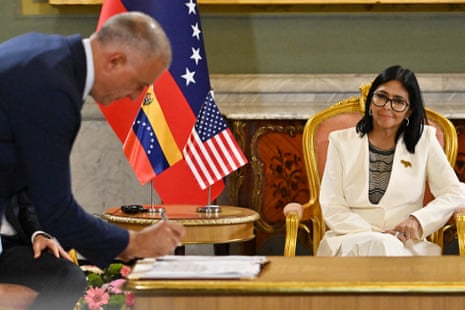
Speaking in the White House, Trump heaped praise on his unlikely Venezuelan partner. “Delcy is doing a very, very good job – very highly respected,” he told reporters.
Trump claimed Venezuela had only just escaped a “very nasty” regime and was not ready for elections. “You know, it’s very new. We took them out of a dictatorship, and we’re getting along great with the government,” he said.
Such comments will have been music to Rodríguez’s ears. “Delcy wants to survive,” says Oner. “And she knows that if she gives enough to the Trump administration, the Trump administration will allow her to stay in power.”