 3 hours ago
12
3 hours ago
12
As Francesca Hong surged ahead in the final weeks of the chaotic Democratic primary to be Wisconsin’s next governor, the democratic socialist has become the internet’s main character.
Donald Trump has mocked her old tweets, while major figures in her own party publicly questioned her ability to win a general election. The man she is vying to succeed even launched a late blitz in support of one of her rivals.
But on the ground in Wisconsin, the enthusiasm for her shines through.
Riding through a 24-hour bike race in Milwaukee’s Riverwest neighborhood in late July, residents passed Hong coloring books on a table of campaign merch; a scrolling sign saying “We love Fran”; and a DJ calling Hong “so fresh and so clean” as he played OutKast.
After the sun went down, Hong hopped on a bike herself after a line of supporters grabbed photos with her. She danced with other racers in a tame mosh pit at one of the race’s side quests, and later that night got a tattoo to commemorate the race, Riverwest 24, on her leg, alongside her Milwaukee Bucks tattoo.
In hundreds of events across Wisconsin – from karaoke nights to ramen pop-ups – Hong, 37, built a grassroots army that pushed her to the cusp of clinching the Democratic nomination for governor in a marquee battleground state.
Her status as frontrunner put Hong on national shows in recent days, summoning a wave of headlines about her past tweets, including one – seized on by Republicans, including Trump – where she called for cancelling Thanksgiving.
After the progressive Abdul El-Sayed won the Democratic primary for US Senate in next-door Michigan last week, scrutiny of Hong intensified. In Wisconsin, Democrats face another test of whether voters in a swing state will side with leftwing candidates in primaries – and what that could mean for the party’s chances in a typically close general election in November.
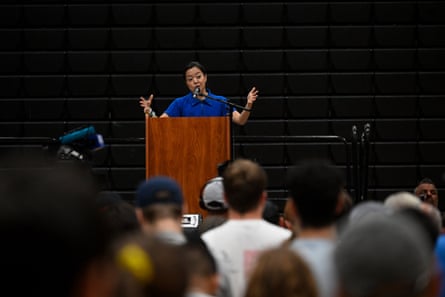
Hong – a chef and former restaurant owner, a single mom and a state lawmaker from Madison – is running on a progressive platform that includes universal childcare and fully funding the state’s public schools. She is also calling for a moratorium on datacenters, a centerpiece that differentiates her from the other Democratic candidates.
“I got into this race because I know that we can win and that Wisconsinites are going to fight for one another and fight to be a part of the change,” she told the Guardian, “because they’re tired of people making decisions that don’t improve lives and they’re tired of the status quo.”
Four candidates are vying for the open governor’s seat on Tuesday, with most polls showing Hong in the lead. Kelda Roys, a state senator, and Joel Brennan, a former head of the state administration department, are still in the race. A previous contender, Sara Rodriguez, left the race after campaign finance irregularities. Mandela Barnes, the Democratic nominee for US Senate in 2022, dropped out on 31 July.
David Crowley, the Milwaukee county executive, exited the race and then reentered it – receiving the endorsement of the outgoing Democratic governor, Tony Evers. A memo from the Crowley campaign on 5 August suggested polling may be off, pointing to Michigan polls showing El-Sayed with a much broader lead than he actually achieved. Evers recently claimed Hong’s campaign was “in a tough place”, because she had to spend time dealing with “what’s on the Twitter”.
Hong has pointed to Crowley’s change of heart as evidence of panic by the Democratic establishment. There is a “reluctance to change, and a fear of change” among “a lot of our candidates and some of their consultants”, she suggested after he reentered the race.
A really good chance
Whoever wins the Democratic gubernatorial primary in Wisconsin will face Tom Tiffany, an ardent Trump supporter running unopposed in the Republican primary. He voted against certifying the results of the 2020 election, which Trump lost. Tiffany has more cash than any of the Democratic candidates so far, and Republicans are sure to flood the market to boost him.
“The Wisconsin governor certifies the presidential election results, and Tom Tiffany was part of a plot to overturn the 2020 results,” said Ben Wikler, the former chair of the Wisconsin Democratic party. “This is a very high-stakes seat that will affect not just the lives of every Wisconsinite, but also potentially the future of American democracy.”
Five of the last seven presidential elections in Wisconsin have come down to less than one percentage point, Wikler notes. Most states have trended red or blue over time, but Wisconsin stays “consistently right on the knife’s edge”, he said.
The stakes are greater than Wisconsin’s role in the national elections. Democrats are angling for a governing trifecta in Wisconsin, trying to win back control of both chambers of the state assembly and keep the governor’s office so they can enact a full agenda.
Some want a perceived “safe” candidate, and have expressed doubt that Hong could win a general election, even in a predicted wave year for Democrats. David Axelrod, the Democratic strategist who helped Barack Obama win, has repeatedly panned Hong, whom he has described as “a font of zany liberal, faculty lounge exotica”.
Michael Wagner, the director of the University of Wisconsin-Madison’s journalism school who researches political communication, said that while Republicans have increasingly run more extreme candidates in the past decade, Democrats have instead believed the only way to win statewide in swing states is with moderate candidates. But there’s evidence that’s not true, he said: Wisconsin’s two US senators fall on either edge of their parties, with the progressive Tammy Baldwin, and Ron Johnson rising from the Tea party.
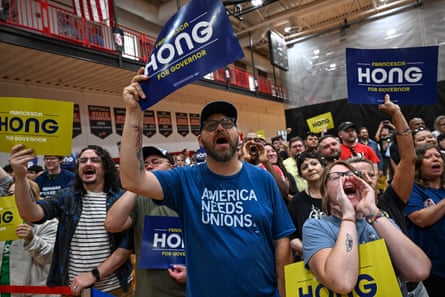
“Sometimes the party establishment can get too cute with what they worry about,” said Wagner. “But it’s not unreasonable that they’re worried, because in an election in Wisconsin, any one of 20 things could shift 10,000 votes, and that could be it.”
Wagner said Hong’s strongest coalition is among young voters, so she needs to make sure they show up and vote for her, while calming any fears from moderates and independents. But in a place like Wisconsin, where voters are willing to take chances on people who speak directly to the issues they are about, Hong has a good shot at winning both the primary and the general, he added. “That doesn’t mean she’ll win either of them, but she’s got a really good chance.”
Hong often counters the electability question with: “The person who wins the most votes is the most electable. And we are fighting harder than any other campaign to win the most votes.”
On the trail
In one recent conversation on the campaign trail, a voter asked Hong point blank: what are you going to do for me?
“I was like, I’m going to work harder for you than anyone else and make sure that we’re raising wages, taxing the billionaires, and we’re stopping datacenters,” she recounted, sitting outside at the University of Wisconsin-Superior in northern Wisconsin after an education forum with other gubernatorial candidates.
She thinks voters appreciate her firm, bold stances. She doesn’t shy away from the democratic socialist label, but noted that the DSA hasn’t endorsed her, and stressed that she doesn’t agree with the full DSA platform. She previously said she wanted to defund the police but now says she does not.
“The urgency of this moment requires actually meeting the scale and speed in which these different things have become a problem,” she said. “You see the mass income disparities. You have to meet that with a policy that’s going to fix it permanently. And that’s changing a rigged system.”
She wears a stack of beaded bracelets picked up while campaigning – one from a datacenter organizing meeting, another with the ICE watch hotline. Born in Madison, she cut her teeth in restaurants, and was elected to the state assembly in 2020, becoming the first Asian American member. As a lawmaker, she authored a bill that would provide healthy school meals for all kids and a package of bills that would fight back against Immigration and Customs Enforcement (ICE) overreach.
Chris Larson, a state senator who recently endorsed Hong, cited her ability to form coalitions at the capitol, including by bringing in outside groups affected by policy ideas. He is friends with multiple people running for governor, but saw the maneuvering against Hong over electability concerns “lacking in imagination”.
“This is where we build hope. This is how we get shit done,” he said during Riverwest 24. “And that for me is what Francesca Hong brings. And if there are folks who are saying that that is too much, I want to be part of the pushback against that.”
On datacenters, Hong’s call for a one-year moratorium on their construction opens the door for voters to wonder why no one else is trying to stop this, Larson said.
Hong said the datacenters piece resonates because people feel the most threat to their own control. The unregulated boom of AI has people feeling a need for quick action, she said. “Just because I’m team human doesn’t mean I’m anti-AI. I just don’t want it to control us. I think that we get to regulate it.”
Riding through the Riverwest neighborhood with bright green Hong signs strapped to his bike, people stopped Larson to ask if Hong would be there. One man, Chris Montezon, asked if he could snag a sign. Larson handed one off as they biked through city streets.
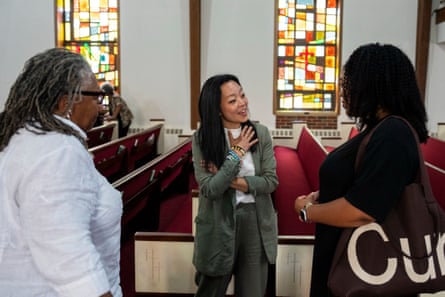
Montezon said he appreciated Hong’s policies, but also that she’s gone all over the state, including rural Wisconsin, to engage with people. He thinks she can win a statewide general election. “I think there’s a lot of disaffected voters in the state.”
At the education forum in Superior, four gubernatorial candidates went deep on funding formulas and spending. They didn’t attack each other; for the most part, the race has remained friendly, with veiled references to electability aimed indirectly at Hong.
Terrence Dahmen, a 73-year-old independent who said he ends up voting for Democrats most of the time, watched the candidates at the forum and found them all “young, enthusiastic, well-read and well-spoken”.
He didn’t think the state could go wrong with any of them, but was leaning toward Hong because of her datacenter moratorium. She was “a little more of a socialist, which doesn’t bother me at all”, he said, adding that Evers’ intervention in the race “doesn’t smell good”.
“I know she could probably get elected in Madison pretty easily and probably in Milwaukee, but I’m a little leery about northern Wisconsin,” Dahmen said. “I live in northern Wisconsin and there’s a lot of racism up here, so that might weigh against her.”
But Robert Edelstein, a 62-year-old who described himself as progressive but isn’t registered with a political party, was concerned that Republicans were boosting Hong. He wants a a Democratic candidate who will prevail in November. “I’m troubled that it could be someone who can’t win.”
Enter the establishment
Crowley, 40, told the Guardian his decision to reenter the governor’s race and make a last-minute, all-out bid to topple Hong did not have anything to do with the so-called Democratic establishment. While he’s happy to have Evers’ endorsement, he has insisted his reentry didn’t hinge on the governor’s support.
Instead, after Rodriguez, Wisconsin’s lieutenant governor, unexpectedly left the race, Crowley and his wife prayed over whether he should get back in, and the answer was at first a solid no. They had booked a trip to Jamaica. He knew it could be confusing to voters. His wife asked the Lord to send a sign – a red bird – if they should get back in the race. Crowley continued to field calls from supporters. His wife saw a red cardinal on a Friday morning, just minutes before Rodriguez announced she would drop out.
“We knew that the stakes were too high for me to sit on the sideline, and that we need the best candidate – not just with executive leadership, but somebody who has a proven track record of getting things done,” Crowley said. “And that’s what voters want. They want someone that they can trust. And that’s why we got back into this race.”
Crowley said voters have raised concerns about electability in a general election as he’s traveled throughout the state, and he said polls show him beating Tiffany in a head-to-head matchup. “We need to make sure that we build a winning coalition to bring not just Democrats, but those independents and even Republicans who are exhausted by Maga on to this campaign to make sure that we reach our ultimate goal.”
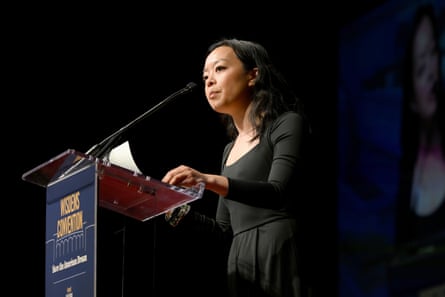
“I know that it has been a little chaotic,” he acknowledged. “It’s a little messy in this primary, but so is our democracy.”
He is “far from” the establishment, he said: he grew up with parents who struggled with mental health and drug addiction. He was evicted three times. He worked hard to get to where he is.
“I don’t want folks to get me being established because of what I’ve worked extremely hard for, for me being a part of any type of establishment,” he said.
Some voters have struggled with his reentry, and Evers’ involvement. William Norman, a Hong supporter who biked in the Riverwest 24 alongside his parents, said the race got hectic in the last few weeks “for all the wrong reasons”.
“I think it’s kind of loser behavior to think that one of your candidates can’t beat somebody who’s running on such a nasty platform across the aisle,” Norman said. “I just feel like you should have faith in your candidate. Whoever the people want should be the person to be sent into battle.”
Others, including Crowley and Evers, point to the haranguing over Hong’s old tweets, most of which have not been deleted, that journalists and Republicans have elevated in recent. Her campaign told the New York Times that a lot of those tweets were written during “peak woke” in the 2020s.
When initially asked by CNN about the since-deleted “cancel Thanksgiving” tweet from November 2020, Hong said “views can evolve” and that Thanksgiving can be “incredibly painful for many people in our communities”. She later joked to Politico that Thanksgiving was her favorite.
Becky Cooper, Hong’s campaign manager, said digging up tweets from more than five years ago is an attempt to distract from voters’ needs, including affordable healthcare and property tax relief, as well as a “huge waste” of time and energy. “But,” she added, “we’re always working to sharpen language and deliver the message.”
Hong told the Guardian she welcomes national interest in her campaign, but does feel the pressure. For a Democratic socialist running on a broad agenda that disrupts the political status quo, winning in a place like Wisconsin could change politics – not just in the state, but across the country, she said.
“We can’t have a more representative democracy unless we have more folks who are willing to fight the way things have been done,” she said. “Because that’s what’s gotten us here.”