 3 months ago
73
3 months ago
73
In January 2023, a friend recommended I read a dating self-help book with her. “I think we need to read this,” she said. “My friend did it and that’s how she met her husband.”
But when the book arrived, I discovered it wasn’t a recommendation so much as an enlistment.
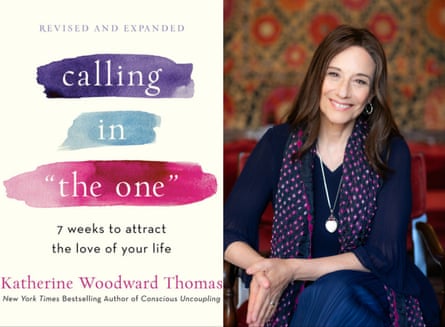
Calling in “the One”, written by Katherine Woodward Thomas, is a seven-week workbook designed to “attract the love of your life”. The introduction suggests that you complete the book with a friend, using them as an accountability partner – in her case, me.
Still, when the ruse was revealed, I didn’t object. I had been single for five years. I had trudged, reluctantly, through the sludge of dating apps, and had begged my friends to set me up, yielding humiliating results. I had said yes to dates with total strangers from my DMs – which is inadvisable from almost every angle. I worked up the courage to leave my hot neighbor a flirty note, to which he responded that he was gay. I even paid a matchmaker $6,000 to try to circumvent the misery of dating when I could have – should have – just bought a Chanel bag.
Needless to say, I was working overtime. I had a scarcity mindset, common to many single people. Fears circled around my head: There’s no one out there! Dating has mutated into a dystopian technological experiment! I’m in my early 30s, getting older, losing time!
I had nothing left to lose, which is why I – a hardwired cynic – agreed to read this book.
Calling in “the One” was originally published in 2004, then updated and republished in 2021. It contains many suggestions for how to achieve the relationship of your dreams and “calling in” (ie imagining and finding) your ideal partner, but makes no promises and lays that out up front.
“There is a huge chasm between wanting to find a great love and being truly available to create a loving union when that person appears,” reads the introduction. “This course is about bridging that chasm. No matter how disappointed you’ve been, or how weary and resigned you’ve become, your past does not define what’s possible for you in love. You do!”
Woodward Thomas, a California-based therapist, secured love for herself via the book’s methods. She also conceptualized the term “conscious uncoupling”, which famously went mainstream after Gwyneth Paltrow and Chris Martin used it to announce their separation in 2015.
I know what you’re thinking. I, too, did a double take about taking relationship advice from someone best known for streamlining breakups.
On our Zoom call, Woodward Thomas speaks so slowly and carefully that it has an almost immediate calming effect. You can just tell that she has a regulated nervous system.
When she was 41, Woodward Thomas was single. “I declared this kind of outrageous, unreasonable intention to be engaged by my 42nd birthday,” she says of what inspired the book. “I decided to focus on becoming who I would need to be in order for that to happen, as opposed to trying to rush it. It was almost magical, truthfully. So I did manifest a miracle and I called in a really decent, loving, handsome, successful man who was completely available to create a family with me. I had my first child when I was 43.”
Countless platitudes have been offered to struggling singles forever: it will happen when you least expect it. Learn to date yourself first. Calling in “the One” is different, designed to help you understand if any attitudes, behaviors and narratives might be holding you back. There’s no blame or condemnation, but the book encourages readers to take responsibility for the ways they might involuntarily be contributing to their dating woes. It holds up a mirror – and sometimes the reflection isn’t what you want to see. The hope is that you recognize and alter that.
“You cannot do this course effectively on the level of intellect,” Woodward Thomas warns in the book. “I can only promise you authentic movement in your life to the extent that you are willing to do the course and not just read the course.”
It sounded like a big commitment, and pretty woo-woo to boot. Sometimes, skepticism urged me to roll my eyes rather than turn the page. But what kept me coming back to the book was the vulnerability shown by Woodward Thomas, who describes the limitations and long-lasting effects that her own parents’ divorce had on her views about love, and by readers who had completed the workbook.
It was difficult not to get drawn in by the multiple happy participants featured in the pages who said they thought love was out of the question, then found it after going through the process. Their dating misadventures demonstrated that my fears were valid, but could ultimately be rewritten. Whether it could be replicated or not, I wanted to try.
“It’s no small matter, this devaluing of a person, if they’re single – a woman in particular,” Woodward Thomas said. “I know a lot of people feel ashamed about it, and feel like they’re failing. I think we have to push back against that.”
Now is probably a good time to mention that going through the book is one of the hardest things I have ever done.
Every day, there’s a lesson followed by an exercise, ranging from really fun to absolutely excruciating. The first one is gentle: do a short meditation on what love feels like. But by week five, you’re writing a list of your bad habits and being challenged to change those patterns. I identified my tendency to people-please and playing it “cool”, which had left me chronically disappointed.
The course is seven weeks, but it took me 13 to actually finish. It was grueling, but I did not allowed myself to move on until I had completed a lesson. On paper, it sounds simple, but once you’re in the emotional trenches – unpacking the subconscious promises you made to your parents and how they’ve shaped the way you choose to partner, or avoid it – you want to quit.
But getting to the end felt worth it, because while this is a dating book, self-discovery is a huge part of the puzzle. “Sometimes people do Calling in ‘the One’, and then they come out and they say, I wanna be single for a while,” said Woodward Thomas. “The joke of those who’ve done Calling in ‘the One’ is, ‘Oh, I get it. I called in myself.’ It’s about becoming your best self. ”
Katie Schloss, a licensed social worker operating a practice between New York City and Chicago, recommends the book to clients regularly – and not always to those who are actively dating. “I think it is the perfect book for when you’re not quite ready to date yet, or you’ve been really burned out on dating, nothing’s working and you need to take that break,” she says. “The perfect thing to do is to not date at all for a hot second and read this book … and think about what you actually want and how you want to show up as a partner.”
Mercedes Delusive, an entrepreneur in Stow, Ohio, purchased Calling in “the One” for 15 other people after completing it. “Before reading the book, I was deeply codependent,” she says. “I loved feeling intertwined with another person, and mistook that closeness for intimacy. Since then, I’ve learned to stand on my own and build a life that feels whole, without relying on someone else to anchor me.”
Delusive ended up considering new possibilities for love: “Before the book, I had a massive checklist for what my male partner ‘had’ to be. The book helped me release control and attract the love I truly deserve, which ultimately led me to dating women.” She is currently happily partnered.
Naturally, there are people who will disagree with the book. My sister likes to joke that my friend and I have been “brainwashed”. There are Reddit threads dedicated to it, full of believers and naysayers. Many readers remain – happily or unhappily – single. Some readers report that they completed it and then dated the worst narcissist they’ve ever encountered; others are offended by the agnostic spiritual principles and opine that the book is cult-y.
Admittedly, when I began reading it, I had suspicions about whether it could helpfully address my experience of dating as a Black woman. But as I committed further to the process, those concerns faded. I was not looking to single-handedly correct systemic problems – just thinking seriously about how I thought about love.
For me, the book helped to illuminate my tendency to be hypercritical, emotionally avoidant and, frankly, fearful. It also helped me let go of societal pressures to be “chill” and more tolerant, and allowed me to start developing a firmer idea of what I wanted: a considerate and loyal man who would never make me suffer through a lecture on something he learned from a toxic podcast.
One of the final exercises involves writing a timeline for yourself, however implausible, to meet a mate. I set mine for September, when the first draft of my novel was due, because I wouldn’t be able to think about dating until afterward. After a few delays, I finally got back on the dating apps in November.
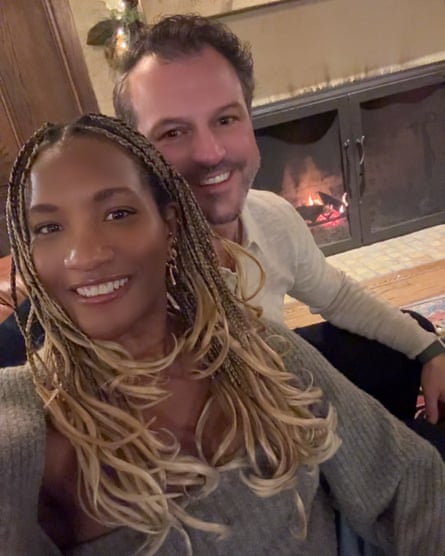
A week later, I met my now boyfriend. We have now been together for over two years. I knew that he was “the one” right away. Totally unprompted, he said things to me that I had written while completing the exercises, like he’d been given a script on how I wanted to be loved. He is romantic, relationship oriented and wanted to make me happy.
Truthfully, seeing the very qualities I’d wanted in a real person freaked me out. He was radically different to my previous exes – a midwestern man who had never heard of Coachella. But I have never been more myself with a partner. I can also say that I have never once had to question how he feels about me. There’s never been any games or guessing. A month after matching with him, I texted my accountability partner: “Omg. I think I did it!”
I would never have believed the book worked if I didn’t experience it myself. And it is a bit scary, getting exactly what you want. I had pursued this goal, but I am not sure if I had really known that it would come together exactly as I had asked, and also nothing like I had asked. When it comes to love, there’s no guarantee. But in the same way that a GPS system makes it easier to drive somewhere, Calling in “the One” can show the way with less friction.
Woodward Thomas had no idea that it would work either. “It was a bit of a leap of faith,” she said of writing the book. “It took everything I had just to deliver it on time.” Then, she invited 12 women to her house, and asked them to read it and go through the process. “That was in 2004 and every one of those women is still with their person,” she says.
It can be a powerful tool, but ultimately the results are up to you – which might be frustrating to hear after your third weird Hinge date of the week. But if you feel like you’ve tried everything else, it might be worth a shot.
-
Danielle Prescod is the author of The Rules of Fortune, Token Black Girl and a forthcoming 2027 novel. She recently launched a Substack newsletter called Highly Recommended