 2 months ago
73
2 months ago
73
There are many benefits to making music, whether you are one or 100. But how should you approach choosing an instrument to play? And what are the best choices for a complete novice? We asked musicians for advice on how to live a more musical life, at any age.
Know that it is never too late
“There is no age limit on learning,” says the singer-songwriter Billy Bragg, who lives in Dorset. “It is not a teenage thing. If you feel the music, you can probably play it and turn that feeling into something creative.”
“It is never too late to do anything, especially not creatively, because creativity allows you to be playful,” adds Jennifer John, a composer and vocal arranger from Liverpool. “If you think back to when you were a child, that came naturally.”
Listen deeply
“Part of being involved in music is learning how to listen,” says John. “When you’re listening to music, think about why you like it.” Trying to describe this will help you to decide not only what instrument you want to play, but also the sound you would like to achieve.
“A musical life can be many different things,” says Antony Szmierek, an indie hip-hop artist from Hyde, near Manchester, who went from teacher to musician after learning the electric piano during lockdown. “Going to more shows, joining a choir, listening to an album each morning: music is the antidote. I think that people should be letting it into their lives in whatever possible way.”
Pick something easy to learn

“I don’t think of myself as a musician – I think of myself as a guitar player,” says Bragg. “With a guitar, you just have to know where to put your fingers to make the chords. It is a busker’s instrument: it is amazing what you can get away with being a busker.” A guitar can be hard to handle for those who are very young or old, says Bragg, so he recommends the ukulele as a starting point: “It is a very accessible instrument. The scale of it allows you to get your body around it much easier than a guitar.” The harmonica is another easy win, he adds.
“I have quite a few students that have started violin as adults with great success,” says Susannah Simmons, a violinist and music teacher based in West Yorkshire. “Most of them are interested in folk violin (fiddle). This is a great genre to focus on as an adult beginner, especially with the multitude of community folk ensembles, courses and festivals all over the country and of all different abilities.”
A piano or keyboard can be instantly gratifying, says Aga Serugo-Lugo, a multi-instrumentalist from London who leads workshops around the UK. It’s good for “having a go, finding out where middle C is, using YouTube tuition as a starting point, and in no time at all creating a tune”. Alternatively, joining a samba band is a great way in, or “some places have steelpan orchestras. The letters are written on the steelpans, so once someone shows you what to do, you’re off.”
Find a teacher
You can find music teachers in unusual places, says Bragg, who learned to play guitar from a neighbour when he was a teenager. “The kid next door, Wiggy, showed me the basics. I had a guitar but I didn’t have the wherewithal. I suppose that is what you really need: it’s not about having a great teacher, it is about the impetus. That often comes from finding someone to play with. It was sitting down and playing guitar with Wiggy that really gave me the confidence to write songs and to sing.” Bragg says that when his son took up the electric guitar, he didn’t want lessons from his dad, but picked up the basics from playing Guitar Hero with his mates instead.
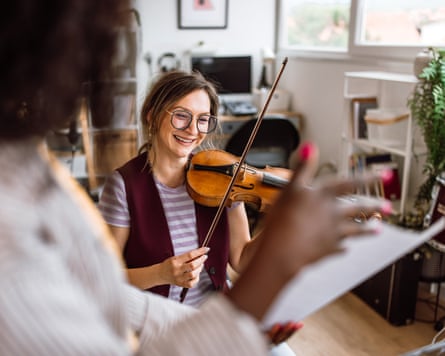
“I played the violin and guitar when I was much younger, and I’m learning them again,” says John. Revisiting them, she says, “is a bit like riding a bike”. John is having in-person lessons with teachers, but says online works too: “Anything that gets you involved in music is a good thing. Before I decided on my guitar teacher, I found some stuff on YouTube and Instagram, and I started to remind myself how to do it.”
In England, “every area has got a music hub programme,” says Serugo-Lugo. “They are a great source of advice on getting into music, whether you’re young or old. They’ve got a huge treasure trove of knowledge about local teachers and access to cheap instruments.”
Practise hard but don’t obsess
Ask yourself: “How good do you want to be?” says Simmons. “You are the best judge of this. Once you start practising you will find out how fast you progress and how much you need to do to reach your personal goals. It can be anything from 10 minutes to hours a day. Everyone is different, although regularity is key.”
John is practising guitar and violin every day for half an hour: “The more you do it, the more your muscle memory starts to get familiar with it, and then the easier it becomes.” But, she says: “Don’t give yourself too much of a hard time. This idea that you can be really good or bad: try not to think about it that way but just for it to be something that you really like.”
“Make it regular but not too long: 15-20 minutes is great,” says Serugo-Lugo. He advises splitting practice into scales and anything your teacher has given you, then saving time for something you really enjoy, which for piano-playing kids is almost always Coldplay or Adele, “so it never feels like a burden and it is your reward for doing all the other stuff”.
“I don’t believe you have to spend hours and hours practising,” says Rosa Walton of the experimental pop duo Let’s Eat Grandma, who are from Norwich. “It is more about just having the passion and creativity, unless you want to be a technical musician. With piano, I was really into trying to play the piece the way the person who wrote it did, and that is a completely different part of the brain to sitting down and writing songs. Maybe you can learn a few chords or play three notes on the piano and see what sounds good. You can learn as you write – you naturally get better technically as you do it.”
If you want to help children get into music, don’t be too forceful about making them practise. Walton says she benefited from not having a pushy parent: “A lot of my friends were having piano lessons and my mum never suggested that. It made me much more dedicated when I did start, because it was coming from me. I played piano every day after I got in from school.”
“You don’t want people to feel that learning an instrument is like climbing the north face of the Eiger,” says Bragg. “They want to feel that they’re leaning into something that’s difficult, but they’re able to progress, because when you make no progress, that’s when you give up.”
Play with others
Playing music with others “is a great way for people to get together from different walks of life,” says Serugo-Lugo, and there are health benefits too. “It uses lots of different parts of the brain simultaneously, uses emotional intelligence and logic. Anything that invites creativity has transferable skills for everybody. But aside from all that sort of stuff, it is just good fun.”

Walton started a band with her childhood best friend – what advice does she have on choosing musicians to play with? “It is important to find someone that you click with personality-wise, that you’re comfortable sharing your innermost thoughts with, and that you share the same vision.”
Use your lungs
Singing in unison is “one of the best feelings ever,” says Szmierek, so get it wherever you can, be that at a gig, the football, or a karaoke night. “Singing and moving together is so primal.”
“It is a bit like exercising,” says John. “All of the serotonin and endorphins in your body that get released make you feel relaxed and happier.”
Even if you don’t have much confidence in your voice, there are lots of opportunities to sing, says Serugo-Lugo. “I co-run a non-audition choir, Camberwell Community Choir. That is a great way of dipping your toe into the musical world, certainly for people who don’t necessarily see themselves as musical but want to get involved.”
“The joy of a choir is it’s not you on your own,” says John. “It’s about how your bit contributes to the overall thing. You’re blending with other people, the spotlight won’t be on you. It’s a collective experience.”
Don’t worry about messing up
“Everyone gets nervous 10 minutes before they go on stage,” says Szmierek. “But you learn to welcome those nerves. They are there to help you. And people want to see mistakes, especially in this current climate of AI. People go to live music shows to see raw emotions and real humans mess things up. They want to know that it’s really happening in front of them.”

Don’t forget to breathe: “Your breathing is key if you feel nervous,” says John. “It works on two counts. One is to calm you down and make you feel really grounded, and that works regardless of what instrument you play. But the other is to help you to be really focused and to help you to sing and play for longer, with more control and ease. Sometimes, when we’re scared of something, we hold our breath and the worry becomes bigger than the actual thing itself. If you just remember to breathe, take your time and remember why you like doing something, it makes everything much easier.”
If performing is out of your comfort zone, don’t worry, says Bragg. “It is a high bar standing up in front of people and playing. You shouldn’t let the fact that you don’t feel like performing stop you from learning an instrument. It’s not all about performance. You can get a lot from just playing in your room.”
Write songs for the right reasons
“You’ve got to follow your instincts and not be afraid to write bad songs, because every good songwriter also writes bad songs,” says Walton. “I write every day and I’m not thinking: ‘Is this going to be what people want to hear? Is this releasable?’ I’m literally just writing to make sense of the world, not thinking about the end goal and just doing it for the process and the joy of doing it.”
Accept that no one is perfect
If you feel that progress is slow or your natural musical talent is low, remember that perfection is a myth. “Think of it as this endeavour where you’re constantly trying to improve,” says Serugo-Lugo. “That is a much healthier approach to music-making. Everybody’s learning, including Beyoncé. She doesn’t spend her days going: ‘I can sing, there’s nothing more I need to do.’ That is absolutely guaranteed. There’s always something new to do or more of something that she would like to explore. And that goes right from the beginning all the way up to being a professional.”