 2 months ago
87
2 months ago
87
People say that Cecily Brown left London in the early 1990s because of the YBAs – as if, she laughs, she wanted to get away from them. “I actually had great admiration for the art being made, I just wasn’t in sync with them.” While Damien Hirst was dunking dead animals in formaldehyde and Sarah Lucas was devouring bananas in front of the camera, Brown was wielding a palette and brush. “There was this feeling in London at the time that if you were a painter, you were a loser. I didn’t feel like a saddo for being a painter in New York.”
You would think, then, that she’d be returning triumphant. She was taken on in her 20s by mega-gallery Gagosian, and has works in MoMA and the Tate. Recent shows include a survey at the Met in New York. Her paintings, slippery and complex canvases that are richly allusive and reward slow looking, sell for millions, making her one of the most valuable living female artists.
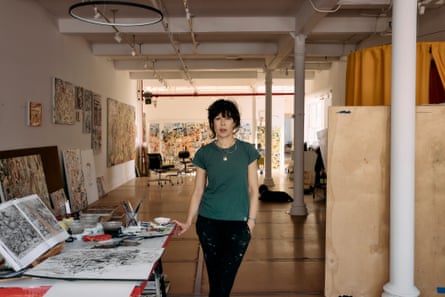
But a few days ahead of her first big museum show back home, at London’s Serpentine Gallery, she’s a bag of nerves. “The thing I’m really afraid of is critics, because they’ll say it’s overhyped. I feel I’ve got to prove myself. I want each show to improve on the last, which of course isn’t going to happen – it’s not linear. As I get older I’m more aware because I think, God, I’ve been so lucky …” She stops, casts around for a piece of paper and a pen, takes a breath. “Sometimes it’s helpful to doodle.”
Brown talks how she paints: energetically, her thoughts and opinions revealing themselves before dissolving, layering like the rhythmic brushstrokes on her dense, roiling canvases. “I tend to ramble,” she tells me, apologetically. We’re drinking tea in an upstairs meeting room at the Serpentine after looking at the exhibition being installed below, and though she’s nothing but warm and friendly, I can tell she’s itching to get back to it.
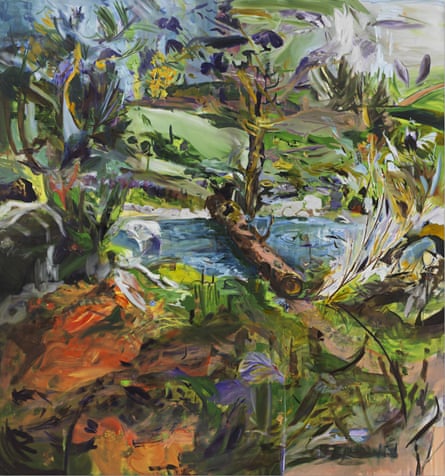
Picture Making brings together new and old paintings, as well as recent monotypes and drawings, all with a nod to the green and pleasant land of her youth. The meandering canvases inspired by Kensington Gardens are a riot of energy and movement. With streaks of sunshine yellow, mud brown and spring green, they seem lighter than the early works, like they’ve gulped fresh air; during the painting process, she was looking at children’s picture books. In signature Brown style, recognisable details emerge amid a tangle of abstract strokes before melting away: blink and you’ll miss the dog, tree, bird box. “It’s celebrating nature, colour and light,” she tells me, “but at the same time, inevitably, there’s instability.”
Now 56, Brown was born in London, before moving with her family to Surrey when she was a toddler. “It was idyllic,” she says. “We walked to school, there was a village green, it was chocolate boxy – at least on the surface.” Her mother is the novelist Shena Mackay. Aged 21, Brown learned that her father wasn’t the man who raised her, but the influential art critic and curator David Sylvester. A family friend, he’d been taking her to exhibitions since she was a teenager, and introducing her to artists including Francis Bacon. He encouraged her ambitions. In 1989 she enrolled at the Slade School of Art.
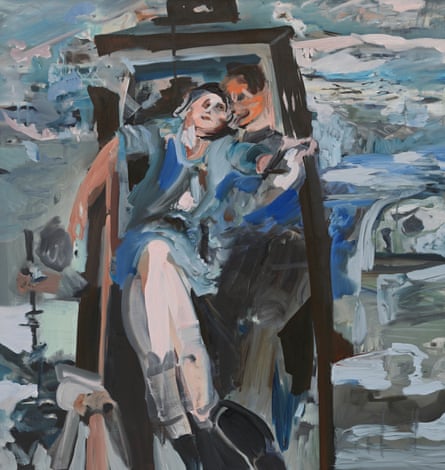
It’s tempting to say that it was the Sylvester-shaped connection to great artists that gave Brown the confidence to borrow from them. Throughout her career, she’s pilfered colours and details from paintings of the past (as well as books and television), breaking them down and making them new again. I tell her it was a bold thing for a young woman to do, lifting fragments from famous art by famous men. “Yeah, I know,” she replies, with a girlish grin. Did it feel bold at the time? “Not at all. When I started looking at art seriously, looking just wasn’t enough. I wanted to copy it as a way of understanding it.” She pauses. “Plus, there was this sense that it was all there to be stolen, I might as well use it.”
She moved to New York in 1994, a year after graduating. Back home, everyone was talking about the death of painting; across the pond, people had moved on. “There were so many more galleries that I felt I could fit in somewhere. In London, I was never going to be a part of it.” But there was more to the move than the fuss over the YBAs. “I had a confidence in New York that I didn’t have at home. I felt oppressed by the class system here. You know that line in My Fair Lady, about it being impossible for an Englishman to open his mouth without making some other Englishman despise him? Back then, I either felt too posh or not posh enough for every situation.”
Was she also conscious, because of who her father turned out to be, that she didn’t want to be seen as a … “nepo baby, 100%. If I was with my dad, I could hang out with Nick Serota or Howard Hodgkin. But if I went to an opening, I was too shy to talk to all these super cool kids like Sarah and Damien.”
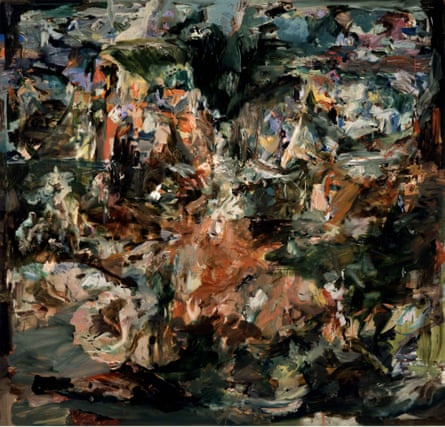
Despite the warm welcome in New York, when she arrived she tried to shrug off her identity as a painter, dabbling in video, photo-based stuff, “terrible assemblages”. Like most young people, she says, she wanted to do something new. “I think one reason a lot of people don’t end up making art once they leave art school is because of the realisation that you can’t. You just can’t. I mean, maybe 1% of artists every 10 years do.”
Within a few years, she’d picked up her paintbrush again, first finding recognition with pictures of hedonistic bunnies emerging from whorls of colour. Orgiastic images of a more human nature followed, along with classical themes such as still lifes and shipwrecks. In the early 2000s, she introduced the English landscape into her work, and the natural world has remained a focus ever since.
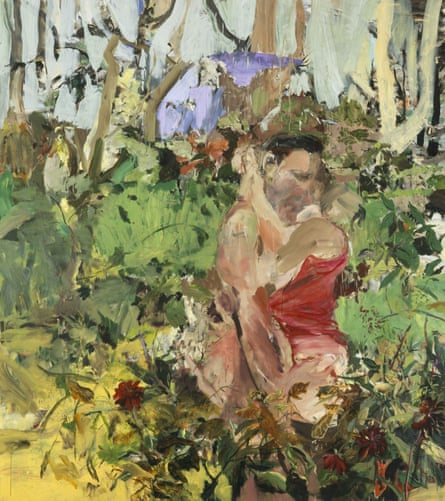
I ask if she still has fond feelings for the New York art world. “Oh my God, if you get me started on the art world … It’s so hard to talk about as someone who’s benefited from the ridiculousness, but I think greed has overtaken creativity. There will always be real artists, but what we’ve got at the moment is a very commercial art world where a lot of artists are making work directly for the market. Sometimes I think people have forgotten what art is.” She winces. “I’m imagining the comments: Oh, shut up, you’re so spoiled in your cashmere sweater while you tell people not to …” She doodles.
Since moving to the US aged 25, the longest time she’s spent outside Manhattan was the six months she and her husband and their daughter lived in Hudson Valley during the pandemic. Would she ever move back to London? “I have a fleshed-out fantasy of living in England. When the weather’s nice I want to move here immediately. But when it’s not … I spent too many hours standing at bus stops in the rain in my youth to ever do that again. But I’ve never lived here solvent. And obviously that makes a huge difference, if you can jump in a cab.”
As for the London art scene, does she feel a part of it now? “Well, the art world has become so much about money. My paintings are expensive, so …” She smiles. “I don’t feel shy walking into an opening any more, put it that way.”