 2 months ago
72
2 months ago
72
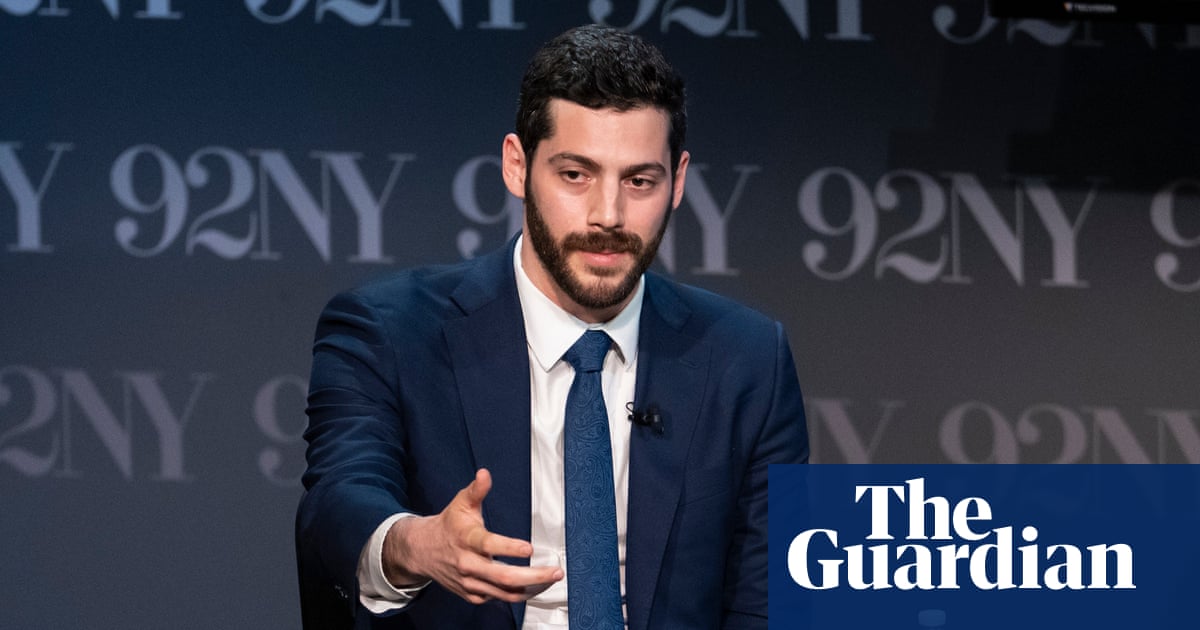
When Paris’s new leftwing mayor, Emmanuel Grégoire, leapt on a bike for a victory tour along the French capital’s large network of new cycle lanes on Sunday night, he was sending a crucial message to Paris residents.
Not only would he continue to build bike lanes and keep limits on cars in the city, keeping the French capital’s pro-cycling focus on environmental issues and reducing its dangerous air pollution., he was also seeking to style himself as humble, frugal – “of an absolute moral rigour”, in his words – after promising to shrink Paris officials’ hefty expenses accounts and end the use of chauffeur-driven cars.
Grégoire, 48, squarely beat the rightwing former minister Rachida Dati who had wanted to take the French capital after 25 years of it being run by the left. His win was part of a final round of mayoral elections in large towns and cities across France, seen as a crucial test of the political temperature ahead the 2027 presidential election when Emmanuel Macron’s two terms in office will end, and Marine Le Pen’s far-right, anti-immigration National Rally (RN) is seen as well placed to make the presidential final round.
In the end the RN failed to win Marseille, France’s second-largest city, but significantly increased its local councillors and won smaller towns including Carcassonne. The RN’s close ally, Éric Ciotti, who will play an important role in the far right’s presidential election campaign, is now mayor of France’s fifth-biggest city, Nice.
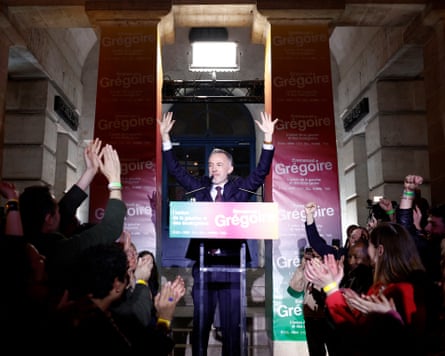
Grégoire, who ran in Paris for a united grouping of Socialists, Greens and other parties on the centre left, said he would now position the French capital to hold back the rise of what he called “Trumpian politics” in France. He said he would make Paris a place of “resistance” against the far right as the presidential election approaches.
Grégoire has delivered a fifth consecutive term for the Socialists in Paris, but until this year’s bruising mayoral election campaign, he was relatively unknown to the public. In 2024, he won a Paris parliament seat after Macron called a sudden snap election and leftwing parties formed an alliance to hold back the far right.
Grégoire has worked at city hall for over a decade, including running the budget and serving for six years as deputy mayor to the leftwing mayor Anne Hidalgo, who has held the office for the past 12 years. But he was not Hidalgo’s personal choice as successor. This in some ways worked in the favour of the father of three: he was able to move away from Hidalgo and position himself as bringing change.
Grégoire enters city hall with a serious crisis to manage. Paris has been shaken by multiple police inquiries into the alleged sexual abuse and rape of young children in state nursery schools and primary schools. At least 30 school monitors were suspended in Paris in 2025, 19 after complaints of sexual abuse. After the city hall was criticised by parents for mishandling years of complaints, Grégoire has promised a “total transformation” of the system of recruitment and oversight of school monitors, who work with children at lunchtimes and during extracurricular activities.
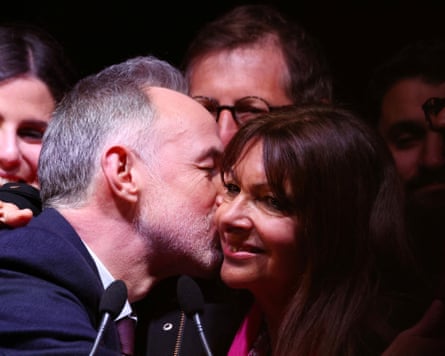
Paris authorities last autumn moved to address the issue, appointing an independent magistrate as a children’s rights ombudsman. But Grégoire said he would go further, promising what he called a “big bang” to deal with what he called “major dysfunction” in the system. He said he would change recruitment and contracts and launch a citizens’ consultation from next month.
Grégoire revealed during the campaign that he had been sexually abused as a child, by a school monitor at a municipal swimming pool. He said he had been carrying the inner harm of this “for a very long time in silence” and at the time he could not find “the strength, nor the means or words to speak of this pain and suffering”.
Parents’ groups and the political opposition at city hall said they would closely watch how Grégoire dealt with the crisis.
He has also said he would “guarantee transparency” on expenses for district mayors and elected representatives in Paris, cutting budgets for items like clothing and travel.
The new mayor will have to tackle not only social housing shortages and tourist rentals in Paris – he has repeatedly said “Airbnb is my enemy” – but also the city’s homelessness problem, and the increasing number of families with children who are on the street. He has promised to ensure no more children are sleeping rough, and charities are closely monitoring how this can be achieved.
Environmental issues will remain a focus. Air pollution has gone down in the Paris area in the past 20 years – not only due to city hall action, but to a combination of national, European and local policy. But it remains a health threat – as do soaring summer temperatures – and Grégoire has acknowledged that more needs to be done. He has promised that 10 boulevards will be turned into public gardens and 1,000 streets will be pedestrianised.
In the first round of the mayoral election, more than 10% of the vote went to Sarah Knafo, the candidate for the far-right party Reconquest, founded by Éric Zemmour, a former TV pundit who has convictions for inciting racial hatred. This was a historic high for the far right in the city, but Knafo pulled out of the final round, saying she wanted to facilitate Dati’s attempt to win the city for the right.
Grégoire said in his victory speech that the left’s win showed “a clear rejection of racism and antisemitism”. He said: “Paris is not and never will be a city of the far right.”