8 hours ago
13
8 hours ago
13
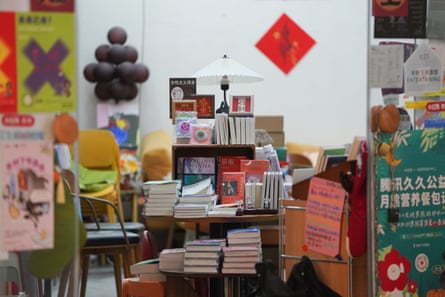
In a small, unassuming bookstore in south-west China, a discreet community of women dream of a more equal future. Here in Chengdu, 42-year-old Shen Shen runs one of the country’s leading feminist bookstores.
“The world doesn’t lack bookstores for men,” she says, surrounded by piles of volumes by authors including Judith Butler, Simone de Beauvoir and Chizuko Ueno.
But Shen Shen must tread carefully. Although “feminist” is not quite a dirty word in China, “gender antagonism” – behaviour or speech could be seen as stoking division between men and women – is.
Being a woman in China is getting harder. The rising tide of a booming economy once lifted up people from all parts of society, revolutionising lives – women’s included. Now, an economic slowdown and Chinese leadership that promotes a return to traditional family values are testing female liberation
Women today are more educated than ever before, yet less likely to be in the workforce. The female labour participation rate has fallen by more than 20% since 1990, as state-sponsored childcare has closed down and caring responsibilities for an ageing population have grown.
At the same time, authorities have become increasingly alarmed by women who shun traditional gender roles – whether that is by refusing to get married or by speaking out against sexism. Feminist social media accounts are regularly shut down by China’s internet censors because of complaints they have incited “gender antagonism”.
In a four-part series, the Guardian is analysing the changing status of women across Chinese society. The series examines how in different aspects of their lives they are responding to government restrictions and shifting social and economic conditions. Some are turning to overt activism to champion women’s rights, despite such behaviour being all but banned by the authorities. Others are resisting pressure to marry and have children, or forging careers outside traditional boundaries.
In the face of an increasingly restrictive political atmosphere, Chinese women are charting their own paths, defying societal pressure to live according to a fixed, Communist party-approved blueprint.
In Chengdu, a city far from the more stifling atmosphere of Beijing, a cautious feminist revival is unfolding. The city is known for its more relaxed social attitudes, and Shen Shen’s bookstore, Laishuxia, is one of a number of female-focused communities that are growing in popularity.
“The bookstore I want to create is one that takes root,” Shen Shen says.
Chengdu: China’s most feminist city?
Shen Shen opened Laishuxia in August 2023. Her first encounter with the concept of feminism was in 2017 when the #MeToo movement ricocheted around the world – including to China, where women spoke out despite heavy censorship from the authorities.
“That’s when I first discovered the word. But as a woman I feel we’ve been encountering the concrete realities of feminism since birth,” she says.
As well as stocking books from a range of Chinese and international feminist authors, Shen Shen hosts small reading and discussion groups centred on themes such as dealing with menopause and whether or not artificial intelligence is biased against women.
In China, hosting in-person gatherings can attract unwanted attention from the authorities. The Communist party is deeply suspicious about anything that could morph into something resembling a social movement.
In China’s major metropolises of Beijing, Shanghai and Guangzhou, film festivals, talks and even board game groups have been shut down because of government pressure. But Shen Shen is careful to avoid any topics that could cause problems, and always notifies the police in advance of her events.
Across town, Zhang Wenjia, 28, is walking the same tightrope. Last year Zhang and her partner opened a female-only bar called Rearview Mirror. Dimly lit with walls plastered with pictures of Ruth Bader Ginsburg and Virginia Woolf, feathered dreamcatchers hanging from the ceiling, it is an oasis of calm.
Zhang says she wanted to create a space for women to come when “they need to relax, unwind or have safe entertainment”. In mixed-gender bars, it’s hard for conversations to stay completely platonic, she says, whereas at Rearview Mirror “everyone’s purpose for interacting is much purer”. Zhang is gay but was put off by the hook-up culture she encountered at some lesbian gatherings, and wanted to make a space that welcomed both gay and straight women.
Opening a business that caters only for women doesn’t violate any Chinese laws, but it does offend some men. One called the police soon after the bar opened. Zhang and her partner told the officers that as female proprietors, they worried about being harassed by male customers. “It’s for our own safety, and to avoid making trouble for the police,” Zhang said. The police accepted her explanation but left with a warning: “Don’t be doing that lesbian stuff.”
Rearview Mirror is one of several female-only bars to have opened in Chengdu in recent years. Other cities have large populations of urban, educated women who are interested in their own empowerment, but Chengdu has seen a bigger flourishing of this trend than anywhere else.
That is partly thanks to its distance from Beijing and Shanghai. As the ancient Chinese proverb goes, “the mountains are high, and the emperor is far away” – meaning the further one gets from the capital, the more free spirited people tend to be.
He Jiayu and Bai Yuanjie are the co-founders of GiCD (short for “Girls in Chengdu”), a social network for hundreds of women across the city which they launched in April 2024. It started out as casual meet-ups but has evolved into a packed weekly schedule of rock climbing, film screenings, craft workshops and other social activities.
Bai says that she wanted a group like GiCD so she could have a space free of sexual harassment or even the prospect of being approached for a date. “I think every woman understands what I mean,” she says.
Like Zhang at Rearview mirror, He and Bai try to keep their project focused on the practical benefits of women-only spaces, rather than dwelling on political ideas. Both are keen to stress they don’t promote anything that could be interpreted as “gender antagonism”.
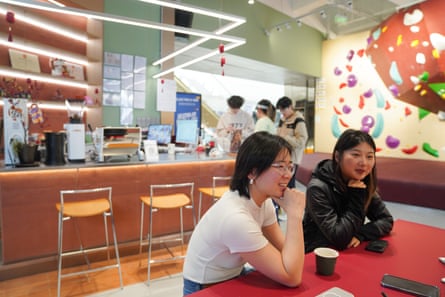
In the 2010s, small groups of women took to the streets to protest against domestic violence and sexual harassment. They were detained, harassed and surveilled. In contrast, today’s independent women focus on the positive aspects of womanhood, rather than the negative aspects of patriarchy.
It is a subtle shift but one that allows them to live their lives with relative openness, within the limits of a government that insists on “positive energy” and censors social criticism.
Li Maizi, one of China’s most well-known feminist activists, left China in 2023. She says that in the past decade “the political environment has become much more restrictive”.
“Rights-based organising can quickly attract government scrutiny,” Li says. “Many feminists have adapted their strategies. Instead of direct confrontation, some create women-centred spaces … that focus on solidarity, support, and empowerment.
“I see this less as a retreat from feminism and more as a strategic adaptation to a tighter political environment.”
For Shen Shen, there is no contradiction between avoiding politics and a belief in gender equality.
“I feel that feminism, more than anything, teaches women how to respond to all crises and challenges with wisdom.”
Additional research by Lillian Yang and Yu-chen Li