 2 months ago
55
2 months ago
55
“This,” says Fiona Copeman, the hub manager of the Malabar wastewater treatment plant, “is what you would call our four-bus area.”
Copeland is gesturing to a model of the plant on a table inside the facility itself. She’s referring to a 300 cubic metre underground chamber that houses, as Guardian Australia revealed in January, a “fatberg the size of four buses that likely birthed poo balls that closed Sydney beaches”.
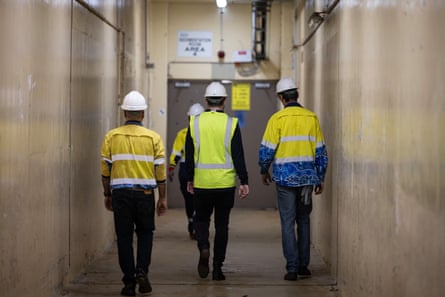
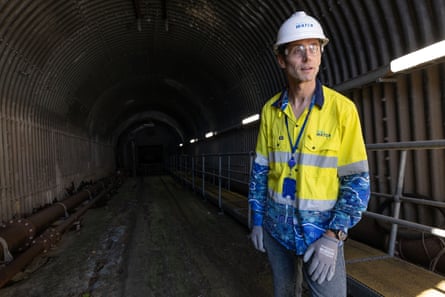
Thirty minutes later, Copeland takes us down a concrete tunnel to a rusty metal door in waist-high water. Beyond this so-called bulkhead door lies the fatberg in an “inaccessible dead zone”.
Sydney Water doesn’t know exactly how big the fatberg is. They’ve tried to find out by sending a drone into the small space above the congealed fats, oils and grease (FOG) and below the concrete ceiling.
But it couldn’t fly straight due to the turbulence created by sewer gases and the rapid flow of treated effluent to a deepwater ocean outfall (Doof) 2.3km out to sea.
The corporation’s working theory is that parts of the fatberg are dislodged during rapid changes in pumping pressure. These “sloughing events” have been caused in the past by a loss of power or heavy rainfall.
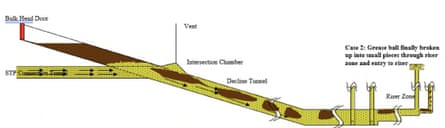
The dislodged pieces of fatberg are then forced through diffusers – enormous upturned shower heads which disperse effluent from the ocean floor – at the end of the outfall.
In late 2024 and early 2025, the poo balls were carried back to shore by waves and wind. A number of Sydney beaches were closed including Coogee, Bondi and Manly.
In February this year, the NSW Environment Protection Authority (EPA) issued a pollution reduction program to Sydney Water “requiring a range of significant works, including fat removal from the Malabar deep ocean outfall bulkhead area”.
‘We’ve tried to understand what it is’
We visit the plant on the day the Artemis II moon mission launches. Clearing a fatberg seems a smaller step for humanity.
A 5-metre-long area directly behind the brooding bulkhead door can be accessed at certain times. It ends at treated wooden stopboards that reach almost to the ceiling of the tunnel. The inaccessible fatberg is just past this point.
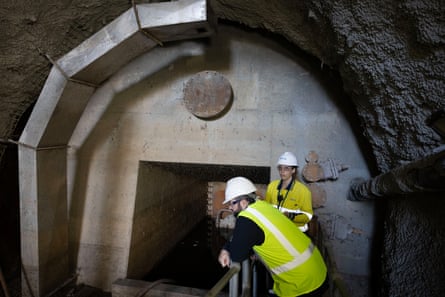
At times of high flow, material constantly comes back over the gap above the stopboards, making it unsafe to open the bulkhead door.
But when the flow is lower, and there’s a lunar low tide combined with minimal rainfall, crews can access this smaller chamber to remove some spillover, typically every four to six months.
Six people work to pump out the rainwater that collects between the door and the stopboard. They pop open the hatch, not the entire door, and insert a hose that allows two hours-worth of fatberg to be pumped out.
Above ground, we are shown the easier option. A gas vent can be opened up and a hose lowered down 20 metres to suck up the fat in front of the stopboards.
Most of the problematic material removed so far, including 53 tonnes in April 2025, has left this way. But more re-accumulates in its place and the “four-bus area” beyond the stopboards remains undisturbed.
Copeman has seen the accumulated FOGs at Malabar over almost 15 years. She says the consistency varies – sometimes it’s gritty. Sometimes it’s scummy.
“We’re inquisitive people, so we’ve put it in our hands and we have felt it,” she says.
“Sometimes we’ve seen if we can roll it into balls and thrown it around – and we’ve tried to understand what it is.”
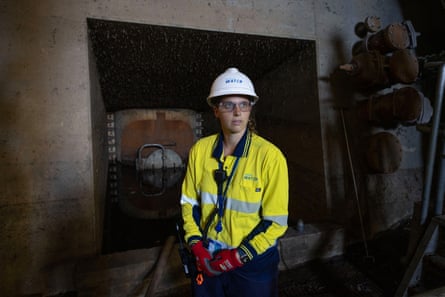
What does it smell like? “Sewage,” Copeman replies.
Sydney Water says most of the outfall tunnel is unsafe for people to access.
The only way to access the fatberg, the corporation insists, is to shut down the city’s largest ocean outfall for months and dump the primary-only treated sewage at the cliff face. A secret August 2025 Sydney Water report obtained by Guardian Australia noted this had “never been done” and was “no longer considered an acceptable approach”.
“The maintenance strategy when they put it [the deepwater ocean outfall] in, in the 90s, because everyone was used to [cliff] outfalls, was just take it offline, put the flow back on the cliff face, and maintain the tunnel,” Copeman says.
Down at the bulkhead door, it is eerily odourless, but this is not the case in Sedimentation Room Area 4, in the primary treatment facility. As we step inside, the smell matures quickly from a seaside pong to a meaty fug which opens up the nostrils. It’s a pandemonium of aromas so bad they seem to cancel each other out.
We are using hearing protection but none of the staff wears anything over their noses.
“I reckon you’re either built for sewage, or you’re not,” Copeman says.
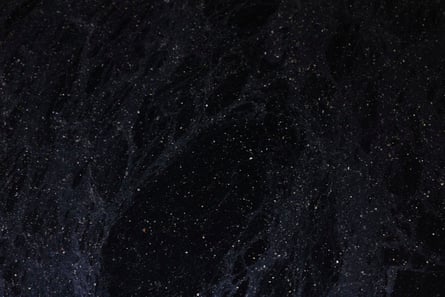
In row upon row of sedimentation tanks, reflectionless water is flowing. It’s black from ferric chloride used for odour control. The water moves so gently you can’t tell until you spot tiny bubbles and fat particles speckling the surface like galaxies.
Slower is better: the more time water spends in a tank, the more solids sink to the scrapers at the bottom. This “sludge” is removed for further treatment and then used on land, in the forestry industry, for example. The remaining liquid or “effluent” is then sent out to sea.
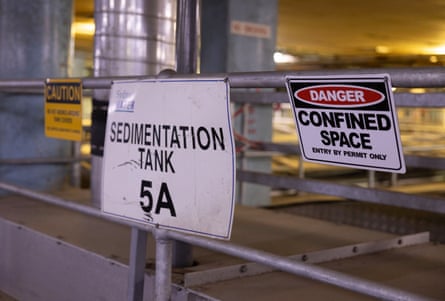
During dry weather, 485 megalitres – or 194 Olympic pools – of wastewater comes through the Malabar plant each day. That rises to 1,300 megalitres during wet weather. Higher volumes mean less time in the sedimentation tanks – and fewer solids being removed.
One of the sedimentation tanks has been emptied out so the scrapers can be upgraded as part of a pollution reduction program.
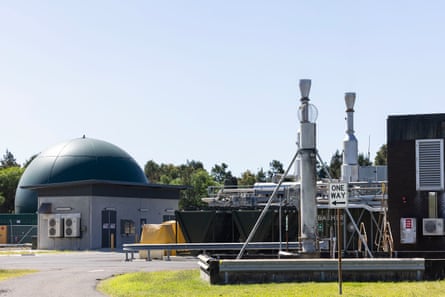
Copeman notes that the “scum” transfer pumps are also being improved. The FOGs on top of the sewage are sent to an onsite cogeneration plant, which typically powers 80% of Malabar’s operations. On a good day the plant sends excess electricity to the grid.
These changes are in addition to $3bn of upgrades from Sydney Water’s existing capital works program to plants upstream, which aim to divert the amount of sewage being treated at Malabar.
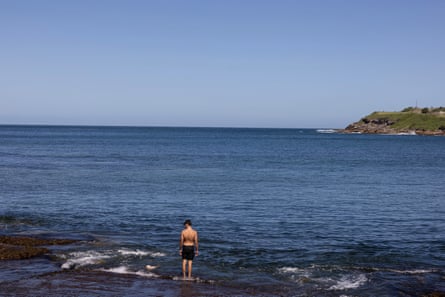
FOGs in the Malabar catchment have reportedly risen by 39% over the past 10 years.
Ben Armstrong, the principal manager of environment at Sydney Water, says: “We’re at the end of the pipe, so it’s really hard when you’re doing those volumes and loads to treat it when you really need to be removing it at the source.”
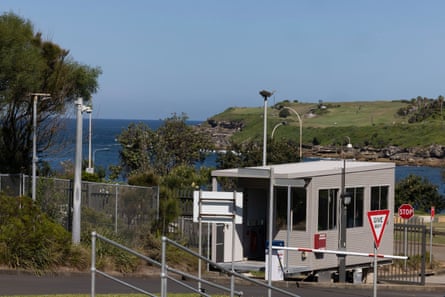
At nearby Malabar beach on the day of our tour, swimmers dive into the water untroubled, as the occasional waft of sewage drifts over the cliffs.
After washing our hands, but before we leave the facility, Copeman shows photos of the headland before and after the Doof came online in the 1990s.
In the first picture, you can see the brown sewage plume advancing into the ocean from the cliffs. In the second, the sea is indigo.
But debris balls washed up on this beach as recently as January. So does Copeman expect they will continue to roll in sporadically?
“I don’t know the answer to that question. I don’t want to say that there will never be an event again. [But] we are trying to do everything in our power [to prevent it].”