 3 months ago
57
3 months ago
57
For decades, the Valero refinery shaped Benicia’s economy, politics and health. Now the city has become a reluctant test case of whether an oil town can reinvent itself
Less than 40 miles north of San Francisco, the city of Benicia has the quaint ambience of an American small town, where a white gazebo and sign for a community crab bake mark the approach to a vibrant downtown stretch of restaurants, cafes and antique shops.
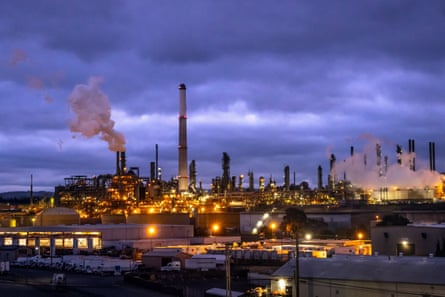
From many vantage points, it’s easy to forget the city is home to a massive 900-acre oil refinery, its imposing sprawl of stacks, holding tanks and billowing steam hidden from view. But for nearly 60 years, the refinery has loomed over every aspect of life in Benicia, exerting outsized influence on its economy and politics, while posing serious risks to public health.
The Benicia oil refinery, which the Texas oil company Valero bought from Exxon in 2000, thrived in an era when fossil fuels reigned largely unchecked over the US – offering reliable local taxes, well-paying jobs and steady economic opportunities for the many small businesses in its orbit.
But as California pivots to meet its ambitious clean energy goals, refineries like this one are on the decline. The state has pledged it will be carbon-neutral by 2045, dramatically reducing its dependence on fossil fuels.
Last April, the multibillion dollar company announced plans to “idle, restructure or cease” operations within a year, citing California’s tough “regulatory and enforcement environment”. The company confirmed in January it would begin winding down operations and “permanently” idle most processing units by April, laying off nearly 70% of its payroll – about 240 employees – in the process.
The move, in effect, seals Benicia’s fate as a post-refinery city, positioning it as a reluctant test case of whether a place long defined by the oil and gas industry can successfully reinvent itself.
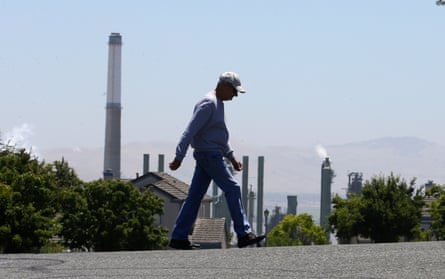
News of the potential closure sent shockwaves through this small, relatively affluent community of approximately 28,000 people in Solano county, on the north-eastern edge of the San Francisco Bay area.
The closure of the refinery – Benicia’s largest employer and the source of nearly 20% of its tax revenue – could have a catastrophic impact on the city’s financial stability. The company also has funded sports teams, community programs and non-profits.
That future holds mixed feelings, depending on who you’re talking to. Some local leaders envision Valero’s exit as a once-in-a-generation opportunity for the city to increase housing at dramatic scale and lure cleaner commercial and industrial enterprises.
“Things are still very much in flux, and it feels like the city of Benicia’s future is yet to be determined,” said Kari Birdseye, a city council member with a reputation for standing up to the company. “I would like Benicia to be the poster child for a just transition for other refinery cities.”
But others – including business owners and plant workers – are less optimistic.
“I’ve lost a lot of customers,” said Chantel Sprankle, owner of Sprankle’s Deli, a homey sandwich shop that’s long been a mainstay of Benicia’s downtown. “We have a lot of regulars and a lot of friends that work for Valero. I probably know 75% of them by name.”
Like many other restaurants, hotels and industrial supply businesses here, the deli relies heavily on the patronage of refinery workers and executives – some of whom have already skipped town ahead of the facility’s now-imminent shutdown.
Sprankle puts the blame squarely at the state, arguing that California’s ambitious climate goals and oversight rules cut into the company’s bottom line, hastening its departure. “I’m sorry, but we’re all in the business to make money. Let Valero make money,” she said. “They’re taking care of our community. Now what’s going to happen? All these people are out of jobs.”
“I hope that we can make it,” she said, her voice catching. “I’m sorry to get emotional, but Valero leaving is the worst possible thing that could happen to our little community.”
Supply anxiety
The city’s challenges expose a broader obstacle in California’s effort to transition to a clean fuel economy by 2045. The state has reduced its gasoline consumption considerably over the last 20 years – by more than 15%, or about 2bn gallons per year. But the pace of that reduction hasn’t matched the steep decline in refining capacity, amid a steady exodus of processing facilities in recent decades.
The Benicia plant, one of only nine remaining gasoline-producing facilities in a state that once had dozens, processes about 145,000 barrels of crude oil a day, accounting for nearly 9% of California’s total production. News of its potential closure came just months after the smaller Phillips 66 refinery in Los Angeles also announced plans to shut down.
But with gasoline still in high demand, the closures have compounded fears of price spikes and fuel shortages. That in turn has led the state’s governor, Gavin Newsom, a likely presidential contender, to soften his tone toward an industry he once attacked. As the closure loomed, state leaders scrambled to save the refinery, even considering paying Valero up to $200m to cover routine maintenance costs.
Despite failing to save the refinery, the governor attempted to place a positive spin on recent developments, saying in a statement that his office had instead negotiated a deal for the company to use the site as a fuel import and storage terminal to “help maintain steady supply and stable prices”.

But Steve Young, Benicia’s mayor, isn’t convinced by the plan.
“That’s a lose-lose situation for us,” said Young in a gravelly drawl, between bites of his turkey club sandwich during a much-needed lunch break at Bottom of the Fifth, a local sports bar and grill. The deal, he said, would essentially turn the property into a “tank farm – sort of like a gas station for the Bay Area”.
“No taxes, no jobs of note, and you’re still gonna have emissions coming off the [fuel storage] tanks,” he said.
A tall, gray-bearded man with heavy eyes in his mid-70s, Young said the proposal could also delay Valero’s legally mandated environmental remediation of the property and lock much of it up behind security fences, blocking the city from beginning the lengthy redevelopment process.
Young noted that he and other city officials weren’t included in the negotiations between Valero and the state, and only found out about the deal after it had been publicly announced. Young said: “The biggest unknown is, how long are we talking about? Three years? Five years? Twenty-five years?”
Once the state capital, if only for a year – in 1853 – Benicia prides itself as the “jewel of Solano county”, boasting well-kept yards and century-old Victorian homes, a low-crime rate, good schools and an abundance of parks, libraries and subsidized artists’ studios.
“We’re a hidden gem – a poor-man’s Sausalito,” Young said, in a nod to the upscale enclave in Marin county.
But many of those amenities are funded in part by the property taxes Valero pays, saddling the mayor and other city leaders with the unenviable task of trying to raise local taxes and identifying potential cuts to everything from the public pool to the Christmas tree lighting ceremony.
“It’s an existential moment for our community,” Young said.
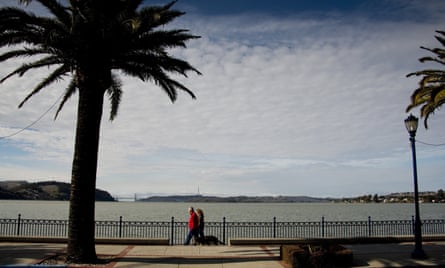
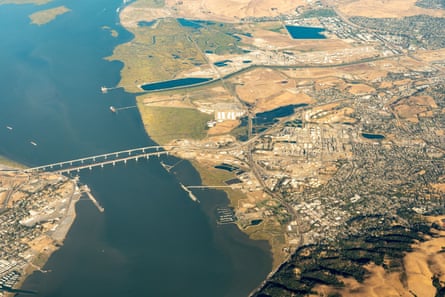
More than half of the 900-acre property, with unobstructed views of the scenic bluffs and waterways of the Carquinez Strait that funnel into the mouth of the Sacramento-San Joaquin delta, is largely undeveloped and could be used as prime residential and commercial real estate to help recoup the city’s dwindling tax base.
Young envisions using the land to build housing, grocery stories, retailers and recreation areas for families. He said: “Things that would draw people here.”
Meanwhile, the site’s proximity to a deep water port, rail lines and two interstates make it well-situated for any number of new, cleaner industries, including large-scale solar or wind development, he said.
But any development plans remain on hold until the company releases more details about the storage arrangement.
That leaves Benicia with lots of questions and no answers, Young said.
He continued: “We’re losing our biggest employer and our biggest taxpayer. And we simultaneously may be faced with the inability to rapidly replace them.”
A cautionary tale
For all its economic benefits, the refinery has for decades exposed the community to serious health and safety risks.
The city has the highest cancer and asthma rates in the county, with downwind residents consistently exposed to toxic emissions and sidelined by intermittent fires and flaring incidents.
In 2024, regional and state air regulators fined Valero a record $82m for secretly exceeding toxic emissions standards for more than 15 years – spurring speculation that the heavy sanction played into the company’s move to announce closure plans roughly six months later.
In a much-needed break for Benicia, the Bay Area Air District moved in late January to let the city apply for up to $40m in grants to pay for public health and economic resilience projects – with another $20m available to local non-profits.
Young, who sits on the regional agency’s board and lobbied aggressively to make the funds available to the city, said the money could go a long way in keeping various programs intact, even if the money can’t be used to replenish losses to city services.
“This is very good from our perspective,” Young said with a rare tone of relief.
Any similar hint of uplift is notably absent at the Plumbers and Steamfitters Local 343 union hall and training facility in nearby Vacaville.
“It’s doom and gloom from the rank-and-file members. They’re very upset,” said Steve McCall, the business manager of the union, whose workers are often hired as contractors during maintenance shutdowns at the refinery.
The 500-member union trains about 75 apprentices at a time, dispatching them to install and maintain high-pressure piping systems at residential and industrial facilities in the region, including hospitals and power plants. But many members only wanted to work at the refinery, and about 10% have left the union since Valero’s announcement, McCall said.
For decades, he said, the refinery provided his members with steady work and high wages; they could earn anywhere from $30 an hour as an apprentice, to upward of $70 as a journeyman. For skilled tradesmen willing to work in difficult and sometimes dangerous conditions, steady gigs at industrial sites like the refinery offered a direct path to the middle class.
“Work hard and you can make six figures,” McCall said, pointing to the soldering stations, welding equipment and piping displays at the union’s expansive new training warehouse.
The refinery’s impending closure comes as the Budweiser plant in Fairfield and the Mare Island dry dock in nearby Vallejo – an extension of the former shipyard – have also recently ceased operations, further shrinking industrial employment opportunities in the county.
“When we lose pillars like that, how else do people live here?” McCall said. “People need to afford homes. If you can’t work here and you have to drive two hours, it becomes untenable.”
It’s for those reasons that Terry Mollica, a Benicia resident, said he certainly didn’t celebrate the news of the refinery’s closure, acknowledging the “short-term transitional pain” it would inevitably inflict on the city and its workforce.
But he admits he is not sad to see it go.
Sitting in his back garden in a quiet subdivision about a mile north of the facility, Mollica said he and his family moved here from nearby Richmond, another refinery town, about 15 years ago, drawn to the city’s good schools, scenic waterfront and strong sense of community.
“It’s a great little town with a great history,” Mollica, a retired attorney, said. “There’s only one negative, and that’s the refinery.”
The city, he said, now has a unique opportunity to correct a huge planning mistake.
“I don’t think that locating a refinery immediately adjacent to a small city is a very good land-use plan,” said Mollica, who helped successfully push the city to adopt a modest set of refinery safety oversight rules last spring – just two weeks before the company announced its departure. He said: “I mean, it exposes people to all kinds of bad stuff.”
But ultimately, he said, Benicia’s situation offers a cautionary tale about relying too heavily on a single industry.
“This town to me has huge potential. It’s a place where people want to live,” he added. “And that’s what should drive a community, not the fact that there’s a big industry in the middle of it.”