3 hours ago
5
3 hours ago
5
Dusk has settled on Edinburgh Castle and now a laser beam is scribbling a route across its ramparts and high into the sky. The voice of actor Richard Rankin is talking solemnly about lonely soldiers answering a call, while a ferocious light rises in the gatehouse. Out of it emerge scores of drummers and pipers, their sound both melodic and awe-inspiring. They crisscross the esplanade to the stirring lament of The Skye Boat Song.
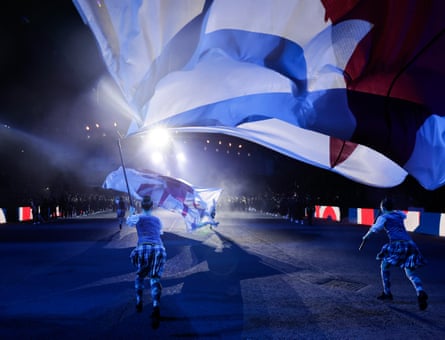
This is the Royal Edinburgh Military Tattoo, an event often overlooked amid the festival cacophony – and yet its popularity eclipses any other event in the city. Last year, it played to 230,000 and raised £1.5m for charity. Like an outsize variety show, it is a formidable spectacle: fireworks, projections, flags dragged over the audience and a soundtrack that ranges from Carmen to Star Wars.
I speak to Susan from Aberdeen who is here with her daughter for the third year in a row. They love the highland dancing. “The atmosphere is amazing,” she says, delighted to be back. From New Zealand, Francesca tells me she is staying with family in Glasgow and is here for the night. “It’s a bucket-list item,” she says. “I was going to go when it toured to Auckland in February but I was told I had to see the original one first.”
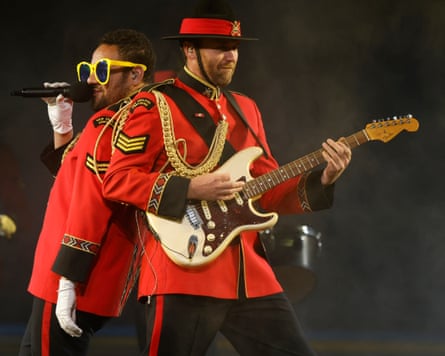
Staff Sgt Ross Yorkstone, drum major with the New Zealand army band, is equally pleased to be here. Performing for the sixth year, he can think of no equivalent. “The closest would be the Basel Tattoo but it’s nowhere near as big as this,” he says. “We always come here with our top A-game.”
On a hot summer afternoon, I sit down with Alan Lane, the creative director, in West Princes Street Gardens to talk about the event’s phenomenal appeal. Our meeting place is deliberate: next to us is a statue of a kilted soldier with a rifle across his knees. He is the figure voiced by Rankin in A Call to Gather, the name of this year’s Tattoo show, and is looking poignantly towards the Scottish National War Memorial high above us in the castle grounds. Known as The Call 1914, the memorial is a tribute to the American expats who came to fight in the first world war. It is Lane’s inspiration. “It’s a celebration of those who will lend a hand,” he says. “If you’re my friend, I’m going to come when you call.”
But which Alan Lane am I talking to? There seem to be two. One is the kind of man you would expect to be commanding a military display: a reservist who trained at Sandhurst as an officer in the Royal Engineers and who, as a wide-eyed 18-year-old, set his heart on directing the Tattoo. He is 1.9 metres tall (6ft 3in) and holds himself with a soldier’s bearing.
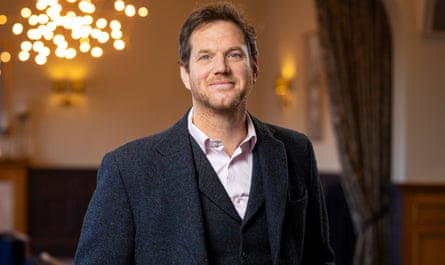
The other Alan Lane is more surprising. A lifelong member of the Labour party, he is the founding artistic director of Slung Low, the Leeds-based theatre company with a speciality in large-scale community events. He was behind Flood, a four-part epic with a cast of 58 for Hull, UK City of Culture, and Camelot: The Shining City, a dystopian fantasy in which the audience was evacuated from the Sheffield Crucible as part of the show.
This Lane set up a community college on a doubledecker bus, took charge of a working men’s club and, for a year during the pandemic, coordinated a free food delivery service in Holbeck and Beeston in Leeds. He is a vegetarian who today has shown up in pink shorts. “Having run a food bank and working men’s club, there aren’t many theatre directors who are more obnoxiously leftwing than I was,” he laughs, keeping an eye on Bolt, his spaniel, who has come along for the walk.
You can understand why Lane is not keen on singular thinking. If others see a contradiction in his background, he does not. “The beach commanders on D-day were part of the Labour cabinet five years later,” he says. “I don’t get how it isn’t leftwing to believe we need a military and that there is some honour in that.”
Still, the organisation took some adjusting to. After his appointment in April 2024, he was kitted out with tweed, tartan and ties. He is not joking when he says that the Tattoo has a crisis meeting when attendance for the 8,800-capacity show drops below 96% – a figure that any arts company could only dream of. “But actually what I’ve found is, fundamentally, we’re not that different,” he says. And anyway, for Lane differences are there to be bridged. “Where that gets us to in this year’s Tattoo is a sharing of culture in order to understand each other,” he says. “This year, we’ve got the Americans and the Qataris in a show – that’s not by accident.”
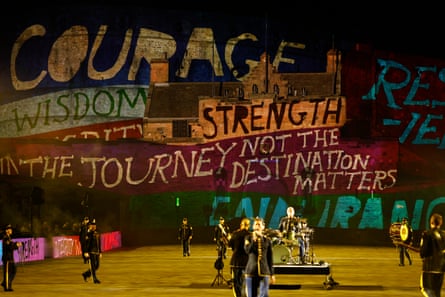
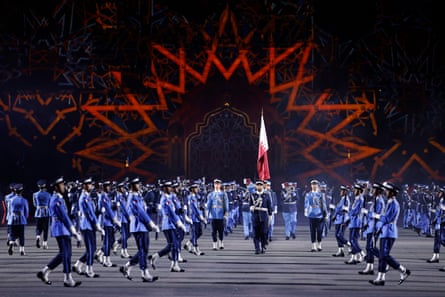
The juxtaposition is plain to see. The Qatar Police Academy Band and Drill Team, with its sky-blue tunics, strident song and Islamic projections, comes on straight after a section called Bright Brave World in which US culture is represented by the Jackson 5, country music and tap-dancing cowgirls. Slogans of the nation’s founding principles are splashed across the castle walls: “All men are created equal”, “A new nation conceived in liberty”, “The pursuit of happiness”.
Launched in 1950, the Tattoo established elements that remain to this day. There will always be marching bands and traditional songs, and they could not do without the lone piper, the solitary player on the ramparts who casts a spine-tingling hush across the audience.
But every year, two-thirds of the event is created anew by the organisation’s own dancers and musicians – 133 of them, one of the largest amateur companies in the country. “In the same way you wouldn’t go: ‘Oh no, I’ve seen Scottish Ballet,’ you’d say: ‘What are they doing this year?’” says Lane. “They’re turning those skills and talents to a different story.”
If he is trying to capture the moment, this is nothing new. In 1962, the audience crowded on to the esplanade to dance to Chubby Checker’s Let’s Twist Again, a hit only a few months earlier. In 2022, the US army Field Band brought hip-hop to the castle, with rappers Lamar Riddick and Nicholas Feemster taking to the mics for a cover of Clean Bandit’s Rather Be.
“It’s a living, breathing thing that speaks to the moment,” says Lane. “The show has to have a specific creative intent at every moment. It’s not enough to say: ‘The New Zealand army band are coming – they’ll do their thing.’ There has to be something worth saying.”
What, then, is worth saying in 2026? “People paying attention to each other’s cultures,” says Lane without hesitation. “This job involves me sitting with lots of military leaders telling me their plans for the next three or four years. All of them involve war. Not preparing for war – actual war. Looking five years out, every one of them says: ‘At that point, we are at war.’ This is a good time to be doing this show, where can we find common ground because they keep telling me war is coming.”
But what of those who see the Tattoo as a celebration of military might? Sensitivities feel especially acute this year, when the Tattoo, like the Edinburgh international festival, is marking the 250th anniversary of the Declaration of Independence at the same time as the US is firing missiles at Iran. Is this really the best moment to bring on the US army Field Band performing the “best of Americana”?
“The Tattoo doesn’t celebrate the military,” says Lane, unruffled by the suggestion. “I sit in meetings with people who wish it would do that, but it’s not our job. The Tattoo is unapologetically Scottish in its celebration of heritage. We genuinely love it. We’re zealots. But it doesn’t speak to militarism in those ways at all.”
He continues: “The thing I’m sure of is: in times of difficulty, talk more, not less. The challenges for an American band to come here are real, and it would be very easy for them to decide they didn’t want to waste any political capital by coming. And it would be very easy for us not to invite them. I think we would be lesser for it because we would forget the great philosophical and poetic ideas of America. It’s brilliant to be reminded of them and to think: ‘Ah, this too shall pass.’”