 2 hours ago
6
2 hours ago
6
Surrounded by towering oil palm trees on his farm in the small village of Caño Barbú, near San Pablo in northern Colombia, Yoger Payares uses a malayo – a pole-mounted iron tool with a hook – to hack at the fronds of one, freeing a bunch of its vibrant reddish-orange fruit so it falls to the ground.
Today, Payares proudly works in the oil palm industry. But for more than a decade, just yards away, he grew coca leaves, becoming embroiled in the illicit industry in 1990 after leaving his job as a cattle farmer.
“It was difficult to be living here and not be involved in coca, because it’s what you grew up to know,” says Payares. He regularly wipes his brow in the 36C heat against a backdrop of the drone-like sound of cicadas. “It was an easy way to make money. Coca was booming … it was like, if I’m not doing that, what am I going to do? It solved my money problems.”
In San Pablo, on the west bank of the mighty Magdalena River, there are thought to be 275 smallholder oil palm growers out of a population of almost 30,000. Payares says his two brothers also joined the coca boom in the area, which endured decades of violence due to gruelling conflict between armed groups such as the Revolutionary Armed Forces of Colombia – People’s Army (Farc) and the National Liberation Army (ELN), later inflamed by the drug trade.
Growing coca was a job fraught with fear, as smallholders constantly worried about armed groups discovering they were selling their leaves to a rival. “It was dangerous,” says Payares, who regularly reels off stories of violence, from the killing of his police-officer cousin to the neighbour’s son who was kidnapped. “You grew up in fear.”
The replacement of coca leaf plantations with other crops has been a Colombian public policy since 1995. The far-right leader Abelardo de la Espriella, recently elected Colombia’s new president and an advocate of a hardline approach to armed groups – opposing predecessor Gustavo Petro’s peace talks – has announced his intention to maintain the policy, with cacao and oil palm as alternatives.
Spurred by the subsidies, technical support and tax discounts offered under the policy, many coca growers have left the profitable business.
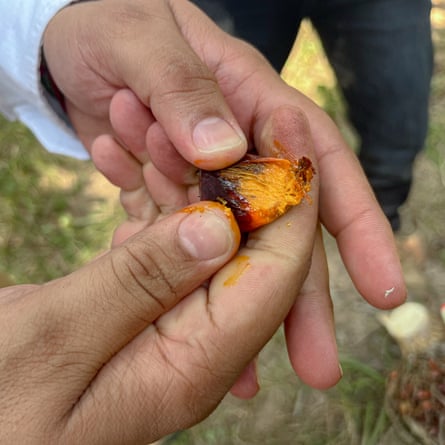
“Things are calmer,” Payares says of growing oil palm on his 11-hectare (27-acre) farm. “I can live safely.” It has also led to other payoffs. “One of my kids has been to university, another is at university. I own a house. I have my own truck. I never thought that I would have my own transport. Everything I have is thanks to what the palm has given me.”
Camilo Santos, deputy director of market transformation for Latin America at the Roundtable on Sustainable Palm Oil, says that today nearly 90% of San Pablo’s oil palm growers are independent smallholders.
“Their efforts have been key to revitalising the local economy, creating jobs, improving food security and attracting workers from neighbouring regions,” he says, adding that oil palm is the region’s most significant source of income.
Colombia is the largest oil palm producer in Latin America, with 609,142 hectares (1.5m acres) planted with palm oil in 2024, according to the National Federation of Oil Palm Growers (Fedepalma), up 2.2% on the year before.
“Along with coffee, oil palm is the crop with the largest planted area in Colombia,” says Arturo Garcia, a project manager at consultancy Econometria. “That’s because it’s a permanent tropical crop, competing only with tropical countries like Indonesia and Malaysia, which have practically already reached their production peak.”
Demand is driving production, he says, and many palm oil producers in Colombia are seeking environmental certifications, which include satellite monitoring to combat deforestation. Yet, Garcia says, the surge in the palm oil market raises questions about sustainability.
Palm oil cultivation can harm the environment by causing deforestation and loss of biodiversity, especially in tropical areas, and contributes to greenhouse gas emissions through forest clearing and peatland draining. These impacts vary by location and method, though some studies suggest palm oil can be relatively land-efficient.
“I’m concerned about the monoculture nature it tends to have, due to negative effects on the environment – for example, the ease of spreading pests – on biodiversity, on food security and on income during times of falling international prices,” says Garcia.
Despite the new president’s support for fossil fuels and pesticides, many smallholders remain hopeful about De la Espriella’s bioeconomy plan aimed at agro-industry development. They view Fabio Arjona’s appointment as environment minister – a marine biologist and former conservation leader – as a sign that production and conservation can coexist.
“The commitment to sustainable oil palm is a strong trend, and I’d say irreversible,” Garcia says. “The new government may not prioritise environmental issues, and standards may be lowered. But oil palm growers are very interested in maintaining high environmental standards as the market, particularly in Europe, demands it.”
So, according to the farmers, there is no reason to expect that palm oil production would be replaced by coca cultivation again, especially as De la Espriella promises to be relentless with armed groups.
At the offices of Extractora Loma Fresca – an agro-industrial company where each independent smallholder sells their crops, which also operates a mill in San Pablo – Javier Mejía Palma says he was a fisher for 17 years before becoming a coca grower in 1992 for about four years. But with the presence of armed groups, the territory was “dangerous”, he says, noting that the ELN regularly kidnapped people.
Mejía Palma says he stopped in about 1998. “The violence was out of control,” he says, adding that his life was at risk. “I was living in danger.”
In 1999, a group of about 50 people, mainly former coca growers and fishers in San Pablo, decided to follow in the footsteps of those in the nearby town of Puerto Witches and move into the oil palm industry with the help of a programme facilitating access to land. He does not want a return to the days of the coca leaf.
“We saw what was happening with the palm industry in Puerto Witches and wanted to replicate it,” says Mejía Palma. “Now I have a good job, good money and I can provide for my family.”
In San Pablo, everyone will know someone affected by the armed conflict. The family of smallholder Sandra Cárdenas, who moved into the palm industry in 2005, were caught up in the conflict. She says the Farc threatened to kill her mother, so she moved to the nearby city of Bucaramanga for nine years.
A friend of her mother’s was killed, Cárdenas was kidnapped for a day and her farm was taken over by coca growers. Now she is grateful the tide has changed.
“Before the palm industry was here, the young people turned to all these armed groups,” says Cárdenas. “Now when many of these young people finish their studies, they have work [in the palm industry]. It’s beneficial for the young people, for the community, for everyone. We now live a life without this violence.”
Standing in the shadows of the palm tree in the baking heat, Payares says he tries to convince other coca growers in the area to transition over to oil palm. “I want to show them,” he says, “that they can have a life that doesn’t involve risk and danger.