 2 months ago
68
2 months ago
68
The US men’s national team met Portugal at Mercedes-Benz Stadium on Tuesday evening having spent the days leading up to the match preaching about intensity. Following a 5-2 drubbing at the hands of Belgium on the weekend, players and coaches alike stressed the importance of showing well against Portugal, sixth in Fifa’s world rankings.
Instead, the US closed this window with another flat performance, undone by a talented Portuguese side that easily unlocked the US in front of a sellout crowd of 72,297. The 2-0 loss was the USMNT’s eighth consecutive defeat at the hands of a European opponent, a stretch that’s seen them outscored 22-6.
As expected, US head coach Mauricio Pochettino made a raft of changes to the lineup that faced Belgium on Saturday. New England Revolution keeper Matt Turner was replaced by NYC FC netminder Matt Freese, Pochettino’s preferred choice over the last year or so. In central defense, Chris Richards and Auston Trusty partnered for the first time, replacing Tim Ream and Mark McKenzie, flanked by right back Alex Freeman and Antonee Robinson out left. Sebastian Berhalter and Aidan Morris were favored over Tanner Tessmann and Johnny Cardoso in midfield. And perhaps most interestingly, Christian Pulisic spent much of the game as a central striker, with Tim Weah, Weston McKennie, and Malik Tillman in support.
For a spell, Pochettino’s choices proved serviceable enough, but the US eventually unraveled, undone by a 37th minute finish from Sporting winger Francisco Trincão and a lovely, perfectly-placed attempt from former Atlético Madrid forward João Félix a quarter-hour into the second half.
They never fully folded in the way they did against Belgium, but Tuesday evening’s performance likely did little to inspire hope in the hearts of US fans as they prepare for a World Cup on home soil in a little over two months.
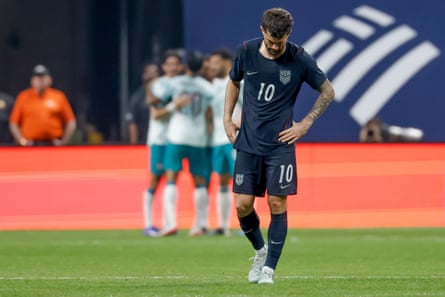
Pulisic frustrations boil over
US midfielder Christian Pulisic is usually far from the most visibly expressive player on the field, but with each of his misses on Tuesday, he grew more and more openly frustrated. Nobody could blame him.
There was his sixth minute miss, a low, poorly-struck effort off an excellent ball from Tillman. Fifteen minutes later, an even better chance came off a well-worked sequence from the US, but Pulisic failed to even make contact with a volleyed attempt from the edge of the six-yard box. His 35th-minute effort was much better but only caused him more heartburn when it skidded inches wide of the post. In the 41st minute, his frustrations over a missed call resulted in a needless tackle on Vitinha in the center circle, whic earned him a warning from the referee. By the time Pulisic was wrestled off the ball in the 45th minute, he’d seen enough. He lashed out in frustration at Portuguese midfielder Samu Costa, earning himself a yellow card. Pochettino subbed him off at halftime.
Pulisic remains a key piece for Milan but is stuck in a run of poor club form, having failed to find the back of the net this calendar year. Many had hoped this international window might have helped his form, but by all accounts it’s done nothing of the sort. It feels a bit harsh to suggest that the US midfielder, who played with the type of intensity Pochettino preached about all week long, had a terrible game. It feels more accurate to say that he looks nothing like the player US fans have grown accustomed to. Save his near miss, none of his chances were taken confidently.
Maybe the perfect summation of his night came just before halftime, when he galloped some 30 yards through midfield, electrifying US fans, many of whom likely expected him to finish his run with an attempt on goal. Instead, Pulisic held the ball too long, eventually making a poor attempt to connect with US midfielder Weston McKennie.
It’s far too early to start talking about the “Pulisic of old,” but that player, with all his confidence, feels much more likely to have found the equalizer in that sequence, or at least attempted to do so. PM
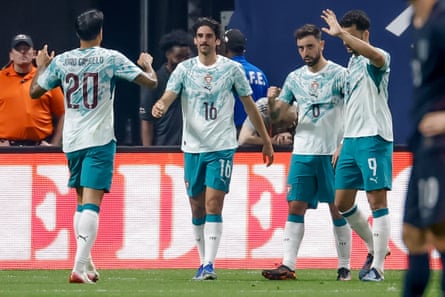
A familiar opener
One would be forgiven for feeling a bit of déjà vu when watching Portgual’s opening goal against the US – the circumstances and timing of it neatly overlapped with Belgium’s equalizer on Saturday. Like that goal, Trincão’s finish came towards the end of a first half that the US would have otherwise felt fairly proud of. And also like on Saturday, the goal came mere moments after Pulisic missed a gilt-edged chance to put the US in front.
Also like Saturday, the US allowed that opening goal to be a harbinger of things to come. The second halves of both games against Belgium and Portugal saw the US retreat into themselves, with a sloppiness in possession driven perhaps in part by the large number of second-half subs, with both teams agreeing to a maximum of 11.
The pure manner of Portugal’s opener will worry the US, though. A spell of that sloppy possession ended when Alex Freeman had the ball knocked away from him on an aimless run inside at the halfway line. Weston McKennie, in an effort to clean up the mess, played the ball backward, right into the path of Vitinha. The PSG man did not need much time at all to pick up his head and find Bruno Fernandes already running into space, ready to play a backheel to the endline that was easily finished off by Trincão.
It was a study of two sides: One clinical and ruthless, the other still finding their feet. AA
An emerging, unwelcome danger zone
Most teams direct their chance-creation toward the heart of the box, ideally away from the goalkeeper’s zone of influence and away from defense. Belgium and Portugal feasted a bit further afield, finding plenty of open terrain at the edge of the US’s eighteen-yard box – both to extend set piece windows of danger as well as during the run of play.
If you’re reading this and thinking “isn’t that where defensive midfielders are supposed to do their dastardly best?” you would be correct! No doubt, Tyler Adams was sorely missed as far and away the best midfield enforcer in the pool, if not in the history of the program altogether. That said, Pochettino brought in a few players – Tessman, Morris, and Roldan – who play defensive midfield for their clubs. This isn’t a group unaware of expectations for the role.
On Portugal’s opener, Morris was tardy to backtrack and ended up just behind the play as Trincão strode onto Bruno’s backheel. The visitors doubled the lead a bit more directly, decoying a normal inswinging corner before Bruno lobbed it to João Félix at the edge of the box. Morris was slow to pick up on the ball, Félix had a surprising amount of time to settle the lob and prepare his shot after a lofty bounce off the installed grass surface, and the US went 2-0 down inside 70 minutes.
Since his international debut in 2017, Adams has become a uniquely vital figure for the US. In a pool of players who offer versatility, his steadfast commitment to the hard yards is unparalleled in this program. Having him at 100% fitness has proven quite a trick, but it’s a mandatory component of this team being at its best. Without him, the US is finding seemingly low-danger looks as dangerous as any. JR