 3 hours ago
9
3 hours ago
9
US-Saudi strikes on Iran-backed militia in Iraq have pushed the region into “uncharted territory”, analysts have warned.
Amid stark warnings of a widening and increasingly “unpredictable” conflict, Riyadh’s decision to publicly join the US in striking sites associated with Iraq’s Popular Mobilisation Forces (PMF), killing at least 20 fighters, has added another complicating dimension to the war.
The strikes on Wednesday came after a brief lull in direct US attacks on targets in Iran, but Tehran’s allies in Yemen and beyond have become increasingly drawn in.
Iran, meanwhile, launched missiles at US military installations in Jordan in its first attack in the region since the pause in fighting with the US.
Those tit-for-tat strikes seemed to indicate the pause in fighting was at an end The US president, Donald Trump, said the US would be “be hitting [Iran] hard”, even as he claimed the strikes in Iraq were coordinated with the government, despite Baghdad’s condemnation.
Also on Wednesday, explosions hit a natural gas loading port on the Mediterranean Sea in Damietta, Egypt, reportedly involving a drone strike, the first reported strike on Egypt in the war. The source of the drone was unclear.
The British maritime security company Ambrey said a US-owned floating storage tanker there had been hit by a drone, in another potential spread of the Middle East war.
In Baghdad, the Iraqi presidency called the air raids on the PMF, also known as al-Hashd al-Shaabi – an armed alliance that includes powerful pro-Iran factions – “a blatant violation of Iraq’s sovereignty, targeting its official institutions”.
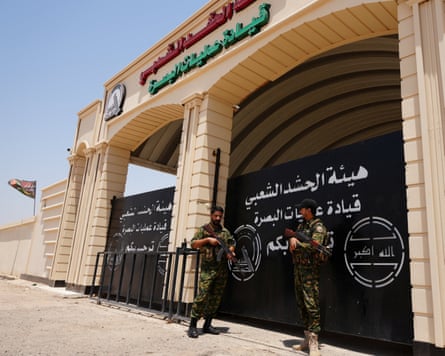
The PMF is a network of Shia-majority factions that was established in 2014 to fight the Islamic State group. Their efforts were overseen by the Iranian general, Qassem Suleimani, the former head of the al-Quds force, the foreign operations arm of Iran’s Islamic Revolutionary Guard Corps. Suleimani was killed by a US missile strike in Baghdad during Trump’s first term.
The Iraqi prime minister, Ali al-Zaidi, who recently met Trump, called off a planned meeting with Saudi Arabia’s Crown Prince Mohammed bin Salman in Jeddah on Thursday in the wake of the strikes.
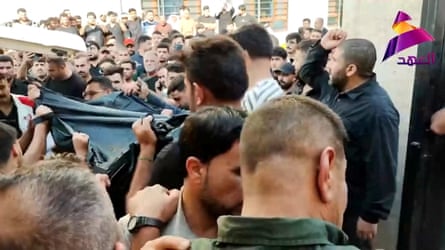
Iraq’s Harakat Hezbollah al-Nujaba, an Iran-backed militia, added that Washington’s and Riyadh’s interests and security would face consequences. Mourners shouted Shia sectarian slogans and “Death to America!” as they carried the bodies of slain fighters in body bags out of a hospital in Mosul, northern Iraq.
Iraq, heavily affected by the closure of the strait of Hormuz, through which most of its oil is exported, has struggled to prevent the war between the US and Iran spilling over its borders.
Its governments have tried to maintain a delicate balance between the US, which invaded the Shia-majority country in 2003, and Iran, which has long sought to exert influence there and has backed powerful militias that played a leading role in the fight against IS.
after newsletter promotion
While Saudi Arabia has reportedly been involved in a handful of secretive strikes on Iran as part of the war, Riyadh’s overt involvement marks a new turning point in the conflict. Yemen’s Iran-backed Houthi rebels announced a blockade of Saudi ports and cargoes at the entrance to the Red Sea barely a week ago.
The latest serious flare-up in fighting follows days in which Tehran and its proxies have targeted bases and facilities of the US and its allies, including in Saudi Arabia, despite the brief US pause.
The sense of growing chaos in the Middle East was summed up by Sanam Vakil, the director of the Middle East and north Africa programme at the Chatham House thinktank.
“Everyone is trying make sense of something that is increasingly senseless,” she said. “One view is that the informal [US] pause in direct strikes on Iran saw a shift from Tehran to its proxies to maintain pressure [on Washington]. But there is no longer any plausible deniability because everyone knows how the relationships are intertwined.”
On the Iranian side, suggested Vakil, the unpredictability of Tehran’s tactics appeared to be a deliberate strategy to pressure Trump “either into confrontation or concession” with the aim of maintaining “a stranglehold on the strait of Hormuz”.
Vakil also said countries in the region were interpreting the chaotic context of the conflict as a historic opportunity, including to weaken Iran. And on the Saudi side, she said there was a similar desire to be unpredictable. “No one wants to stay in the status quo.”
“I think from the point of view of the Saudis,” said HA Hellyer, a senior associate fellow in Middle East studies at the Royal United Services Institute, “there is a feeling that the Iranians are doing what they are doing because they feel that the Gulf Arab states won’t move up the escalatory ladder. The Saudis want to make it clear that assessment is wrong and that if Tehran thinks the Gulf states are easy prey, they are wrong.”
The problem, Hellyer said, was that while the Saudis may have rationalised the attack on the PMF as a precisely calculated act, it may be impossible to anticipate the response.
“Because we don’t know that, we are in uncharted territory not just because of the context of the war this year, but the wider issues in the region,” he said. “And it is risky because Tehran sees itself as having been targeted by the US and Israel in a war of existential survival. They see everything through a prism that they have to reset the rules of the game in the region dramatically even if they are wrong and overplaying their hand.”