 1 hour ago
6
1 hour ago
6
Former Brexit negotiator urges likely new British PM to ditch reset in relations

Lisa O’Carroll
Meanwhile, former Brexit negotiatior David Frost has said Andy Burnham, if made prime minister, should ditch much of Keir Starmer’s reset with the EU.
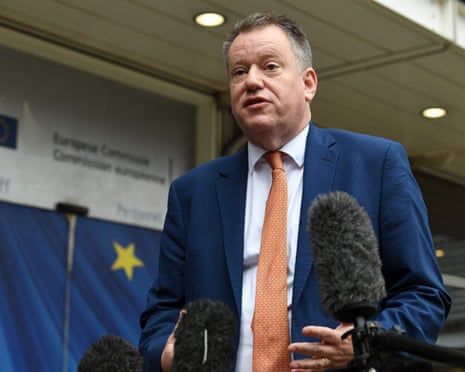
Specifically he should scrap plans including the food and drink deal designed to reduce red tape for British exporters to the EU.
Speaking at a UK in a Changing Europe conference, he said that he thought Keir Starmer and his team did not think through their “reset” properly and pursuing agreements that would force the UK to be a rule taker rather than a rule maker was a mistake.
“I don’t think proponents of the reset have thought it thought properly,” he said of the outgoing UK leadership. “They didn’t think hard enough about choices and the processes,” he said.
“I guess my advice to Andy Burnham would be if you must continue with the reset ... then don’t get into submitting to new laws,” he said adding “don’t proceed with the SPS, ETS, electricity” in a reference to the Sanitary and Phyto Sanitary or food and drink deal, the Emissions Trading System (alignment on charging for carbon emissions involved in manufacturing).
These he said “are the elements that involve EU law” adding that if Burnham “must proceed with Erasmus and other things” on the cultural side including youth mobility “try and persuade us that this is good use of our resources”.
His remarks come a day after the EU postponed a scheduled 22 July summit with the UK government to agree on SPS, ETS and youth mobility.
Talks on youth mobility were until recently deadlocked over the UK’s refusal to accede to the EU’s demand that EU citizens should be able to study in UK universities on the basis of home tuition fees.
Frost said he was “sceptical it was the right moment” to do a youth mobility agreement and “giving concessions to Europeans that we don’t give to others” such as tuition fees.
Key events
40 people drowned in France since weekend as country sees extreme temperatures, PM says
Meanwhile, we are also getting a dramatic update from France, with the country’s prime minister Sébastien Lecornu saying that forty people have drowned while swimming in unsupervised areas in France since the weekend.
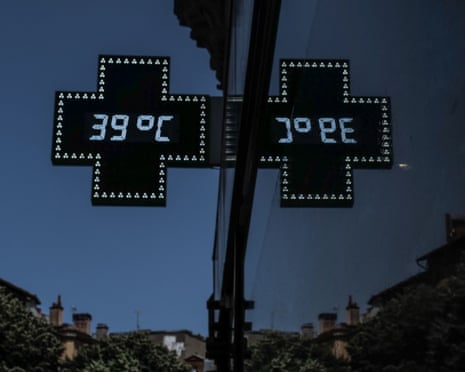
Much of France is under severe heat alert and set to experience temperatures around 40C on Tuesday, Meteo France said, with temperatures of up to 43C expected in some parts of western France.
France experienced its hottest night from Monday to Tuesday since measurements began in 1947, the national weather agency said.
More on that on our heatwave blog here:
EU should integrate Ukraine in defence union, commissioner says
In other news, EU defence commissioner Andrius Kubilius said the EU needs to integrate Ukraine in a future defence union.
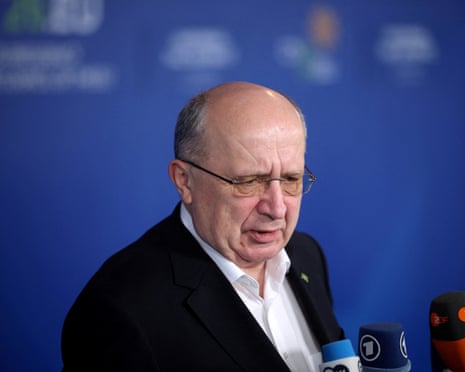
“Thanks to transformation of its war doctrine, Ukraine is prevailing” defending itself from Russia, Kubilius said in a speech in Brussels, quoted by Reuters.
“It would be difficult to understand if we in Europe would not take it as our vital interest to integrate the military force of Ukraine into our European defence architecture,” he said.
The European Commission will likely present first proposals for a further integration of the European defence market next week “with detailed analysis and follow up steps“, the commissioner said, speaking at the European Defence and Security summit.
“Later this year we will present a proposal to change defence procurement rules. And other market rules,” he added.
Former Brexit negotiator urges likely new British PM to ditch reset in relations
Lisa O’Carroll
Meanwhile, former Brexit negotiatior David Frost has said Andy Burnham, if made prime minister, should ditch much of Keir Starmer’s reset with the EU.
Specifically he should scrap plans including the food and drink deal designed to reduce red tape for British exporters to the EU.
Speaking at a UK in a Changing Europe conference, he said that he thought Keir Starmer and his team did not think through their “reset” properly and pursuing agreements that would force the UK to be a rule taker rather than a rule maker was a mistake.
“I don’t think proponents of the reset have thought it thought properly,” he said of the outgoing UK leadership. “They didn’t think hard enough about choices and the processes,” he said.
“I guess my advice to Andy Burnham would be if you must continue with the reset ... then don’t get into submitting to new laws,” he said adding “don’t proceed with the SPS, ETS, electricity” in a reference to the Sanitary and Phyto Sanitary or food and drink deal, the Emissions Trading System (alignment on charging for carbon emissions involved in manufacturing).
These he said “are the elements that involve EU law” adding that if Burnham “must proceed with Erasmus and other things” on the cultural side including youth mobility “try and persuade us that this is good use of our resources”.
His remarks come a day after the EU postponed a scheduled 22 July summit with the UK government to agree on SPS, ETS and youth mobility.
Talks on youth mobility were until recently deadlocked over the UK’s refusal to accede to the EU’s demand that EU citizens should be able to study in UK universities on the basis of home tuition fees.
Frost said he was “sceptical it was the right moment” to do a youth mobility agreement and “giving concessions to Europeans that we don’t give to others” such as tuition fees.
Three in five gen Z Britons would like new vote to rejoin EU, poll finds

Jamie Grierson
A generation of young Britons who were locked out of the 2016 EU referendum because of their age now believe that Brexit has failed, with a majority demanding a fresh vote to rejoin the EU, exclusive polling shows.

Gen Z Britons show deep dissatisfaction with the UK’s departure from the EU, according to new polling of 18- to 28-year-olds conducted by the thinktank More in Common and shared with the Guardian.
The data reveals that 60% of this cohort would vote to rejoin the bloc if given the opportunity, compared with 9% who would vote to stay out.
When filtering the results to focus solely on those likely to cast a ballot in a hypothetical second referendum, the margin becomes a landslide, with the pro-EU Remain/Rejoin camp capturing 81% of the vote against just 19% for remaining outside.
Brexit bellwether constituencies revisited 10 years on
If you want to know how people on the ground, in bellwether constituencies, feel about Brexit ten years on, we have something for you.
But let me just say: yeah, they think exactly what you think they think.
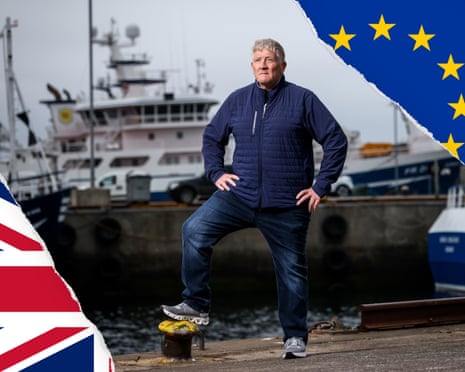
“Absolute nightmare, shambles, and still is to this day,” says Tony Rutherford, a decade after he voted leave to save the British fishing industry.
In May 2016, David Milne, the chair of the Scottish White Fish Producers Association, leaned against an EU funding sign on the quayside of Fraserburgh harbour and said he hoped Brexit would allow his industry to “manage our own destiny”, but he now feels their livelihoods were “bartered away”.
For Milne, “control” was the main appeal of Brexit.
We are bitter about it because we haven’t gained any.
Czechia's Pavel hits back at 'unprecedented' decision to exclude him from Nato summit
As expected, Czech president Petr Pavel has filed a complaint against the government’s decision to exclude him from the Czech delegation for next month’s Nato summit in Ankara.
The move comes after the Czech prime minister, Andrej Babiš, said yesterday that the decision to exclude the president was “purely practical,” as he dismissed “an unnecessary” dispute with the president (Europe Live, Monday).
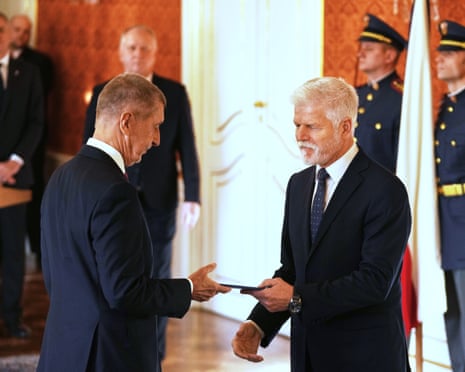
The pair is at loggerheads over Czechia’s defence policy and spending commitments, with the government currently spending less than 2% GDP on defence, way below Nato’s targets, and other political issues.
In a formal response to the government’s decision this morning, Pavel said it was an “unprecedented and extremely unfortunate step,” and a dangerous break from the past convention that historically saw Czechia represented at Nato summits by the country’s president ever since it joined in 1999.
He said that when he attended three Nato summits in the past, he always followed the government’s position, and he would do the same this year.
But “months of public bickering about who will fly where have been seen as an inability of the highest state officials to reach an agreement among themselves,” and “at a time when Nato is dealing with the greatest security threats in the alliance’s history, I consider this an irresponsible approach to our citizens and our allies.”
“This must end,” he said.
Pavel said that he repeatedly put forward compromise proposals that would see him attend the informal part of the summit – a policy discussion – while leaving the budget talks to the government. But he said he received no response or counterproposal from Babiš.
“It is my duty not only to exercise the powers of the President to the fullest extent, but also to defend them. Not for my own sake. But for the sake of all the presidents who will come after me,” he said.
The complaint has now been received by the Constitutional Court, and it will consider how to progress the case tomorrow.
Morning opening: Ten years on

Jakub Krupa
Good morning on the tenth anniversary of Brexit.
Tenth!
Time flies when you are having fun, I guess.
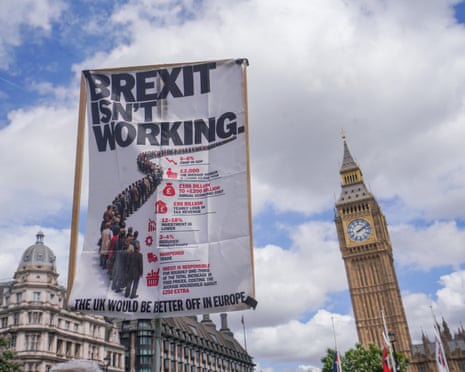
There will be plenty of commentary, but here, at the Guardian, we have gone back to the people who spoke to us 10 years ago with their first reaction after the vote.
Here are their comments. Spoiler alert: it also includes, erm, me.
I will bring you some of the best stories and analyses from our Brexit: ten years ago catalogue throughout the day.
But we also have plenty of other topics to cover in contemporary European politics.
Leaders of the Visegrad Four – the regional grouping of Czech Republic, Hungary, Poland and Slovakia – are meeting in Hungary to revive the group after years of disagreements under Viktor Orbán’s rule.
We are also expecting to hear from the Czech president Petr Pavel this morning as he is due to respond to the Czech government’s decision to block him from attending the Nato summit in Ankara next month.
And there are also continuing heatwaves across the continent, with Jamie Grierson covering the latest for the UK and parts of Europe.
Lots to cover today.
It’s Tuesday, 23 June 2026, it’s Jakub Krupa here, and this is Europe Live.
Good morning.