 5 hours ago
4
5 hours ago
4
Emily named her daughter Jessie. Any millennial woman watching Toy Story 5 over the weekend just about held it together before finally letting the sobs roll at this discovery. The film takes our yarn-haired cowgirl back to her first kid’s home, where she ends up at the tree they used to play in. An unearthed memory box is packed with photos showing Emily grown up, happy and cuddling the child she gave her beloved toy’s name to. Many thirty- and fortysomething women sat watching the scene in the cinema next to their own daughters; some were thinking of the ones they want but don’t have; and others reflected on a decision to be child-free. All of us, though, also took a teary minute for our own girlhoods.
Toy Story has always spoken to adults as deeply as it does to kids, and flock-herding feminist Bo Peep gave a lesson on living life on your own terms away from traditional expectations in the fourth film. But this reveal is the moment that truly tugs the hearts of women who grew up with the franchise.
Thirty years have passed since we first met Andy’s toys. It’s an especially poignant milestone for the girls who are now older than his mum was back then. In that time we have learned what it really means to be both a girl and a woman in this world, and the next generations are taking that same journey. Except, as the new film shows, big tech is now crushing their confidence and connections. If the lyrics to When Somebody Loved Me left a guilty sting when, a few years older, we saw Emily dumping Jessie in Toy Story 2 (“She began to drift away, I was left alone”), this next turn in the doll’s journey hits even harder, forcing us to at once face the lifetime we have spent with these films and consider the future of the young girls now watching them with us. Toy Story 5 might well be the ultimate millennial girl film.
Jessie’s return to home set off a reel of my own flashbacks; a nostalgic rush even woozier than when the food critic takes a bite of his childhood in fellow Pixar film Ratatouille. When Jessie saw the tyre-swing that she has spent years dreaming about, I yearned for one more summer spent rocking in the garden tree hammock at the home we left when I was six after my parents’ separation. Jessie found that Emily’s house had a new family of strangers in it; mine has since been renovated beyond recognition.
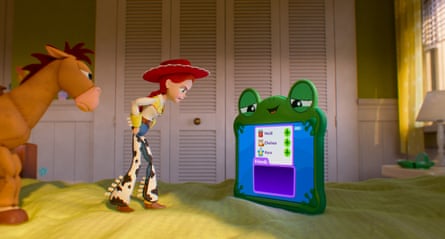
If Jessie is the woman looking back on a childhood, Bonnie is the kid currently in the thick of it. The eight-year-old pretends she doesn’t like her old toys, including Jessie, and instead gets a Lilypad digital tablet to fit in with her sneery new friends. I might not have been handed such a gadget in the 00s, but I now wonder when exactly I stopped taking my secret emotional support Bulbasaur to school in my pocket. One day I will never forget was when two sniggering teenagers called me and my mate babies for playing a clapping game in the park (“Suzie Anna plays the piano 24 hours a day, SPLIT!”). I burned red with embarrassment. We must have only been 12 or 13.
The first sleepover is another rite of passage for girls of all generations. Bonnie’s excitement and fear after an invitation is all too relatable. It triggered the memory of buying a cool, knitted crop top to wear at the sleepover of a girl at my new school; her friend told me she liked my clothes before commenting that I was shy (a brutal first experience of negging). These are where social tribes and roles are first formed. Here we are, three decades on, realising just how much that stuff sticks, and clearly still not over it. Luckily, I now have a different type of emotional support: my little knitted sloth.
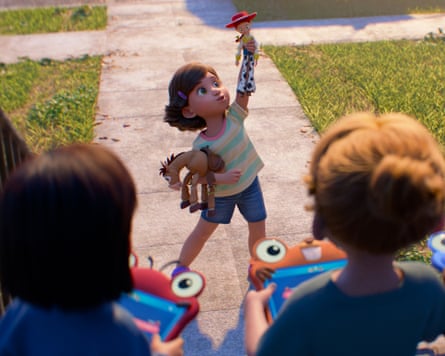
But this is Toy Story: of course the gloriousness of being a girl is celebrated, too. Like Bonnie finding a friend with her same brand of weird, or conducting a wedding for two pieces of plastic cutlery with goggle eyes, and learning to share problems to help overcome them. There’s even the happy 00s romcom ending for Jessie and Buzz: the loyal space cadet, who has long been in awe of the fearless deputy sheriff, pops the question mid-air while rescuing toys together. It’s the healthy love the girl inside all of us deserves.
We were warned that Jessie’s story would cut deep. Taylor Swift announced a song for the film – I Knew It, I Knew You– by sharing a home video of her young golden-ringleted self dressed as a cowgirl, with a caption honouring the toys who, “helped us learn lessons and think outside the backyard”. Swift is now 36 years old, with a two-decade career behind her and about to get married. Like the rest of us, the biggest pop star in the world is revelling in this nostalgia.
Pining for the past is nothing new, but millennials are particularly bad for it. This makes sense: we have known pre- and post-internet lives; we started our careers in the “girl boss” era; we are the “burnout” generation; we literally cannot afford to have the same adult lives of our parents. It’s no wonder that, in search of simpler times, adults are obsessing over rose-tinted teenage romance dramas and novels, or lapping up every 00s film reboot and sequel going. “Maybe I’m the useless one,” Jessie ponders at one point, speaking for every sad girl millennial who, ultimately, worries they let their younger selves down. This Toy Story taps into that so painfully well.
For women with daughters, seeing this cycle on screen must be a wild experience. But whether you are a mother or not, it’s hard not to worry about the futures of the girls in our lives, beyond the moments we all must pass and the maddening fact that they are forced to grow up quicker than boys. In another 30 years’ time, they too will probably look back and – between the painful, awkward parts – have a cry about how precious it all was, emotional support sloth in hand.