 1 month ago
62
1 month ago
62
Key events Show key events only Please turn on JavaScript to use this feature
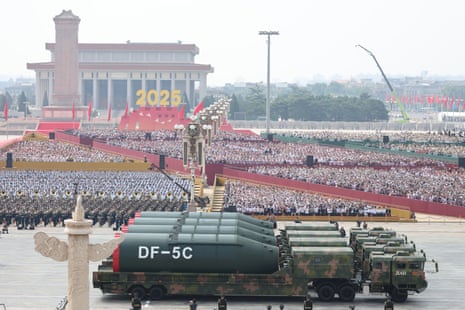
During the summit, Donald Trump also intends to raise the idea of the US, China and Russia signing a pact that would set limits on the nuclear weapons each nation keeps in its arsenal, according to a senior Trump administration official who spoke anonymously in briefing reporters ahead of the trip.
China has previously been cool to entering such a pact. Beijing’s arsenal, according to Pentagon estimates, exceeds more than 600 operational nuclear warheads and is far from parity with the US and Russia, which each are estimated to have more than 5,000 nuclear warheads.
The last nuclear arms pact between Russia and the US – known as the New Start treaty – expired in February. As it was set to expire, Trump rejected a call by Russia to extend the two-country deal for another year and called for “a new, improved and modernised” deal that includes China.
Rubio says US will urge Beijing to be more 'active' in resolving Iran war – report
Marco Rubio says American officials will try to persuade China to take a more “active role” in resolving the conflict in Iran, Fox News is reporting.
The US secretary of state told the network from aboard Air Force One while en route to China that the US had made its case to Beijing on why it should engage in efforts to settle simmering tensions with Iran.
“It’s in their interest to resolve this,” Rubio said.
We hope to convince them to play a more active role in getting Iran to walk away from what they’re doing now and trying to do now in the Persian Gulf.”
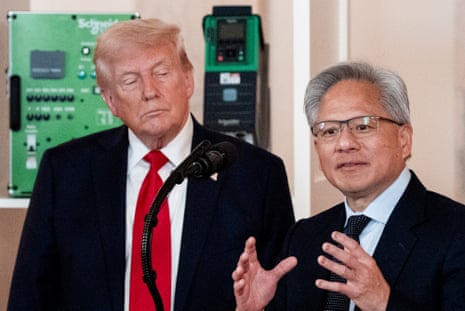
Among the big tech leaders who (eventually) flew to China with Trump on Air Force One is Jensen Huang, the president and CEO of Nvidia.
Trump was reportedly picked up Huang in Alaska en route to the Beijing summit, while the presidential plane was refuelling. Trump asked Huang at the last minute to join the trip, Reuters quoted a source as saying. Huang had not figured on an initial list of travelling executives provided by the White House.
Various media outlets had reported on Huang’s apparent omission after the plane had departed for Alaska and Beijing. Trump later posted from Air Force One saying Huang was onboard and he denied the CEO had not been invited.
The Nvidia boss is close to Trump, but in April Huang criticised the US’s limitations on chip sales to China, saying he didn’t want a “loser mentality” to cost the US its edge in AI. The sale of US semiconductors to China is believed to be a key agenda item for the summit.
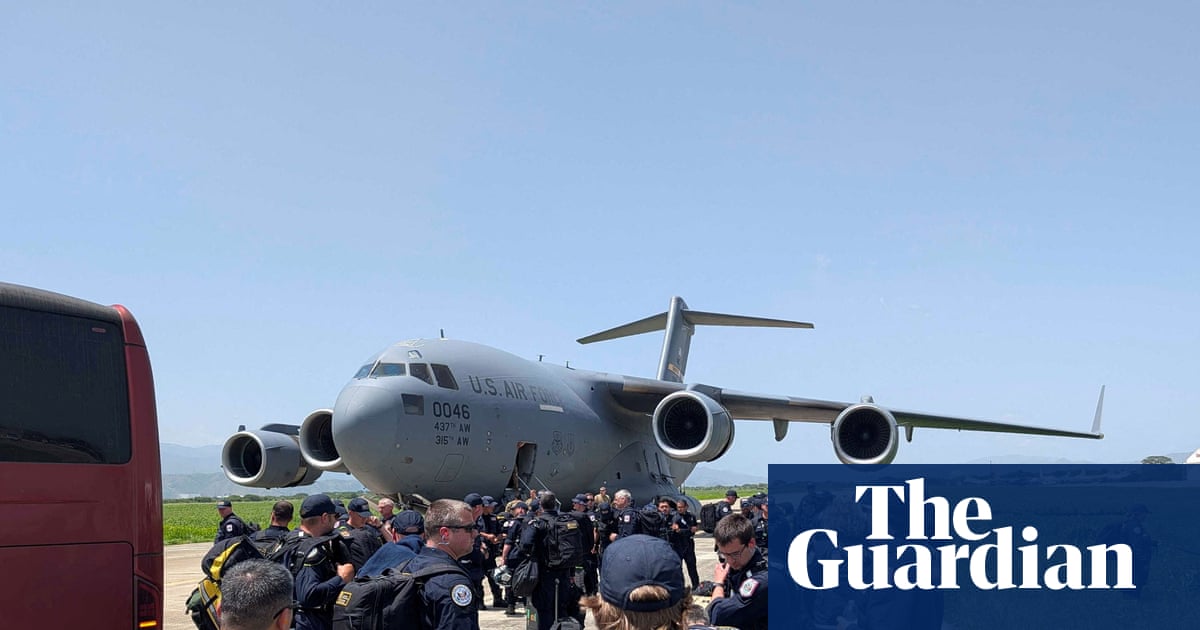
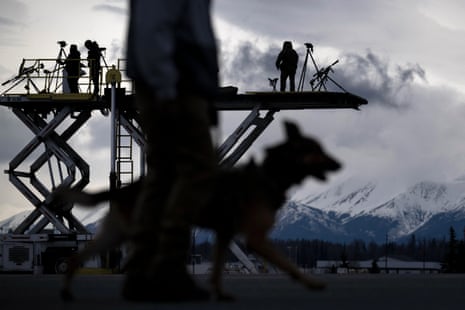
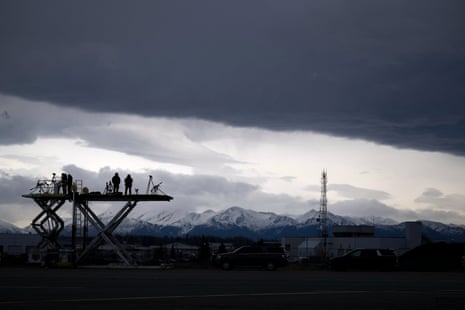
Here are some photos of US snipers and other security forces watching over Air Force One while it refuelled on Tuesday at Joint Base Elmendorf in Anchorage, Alaska.

Amy Hawkins
Donald Trump will drive through a Chinese capital that is smoggier than it was on his last visit in 2017, when the authorities launched emergency measures to clear the skies of pollution days before his first state visit to Beijing.
Factories were ordered to halt production and heavily polluting cars were banned from the roads in the days ahead of the US president’s trip nearly a decade ago, an era in which China had declared war on air pollution and made special efforts to clear the skies ahead of important political events such as visiting dignitaries and the Beijing Olympics.
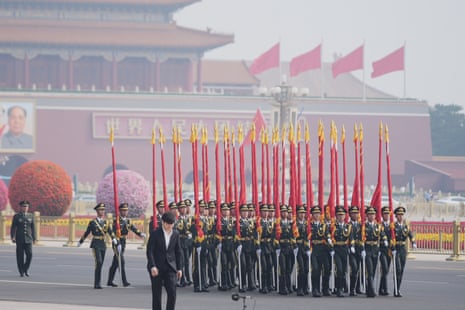
No such efforts have been made this year. The air quality index in the capital is over 150 today, well over the World Health Organization’s guidelines for healthy air, shrouding the city in a greyish smog full of pollutants that are harmful to human health.
In recent years China’s fight against air pollution has slowed. That is partly because huge improvements have already been made: last year average levels of PM2.5 in Beijing – the most harmful particulate in air pollution – dropped to below 30 for the first time since records began more than a decade ago.
But heavily polluted skies remain a fairly common occurrence. And a visit from the US president is no longer a reason to clear them.
Trump is soon to kick off the busiest part of his China trip.
He arrived in Beijing late on Wednesday but on Thursday the summit begins in earnest.
Xi Jinping will officially welcome the US president during a ceremony at the Great Hall of the People reportedly beginning at 10am local time – just under 45 minutes away – followed by bilateral talks.
Then there’s some cultural programming – a visit to the Temple of Heaven – before a state banquet capping the day.
This trip is expected to be long on pageantry and symbolism, as the Associated Press reports, but neither side has yet offered concrete details on what Trump or Xi will come away with.

David Smith
I’m now sitting in the press filing centre at the China World Hotel in Beijing. Two American flags and a wooden lectern bearing a “United States embassy Beijing” seal stand on a black podium against a black curtain beneath a giant crystal chandelier.
There are TVs on either side of the podium: one showing CNN, the other Fox News. Sadly, that is as close as many reporters will get to seeing Xi Jinping and Donald Trump in action today.
And there is no guarantee that anyone will appear at the lectern to brief the media, who are sitting on 10 rows of desks covered with blue tablecloths.
The busiest man here today is an IT consultant from the phone and internet company AT&T, who is fielding queries from hapless journalists about VPNs trying to circumvent China’s Great Firewall.
But for western media there are creature comforts nearby. The hotel connects to a luxury mall that includes Peet’s Coffee, Starbucks, Chanel, Dior, Jimmy Choo, Gucci, Hermès, Louis Vuitton, Prada, Burberry, Armani, Givenchy and Hugo Boss.
David Smith
Greetings from Beijing, where I awoke to CNN coverage of Chinese social media mocking Donald Trump and America as a fading superpower.
CNN noted that China’s tough internet censors had evidently allowed these comments to appear. But then my TV suddenly “lost signal”, which felt suspicious, though the coverage soon resumed.
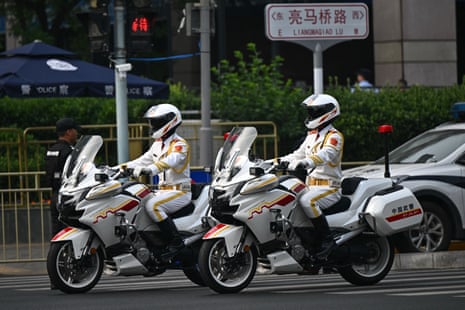
Outside a lift on the 10th floor of the press hotel I bumped into Jacqui Heinrich, senior White House correspondent of the conservative Fox News channel. She had travelled with Trump on the long Air Force One flight but noted that, unusually, he did not come to the press cabin to “gaggle” with reporters.
Perhaps he was having too much fun with Elon Musk? Or maybe White House chief of staff Susie Wiles had intervened to make sure he didn’t make flip comment about Taiwan?
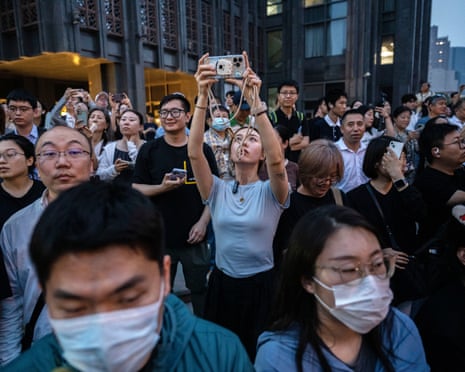
Trump's arrival in Beijing – in pictures
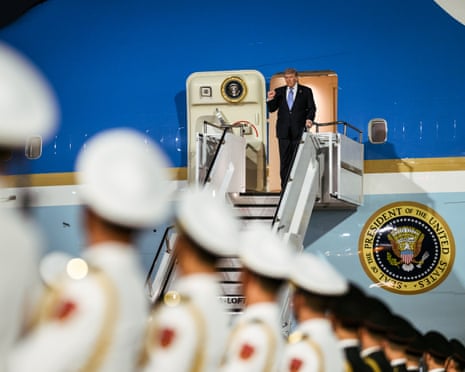
Here are some images of Donald Trump’s welcome in China after touching down aboard Air Force One at Beijing capital international airport on Wednesday night.
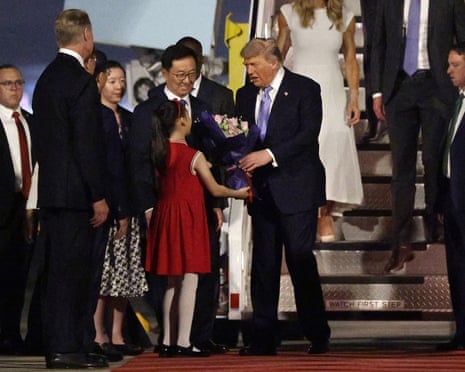
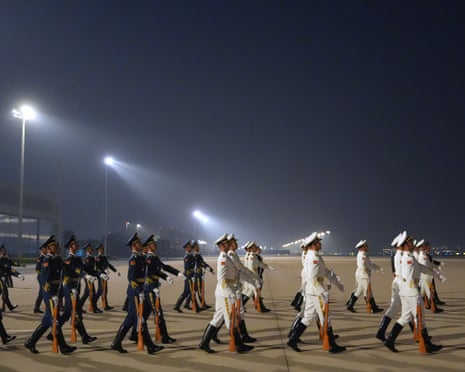
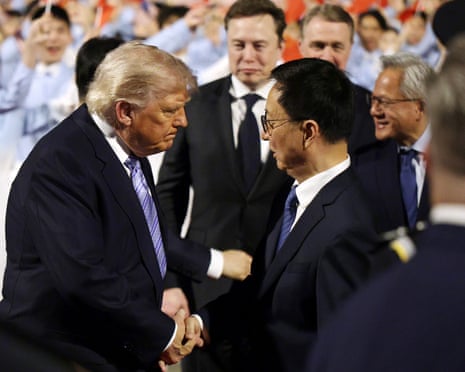
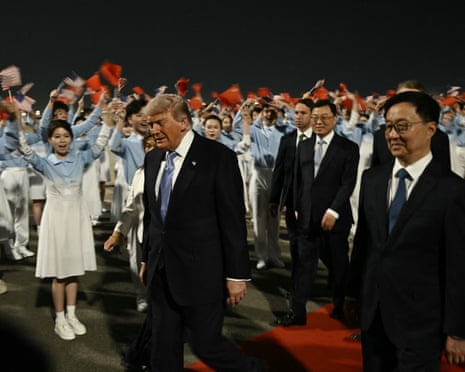
The president is also travelling with a large contingent of business leaders that reportedly includes:
-
Elon Musk, Tesla CEO and Space X CTO
-
Jensen Huang, Nvidia CEO
-
Tim Cook, Apple CEO
-
Kelly Ortberg, Boeing CEO
-
Dina Powell McCormick, Meta president and vice chairman
-
Larry Fink, Blackrock chairman and CEO
-
Other banking, finance and tech executives
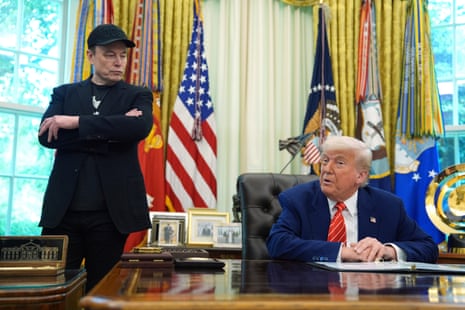
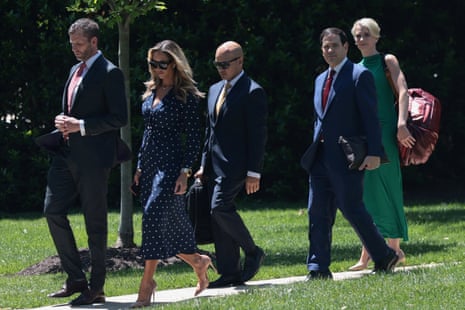
So who else travelled with Trump on Air Force One to China? According to a partial list provided by the White House: US secretary of state Marco Rubio, defence secretary Pete Hegseth and senior adviser Stephen Miller.
Also onboard were Eric and Lara Trump, plus an array of White House advisers, strategists, speech writers and communications executives.
Iran war and the other big questions hanging over Trump-Xi summit
One of Trump’s pressing concerns as he visits Beijing is how to find a way to reopen the strait of Hormuz, through which half of China’s crude oil passes.
China has been more insulated from the energy shock than other Asian countries, thanks to its diversified energy mix and large stockpiles. But the risk of a global recession – which the International Monetary Fund has warned is a possible outcome of the Iran war – is a bigger threat to China’s economy.
About a fifth of China’s GDP comes from exports. If the rest of the world is no longer able to spend money on goods, China will suffer.
There’s speculation Trump could use the summit to seek Beijing’s help to end the war with China-allied Iran. But the US president told reporters before departing the White House on Tuesday:
I don’t think we need any help with Iran. We’ll win it one way or the other – peacefully or otherwise.”
Trump also sought to play down divisions with Beijing, saying Xi had been “relatively good” during the crisis.
The Guardian’s senior China correspondent, Amy Hawkins, has examined the biggest questions hanging over the Trump-Xi talks, which begin later today.
The Trump-Xi summit will span two days. It was originally scheduled for late March or early April but was delayed due to the Iran war.
Now that Trump is in China, here are some of the hazards the US president faces.
Welcome
Donald Trump’s state visit to China this week is the first by a US president in nearly a decade and comes amid a time of geopolitical upheaval, a Middle East war with no end in sight and a sometimes rocky relationship between the world’s two major superpowers.
Aside from discussions about Iran, Trump and Chinese leader Xi Jinping are expected to discuss trade and tariffs, Taiwan and AI.
Stay with us as we cover this high-stakes visit. It’s approaching 8.10am in Beijing.