 2 months ago
59
2 months ago
59
How fast do you have to strike a match to get it to light? Not the chemistry of the ignition, but the actual speed, in metres per second, that the little piece of wood and its bulbous head have to move to spark the chain reaction behind the flame.
It was a question born of insomnia. And there, in the dark, I did the thing you’re not supposed to do, if your goal is to fall back asleep: I opened my phone. Before I knew it, 3am had become 5am. I learned about the composition of the friction strip (red phosphorus, pulverized glass), and of the match head (potassium chlorate, antimony trisulphide, wax), and that a safety match struck against anything else will not light. I found slow-motion videos of a match strike captured at 3,500 frames per second. But nothing about the speed.
Still searching for an answer, I sent off my query to the tobacco multinational Swedish Match, and then I emailed two professors: one a chemist in Tasmania, the other a professor of thermodynamics at Imperial College London. At 5.30, I managed to fall back asleep, slightly frustrated and wondering if Claude would have provided the answer I wanted in seconds.
For the better part of two decades, Silicon Valley has been selling us seamlessness in place of friction, and we’ve become enthusiastic buyers. A few months ago, I felt a slight pulse of revulsion at a LinkedIn post whose author described how much she preferred Amazon’s recommendation algorithm to bookstores. The algorithm, she wrote, knew her and so it was efficient: with the implication that getting lost in a labyrinth of authors and covers one might or might not connect with was a waste of time – was friction.
Imagine being offered the Louvre, I thought when I read the post, without the desire to linger.
Life happens in the slowed down space of possibility that friction creates. AI, on the other hand, is a luge of endless acceleration that turns reflection, which requires time, into certain defeat. “If we impose human oversight for each split second decision, it won’t work,” the head of France’s department for integrating AI into defence told Libération. “We’ll have already lost.” Putting AI at the edge of life and death like this is the kind of thing liable to make you fidget in the night.
I used to joke that some day my own children would consider me an old reactionary about “robot rights”. He’s such a humanist, they might whisper, which by then will have become a contested word, if not an outright slur. I never imagined, in the blissful pre-large language model era of the late 2010s, that my timeframe might be off. That a confrontation between those who see an early form of consciousness in the functioning of pattern-matching “neural networks” and those who see the conjuring of a maddeningly recondite, Daedalian kind of trick, might occur before I ever left my 30s. And yet, and yet.
Some of Silicon Valley’s biggest financiers, such as Marc Andreessen, boast of their own lack of introspection, seeing it as a waste of time. This is the spirit of AI, fuelling the unexamined life, and I can’t help seeing an epochal spiritual crisis emerging from the wreckage. A social emptiness, a desiccation left in place of what the Brazilian writer Clarice Lispector alludes to when she writes about “the force of body in the waters of the world”, and how it “captures that other thing that I’m really saying because I myself cannot”.
The search for frictionlessness impoverishes this ineffable “other thing”, which I might approximate as the space between what we say and what we know and knowing itself. AI collapses this space, and in that flatness there is no there there. Pattern-matching algorithms produce mimicry, not meaning; inside the black box of their output is the simulacrum of what it means to inhabit experience, but nothing approaching consciousness. They produce images but not art, text but not literature, and sound but not a symphony – not something that could cause human skin to tingle with the realisation that this is the closest approximation possible to how the composer felt. Because a pattern-matching algorithm is not a body in the world, and it cannot know laughter, or silence, or grief, or love, and cannot sin, cannot forgive, cannot sacrifice.
What possesses us to try to pull a being out of a linguistic Droste effect, seemingly infinite, but in the end a recursion of itself? Maybe we are seduced by the idea that a technological mirror might show us ourselves – if only we can feed it enough data, enough of our collective historical soul. Except, we won’t find God by projecting her into the machine.
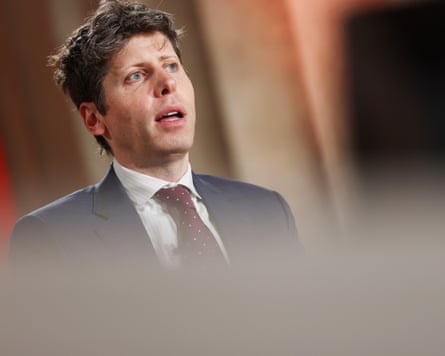
In response to Sam Altman’s comparison between the energy needed to train an AI model and the two decades of food consumption it takes a human being to “get smart”, Sasha Luccioni, AI and climate lead for HuggingFace, posted that such a line of thinking represented the “Black Mirror stage” of capitalism. I would go further and describe it as capitalism’s final stage: a world of all capital, and no labour. At least, not human labour, which exists in biological time and eats, sleeps, socialises, and does any manner of things that capitalism cannot value monetarily, and which make life on Earth life on Earth. Does it really surprise us, this transition from the planned obsolescence of goods to the planned obsolescence of people?
It turns out that most people outside Silicon Valley don’t actually want this, and are more concerned than excited about surging AI use. If anything gives me a sliver of optimism, it’s the backlash, which I think will begin as a backlash against AI use being treated as a “key performance indicator” for western economies, and end in a resurgence of humanism.
In this, AI eats itself. By some measures, AI output now constitutes more than half of the internet. The algorithm is an ouroboros, incessantly retraining on itself: its output slick, seamless and unmistakably airy. Eventually, even those who see in it wisps of the divine – or perhaps more perturbingly, a soul – will come to see just wisps.
In the week after my insomnia, all three of my queries produced replies. Swedish Match told me that they just didn’t know. Nathan Kilah, chemistry professor at the University of Tasmania, wrote back that I would need to talk to a physicist, but that friction force was equal to the coefficient of friction multiplied by force in Newtons, and that depending on pressure, the speed could vary. Erich Muller, professor of thermodynamics at Imperial, advised me to rethink the question in terms of minimum ignition energy required (0.2 millijoules to ignite the red phosphorus on the friction strip), and that using that, we might take the mass of a match and guess a velocity of the strike. And Claude? I never checked. That was never really the point.
-
Alexander Hurst writes for Guardian Europe from Paris. His memoir Generation Desperation is out now