2 months ago
94
2 months ago
94
It was an unusual scene. A lion cub alone for days in southern California’s sprawling Santa Monica mountains, emitting a noise that sounded like a cross between a purr and a light squeal, perhaps calling out for his mother.
Where was his mother?
The National Park Service’s biologists, who monitor the recreation area’s small mountain lion population, visited the cub’s location on several occasions.
They surmised that his mother had likely moved to another den, abandoning the cub in the process.
The lion kitten’s health was taking a turn for the worse. He appeared weaker and was losing weight.
In consultation with the California department of fish and wildlife, the biologists swooped in to rescue the kitten, which would land in the care of the Oakland Zoo.
The 3-week-cub, later named “Crimson”, arrived in late March to the Oakland Zoo, emaciated and unable to stand, according to the zoo’s chief executive officer Nik Dehejia. He was “extremely tiny”, Dehejia said. The newborn cub could fit into cupped hands.
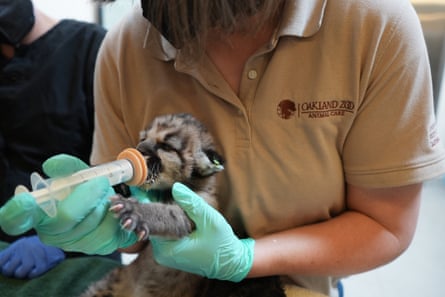
It’s rare for mountain lions to abandon their offspring. It’s unclear why exactly Crimson’s mother left him.
“Often times we’ll never know,” Dehejia said, although one hypothesis emerged that the cub’s abnormality – missing toes – could have signaled to his mother that he would not be able to survive as well. “It’s hard to know how many cubs were potentially there, how many cubs the mother was taking care of.”
Now at the Oakland Zoo, Crimson is in an intensive care unit at the zoo’s veterinary hospital, Dehejia said. He has received bottle feedings every 3 hours to pump nutrients back into his body.
He is the 33rd mountain lion that the Oakland Zoo has rescued. Another young mountain lion, a three-month-old named Clover, is currently at the zoo as well.
“We never want to pull a mountain lion from the wild,” Dehejia said.
While the zoo is proud to be rehabilitating Crimson, they want cubs to be with their families, he said. “These cubs need their mother actively for nursing and socialization.”
Crimson was abandoned by his mother. But, other factors including habitat fragmentation, urban development and human-wildlife conflict have contributed to the zoo receiving distressed animals, Dehejia said.
“More often than not we are in their habitat versus they being in ours. This is a broader scale issue over how we build, how we live, how we co-exist with wildlife around us.”
For now, the zoo is focused on helping Crimson grow strong and weaning him off bottle feedings, Dehejia said.
Crimson and Clover being close in age could make them well-suited companions, although it’ll be weeks before the zoo gradually introduces the two.