 1 month ago
57
1 month ago
57
Russia's Victory Day parade notably scaled-back amid Ukraine security fears

Pjotr Sauer
Pjotr Sauer is the Guardian’s Russian affairs reporter
Vladimir Putin presided over a notably scaled-back Victory Day parade on Red Square on Saturday, with the ceremony lasting just 45 minutes - roughly half the length of previous years - as security fears and the realities of a grinding war in Ukraine cast a shadow over Russia’s most important secular holiday.
The Russian president struck a defiant tone, invoking the sacrifices of the second world war to rally support for his troops in Ukraine.
“Victory has always been and will always be ours,” he told the crowd, using the celebration to draw his now-familiar – and historically false – parallel between the Soviet defeat of Nazi Germany and his invasion of Ukraine.
But the reality on the ground told a different story. The customary display of missiles and armoured vehicles was absent entirely, replaced by a video showcasing Russia’s drone capabilities and nuclear arsenal.
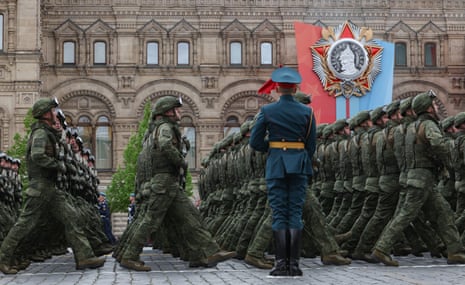
The audience included only a small delegation of foreign leaders from Belarus, Kazakhstan, Uzbekistan, Laos and Malaysia. They watched a column of North Korean soldiers march across the square, troops from one of Russia’s closest allies who have fought alongside Russian forces in Ukraine
Moscow was blanketed in heavy security, with internet services switched off across the city.
Russian authorities openly acknowledged the measures were designed specifically to protect Putin, an admission that underscored how dramatically the calculus of a war Russia once expected to win in weeks has shifted.
It was not until the final hours that it became clear Ukraine would not disrupt the parade, after Donald Trump announced a three-day ceasefire and prisoner exchange on Friday.
With no victory in sight and no timeline for an end to the war, the mood inside Russia is souring. Mass internet blackouts, the contracting economy and rising inflation have all fuelled public anger, yet Putin shows no signs of compromising on Ukraine.
Key events Show key events only Please turn on JavaScript to use this feature
Saturday is also Europe Day, which commemorates the anniversary of the Schuman Declaration that ultimately laid the groundwork for the European Union as it exists today.
On X, Volodymyr Zelenskyy wrote that Ukraine – which is seeking EU membership – is celebrating Europe Day “not formally or through sloganeering, but fully aware that we are already an inseparable part of the European family”.
“We are defending Ukraine, our independence, our future – and in doing so, we in Ukraine are defending our Europe. A Europe of which Ukraine has been and will remain a part,” Zelenskyy wrote.
He continued: “From the first days of the full-scale war until today, Europe has stood with Ukraine. And this is not charity – it is a choice made by Europeans: to stand on the same side as the brave and the strong – the Ukrainians who are fighting today for peace and true protection against tyranny, not only for themselves, but for the entire continent. And we will inevitably defend our state, our people, and our right to freely choose our future – a future in Europe.
Russia's Victory Day parade notably scaled-back amid Ukraine security fears
Pjotr Sauer
Pjotr Sauer is the Guardian’s Russian affairs reporter
Vladimir Putin presided over a notably scaled-back Victory Day parade on Red Square on Saturday, with the ceremony lasting just 45 minutes - roughly half the length of previous years - as security fears and the realities of a grinding war in Ukraine cast a shadow over Russia’s most important secular holiday.
The Russian president struck a defiant tone, invoking the sacrifices of the second world war to rally support for his troops in Ukraine.
“Victory has always been and will always be ours,” he told the crowd, using the celebration to draw his now-familiar – and historically false – parallel between the Soviet defeat of Nazi Germany and his invasion of Ukraine.
But the reality on the ground told a different story. The customary display of missiles and armoured vehicles was absent entirely, replaced by a video showcasing Russia’s drone capabilities and nuclear arsenal.
The audience included only a small delegation of foreign leaders from Belarus, Kazakhstan, Uzbekistan, Laos and Malaysia. They watched a column of North Korean soldiers march across the square, troops from one of Russia’s closest allies who have fought alongside Russian forces in Ukraine
Moscow was blanketed in heavy security, with internet services switched off across the city.
Russian authorities openly acknowledged the measures were designed specifically to protect Putin, an admission that underscored how dramatically the calculus of a war Russia once expected to win in weeks has shifted.
It was not until the final hours that it became clear Ukraine would not disrupt the parade, after Donald Trump announced a three-day ceasefire and prisoner exchange on Friday.
With no victory in sight and no timeline for an end to the war, the mood inside Russia is souring. Mass internet blackouts, the contracting economy and rising inflation have all fuelled public anger, yet Putin shows no signs of compromising on Ukraine.
What to expect from the swearing in of Péter Magyar as Hungary's new leader

Ashifa Kassam
Inside Hungary’s dazzling neo-Gothic parliament, the scenes will be solemn on Saturday as the new leader, Péter Magyar, is sworn in. Outside is where the party is expected to unfold, as people pour in from across the country to mark a pivotal moment: the formal end of Viktor Orbán’s 16 years in power.
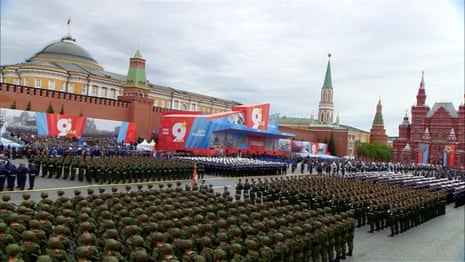
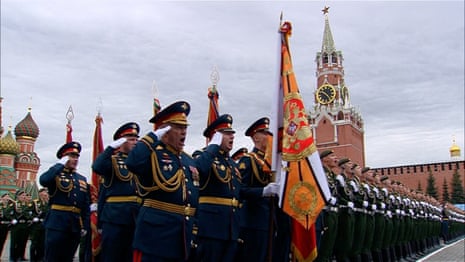
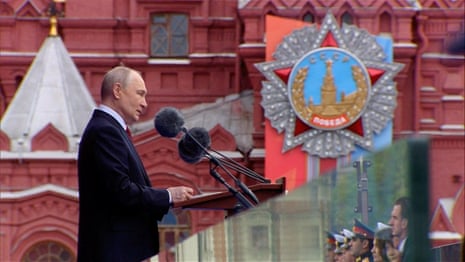
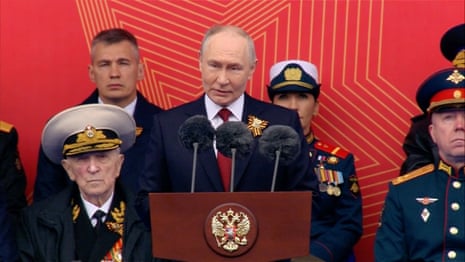
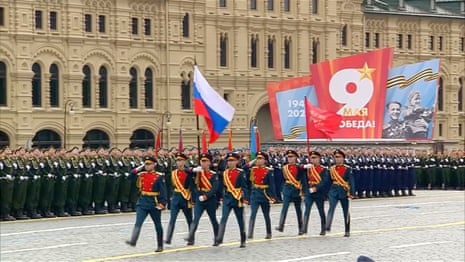
Russia's annual Victory Parade begins in Red Square
Russia’s annual military parade celebrating the allies’ victory over Nazi Germany in the second world war has begun in Red Square.
For the first time in nearly 20 years, the event – typically a bombastic show of military strength – will take place without a display of tanks and ballistic missiles over fears of a long-range attack by Ukrainian drones.
Here are some images of the parade coming in over the wires:
Morning opening: Three-day ceasefire in the war between Russia and Ukraine begins
Hello and welcome to our live coverage of Europe.
A three-day ceasefire between Russia and Ukraine kicks off today that will include “a suspension of all “kinetic activity” and a swap of 1,000 prisoners from each country. Though it was first announced by Donald Trump on social media, it has since been confirmed by both sides.
Russia had previously announced a ceasefire to mark its 9 May second world war Victory Day, which Ukraine had previously lambasted after Moscow intensified attacks with a series of devastating bombings of busy urban areas this week, in spite of a unilateral 24-hour ceasefire called by Volodymyr Zelenskyy in exchange for the Victory Day ceasefire.
Zelenskyy wrote on X on Friday:
In recent days, there have been many appeals and signals regarding the setup for tomorrow in Moscow in connection with our Ukrainian long-range sanctions. The principle of symmetry in our actions is well known and has been clearly communicated to the Russian side.
An additional argument for Ukraine in determining our position has always been the resolution of one of the key humanitarian issues of this war – namely, the release of prisoners of war. Red Square is less important to us than the lives of Ukrainian prisoners who can be brought home.
Elsewhere, Péter Magyar is set to be inaugurated in Hungary. Plus, the Guardian’s Pjotr Sauer will be bringing us scenes from the Russian victory parade.
Stay tuned for more.