2 months ago
86
2 months ago
86
On the second floor of the Reina Sofía, in the very spot where Picasso’s Guernica was first exhibited when it arrived in the Madrid museum 34 years ago, there now hangs a smaller, near-namesake of the Spanish artist’s most famous work.
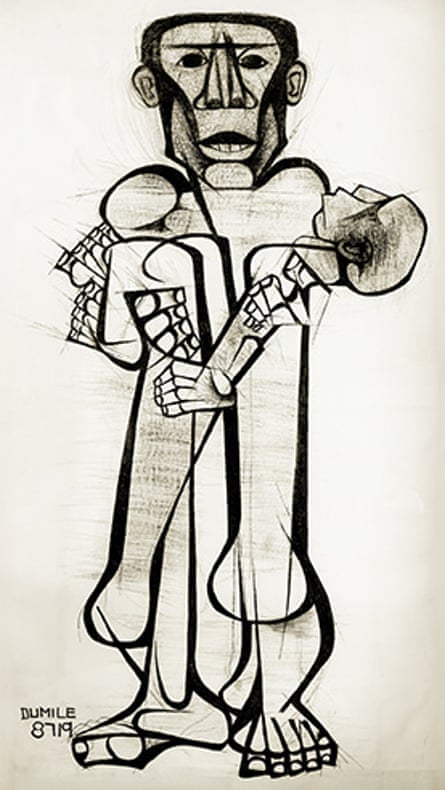
While African Guernica, which was drawn by the late South African artist Dumile Feni in 1967, may lack the scale of Picasso’s masterpiece, its depth, anger and unnerving juxtaposition of man and beast, light and dark, and innocence and cruelty, are every bit as disturbing.
Across its now-yellowing paper, a three-legged man with a grotesque mask for a face wields a stick, a cow with an engorged udder suckles a baby, and birds peck at scraps as shadowy figures loom in the background.
While the Spanish painter’s fury sprang from the Nazi bombing of the Basque market town from which his painting takes its name, Feni’s rage, rendered in charcoal and pencil, was the product of living under apartheid in South Africa.
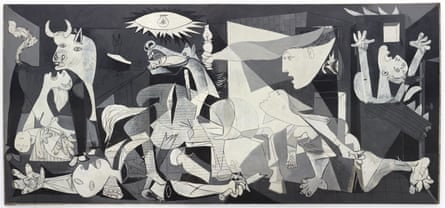
The drawing is the centrepiece of the first in a new series of annual exhibitions at the museum called History Doesn’t Repeat Itself, But It Does Rhyme. The aim, according to the Reina Sofía’s director, Manuel Segade, is to “take works from different cultural and geographical frameworks and put them alongside Guernica” – hence African Guernica’s pride of place on the wall exactly opposite Picasso’s canvas. As well as allowing for re-readings of the museum’s famous work, Segade said, the initiative would also attempt to correct old biases.
“Just as western art has relegated women to one side when it comes to the history of art, so has the history of art been constructed according to racist parameters that have condemned African art to handicrafts or to savagery,” he said.
African Guernica, which has never before been exhibited outside South Africa and which is on loan from the University of Fort Hare, offers a compelling departure point.
Feni, who died in New York in 1991 after spending almost a quarter of a century in exile, had no formal artistic training but was a compulsive drawer from childhood who was fascinated by indigenous African art, from rock painting to mask-making.
When he moved to Johannesburg at the end of his teens, he discovered a vibrant, urban cultural scene that thrived despite the brutal and racist apartheid regime. Once there, he would have been exposed to the works of European artists such as Goya and Bosch – and to those of Picasso, who was profoundly influenced by African art.
“It’s important to remember that Picasso’s Guernica itself could not have existed without African sculpture,” said Tamar Garb, a professor of art at University College London, who is the curator of the exhibition.
“Picasso’s invention of stylisation and simplification and the formalisation of work in the early 20th century via cubism was very, very much a product of, let’s say, looking at, and valuing, African sculptural practices, which he collected and came to know.”
Although there could be an odd circularity to an African artist using European modernism to reinforce or recalibrate his relationship to African art, Garb said the exhibition was concerned with dialogue rather than influence.
“We don’t even know if it was [Feni] who gave it the name African Guernica,” she said. “That name was likely given to the work by a gallerist or an early commentator. [But] the fact is that he was happy to use the name and to exhibit it with that name, so he embraced that.”
Even so, said the curator, it would be a mistake to view the two Guernicas as sharing a common theme. Picasso’s Guernica, said Garb, was an “anti-war cri de coeur”, while Feni’s Guernica is a reaction to a different kind of violence: “It’s the violence, the slow violence, and the actual violence of racist tyranny. So you could see it as a product of a very violent society that dehumanises the majority of its population, but it’s not an equivalent to the kind of bombardment of war. And I think that that difference is also important to stress.”
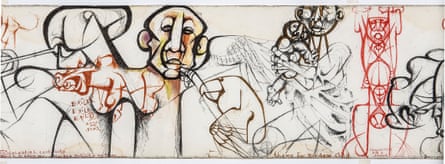
Five other works by Feni are also on show, including the 53-metre-long scroll titled, You Wouldn’t Know God if He Spat in Your Eye, which he worked on during his years in London. Opposite it is his huge 1987 charcoal drawing Hector Pieterson, a stylised and haunting rendering of a famous photograph of a 13-year-old boy lying cradled in the arms of a man after being shot dead by South Africa’s apartheid-era police.
Despite the traditional cosmologies of African Guernica, the inevitable comparisons to Picasso – and the fact that Feni was known in 1960s Johannesburg as “the Goya of the townships” – Garb argues that the artist occupies a unique place in 20th-century art.
“This is a modern artist using drawing materials – charcoal, pencil and conté crayon – at a scale almost unheard of globally at that time,” she said. “If you look at drawing practices globally in the 1960s, there are very, very few artists – I can think of hardly anyone – who works at the epic and monumental scale.”