 1 month ago
52
1 month ago
52
When Linda Perry agreed to let the director Don Hardy film her at work in her studio, she had no idea what she was getting into. Perry – the singer, producer and wildly successful songwriter-for-hire – had been friends with Hardy since she scored his 2020 film, Citizen Penn, about the actor Sean Penn’s charity work in Haiti. If nothing else, Perry hoped she might use some of Hardy’s footage as content on her Instagram account: “So he just started showing up and I soon forgot he was there.”
After a few weeks, Hardy told Perry he had edited 30 minutes of footage and shown it to colleagues. “He said: ‘We think there’s an incredible documentary to be made here,’” she recalls. “And so I said: ‘OK, go ahead but don’t talk to me about it. I don’t want to know anything. Just do what you’re going to do and if I said it or did it, I’ll stand by it.’ And then things just started to go cuckoo for me.”
In late 2022, Perry was diagnosed with breast cancer and had a double mastectomy early the following year. Hardy’s film, called Linda Perry: Let It Die Here, shows her just over a week post-op, walking gingerly into her studio while carrying two surgical drains – she calls them “blood grenades” – so she can get to work on a film score. Then, as Perry was recovering from her surgery, her elderly mother, who physically and mentally abused her as a child, became ill and died three months later.
Perry still lives with the toll of her mother’s abuse. “She caused me a lot of hurt, a lot of damage,” she reflects now. She nonetheless took her into her home for her final months, setting up a bed next to her. Perry notes that she and her siblings had always “dreaded the day Mom was going to come to her end, because she was going to make it absolute fucking hell for us all. This is terrible to say, but it’s beautiful as well: the best gift my mom gave me was a peaceful death.”
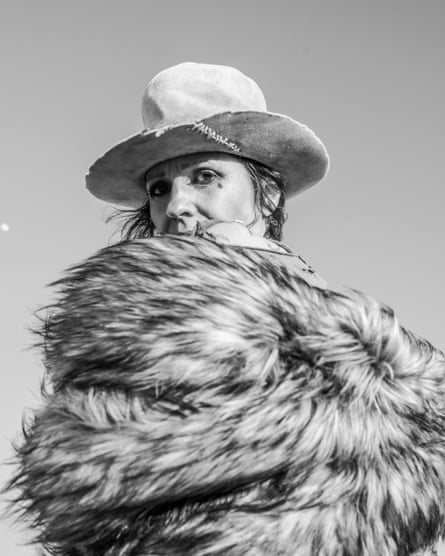
Perry, who shot to fame in the early 1990s as singer of the queer band 4 Non Blondes, and later penned hits for Christina Aguilera, Pink, Courtney Love and Gwen Stefani, is talking over video call from her home in Los Angeles. In her trademark bandana and vintage hat, a tattooed teardrop under her left eye, Perry has a tough-nut aesthetic and a fierce charisma that would be intimidating were it not for her openness and candour. As a child, she says, she was raised to hide her emotions: “I learned from my mom that to show feelings was weak. But I actually turned out the opposite. I’m all feelings. I show them and I wear them proudly, even if they get me in trouble.”
If there was a sense, after Perry’s early brush with success, that she was more comfortable operating in the shadows and using her talent for the benefit of others, now she is throwing caution to the wind and stepping back into the limelight. Last spring, she re-formed 4 Non Blondes for a performance at the BottleRock festival in Napa Valley, California. “I had one caveat,” she says on the reunion. “I said I didn’t want to play the songs on [their only album] Bigger, Better, Faster, More! except for Train and [their biggest hit] What’s Up because I don’t relate to those other songs any more. I told the band: ‘I want to play something new.’ So I wrote an album’s worth of material based on what I want to hear when I go to a festival.” That new album is due out early next year.
Perry has also just released a third solo LP, her first in 27 years. Let It Die Here is a visceral, propulsive and unflinching work about her mother’s death and the complex feelings it unearthed. Songs include I Am Daughter, Now That She’s Gone, Liberation and What Lies With You, in which she calls her mother “the villain and the muse”. Then there’s the documentary, out on limited theatrical release in June. As well as showing Perry’s songwriting prowess in action as she jams with Dolly Parton and Kate Hudson, it sees her hosting an event at South By Southwest festival for EqualizeHer, an organisation she co-founded to promote gender equality in the music industry. Early in her career, Perry was famously denied a producer credit on What’s Up, the track that sent 4 Non Blondes stratospheric. She let it go at the time but vowed it would never happen again.
But Let It Die Here is no rock’n’roll hagiography. It has the intimacy of a video diary as Perry lets cameras in on her most private moments, battling with what seems to be an artistic identity crisis – more than once, she asks who she is and what her purpose is when not creating for others – or dealing with her own and her mother’s illness.
Though we never meet Perry’s mother, she looms over the proceedings as the source of her daughter’s pain. When Perry was 16 and living in San Diego, she attempted suicide by overdosing on her mother’s prescription medication; she only survived because her mother’s doctor had reduced the dose without her knowledge so she could wean herself off them.. Another near-death moment occurred when Perry took acid and crystal meth and fell off a building, miraculously living to tell the tale. Eventually, Perry’s older brother John intervened and took his sister to live with him. “I think that’s all I needed,” Perry says. “[I needed] somebody to see me because I didn’t think I existed.”
There is a scene in Hardy’s documentary where Perry is captured dancing goofily in her closet to Supertramp’s Take the Long Way Home. As she twirls, Perry reflects how she hasn’t danced since she was a child, a time when I “didn’t care if I died … I just wanted out all the time”, at which point she starts to cry in deep, gulping sobs.
“I don’t know what happened,” she says now. “It triggered something in me because there was a time I listened to Supertramp all the time and they used to make me smile … That was me having a real-life meltdown. I don’t even really remember it now, it’s almost like I blacked out. When I watched the film later – honestly, I could cry right now about it – I was, like: ‘Holy shit, what the fuck?’”
Perry pauses to collect herself. She says that when she watched the documentary’s final cut with Hardy, it was through her fingers. “It was like watching a horror movie. But I think maybe the film helped me process and see something I didn’t know I was doing. Like, I am pretty hard on myself. The film was therapeutic for me, but it’s fucking embarrassing and raw and I can’t believe I’m going to let this go out into the world.”
Through her solo work and the re-formed 4 Non Blondes, Perry may be putting herself centre-stage once more, but she hasn’t given up working with other artists: her latest collaborators include Paris Jackson, Mike Campbell, formerly of Tom Petty’s Heartbreakers, and a “phenomenal pop girl” called SophiaTreadway.
Perry fully admits she is a workaholic: as well as writing and producing for others, working on her own projects and campaigning for gender equity in music, she runs arecord label and manages artists. She recently took a month off for the first time in years and went to the California valley town of Ojai, where she slept, ate, hiked and slept some more. “I found it really entertaining in a weird way, because I realised I’m really awkward when I’m not doing something. I don’t know if I want all that time to myself. Like most people who are in trauma, I am afraid to be left alone because I don’t want to go back there. Creating and working and music is my therapy and that’s where I feel safe.”
There is another incredibly moving scene in Let It Die Here about which Perry is anxious yet proud. While on a photoshoot on a windy day in the southern California desert, she found herself getting “upset by the wind because it was taking too much from me”, and so, with the camera rolling, she ripped open her shirt to reveal her surgical scars. It was, she says, “ad-lib, a kind of a ‘fuck-it’ moment. It was something that I didn’t know I would reveal, but it felt powerful after I did it.”
After that, we see her heading off into the distance “so I got my moment just to walk off into the unknown. Everything I’ve just experienced is going to change my life drastically. Life and death happened just now, so let’s see what happens from here.”
The album Let It Die Here is out now. The documentary Let It Die Here will be screening at Olympic Studios, London, 21 June. 4 Non Blondes play Shepherd’s Bush Empire, London, on 24 June.
In the UK, the national domestic abuse helpline is on 0808 2000 247, or visit Women’s Aid. In the US, the domestic violence hotline is 1-800-799-SAFE (7233). In Australia, the national family violence counselling service is on 1800 737 732. Other international helplines may be found via befrienders.org