 3 hours ago
4
3 hours ago
4
On a snowy Norwegian morning in January, Jakob Ingebrigtsen was on his treadmill, shooting the breeze about his running philosophy before our more formal interview. I should write something on this, I told him. Sure, came the reply.
In recent weeks, the 26‑year‑old has added to his legacy with a European 5,000m gold, the World Ultimate 5,000m title and a world road silver medal despite achilles surgery in February and a flu that lingered through May and June. So now seems as good a time as any.
Some of Ingebrigtsen’s opinions were a little hardcore. Others reiterated basic truths. But whether you are a runner or not, there are certainly some life lessons from one of the most beguiling athletes around.
1) To be the best it helps to be a control freak
Ingebrigtsen runs a lot, around 175-180km in a typical week. Apart from his family, that is his sole focus. “I prioritise the absolute crucial,” he says. “That is to wake up, to eat, to train.” It is, he concedes, not a life most would enjoy. “A lot of people could never be in my shoes, having my responsibility. They just wouldn’t handle it. But that’s how I want to be. If there’s anything that’s out of my control, then I’ve not done my job properly.”
2) No days off
“If you have a day off, you lose 20-25km of running,” he says. Counterintuitively, perhaps, he believes the risk of injury goes up too and tries to run even when he is moderately poorly.
“Having one week off if you are sick, injured or travelling, or even just doing easier training, that’s probably the worst thing you can do in terms of risk of injury. Because you are taking your body out of a consistent load. When you get back again, you will have sore legs because your body is not adapted to that load and when you compensate, or just change symmetry a little bit, that’s when something snaps.”
3) Consistency is king
Ingebrigtsen runs twice a day, in the morning and afternoon, with hills on a Saturday and a longish run of 20km on a Sunday. He supplements this with drills, mobility and core work on Monday and Wednesday and weights every Friday and Sunday. He does this week after week after week unless he is injured. Consistency, and gradually increasing load, is a lesson he says amateur runners should apply.
4) Be prepared to work very hard
Ingebrigtsen is famous for his double threshold runs on Tuesday and Thursdays – two runs each day that aim for the sweet spot between hard, but not brutal, fatigue, but sustainable. A morning session, for instance, might involve 5x6 minutes effort with a one‑minute jog for recovery between repetitions. In the afternoon it could be 25 times around a 400m track at 5km-10km pace with 30 seconds recovery.
Ingebrigtsen says that while he runs more miles than his 1500m competitors, “the biggest difference is how often we train and the size of our sessions – we very rarely do more than 10km-12km of quality in one session”. He adds: “With having more sessions you can spread the volume out a lot more without having spikes and peaks in load.”
5) No slacking even on Christmas Day
“Last year, I ran twice and did 22k. I think that counts as an easy day,” he says, although he had to watch for digestion problems. “Christmas dinner in Norway is very rich in fat because we have pork ribs. I just had to be a little bit careful with the amount because we have different sausages, sheep and meat cakes too.”
6) The treadmill is your friend, whatever time of year
“I’ve always used treadmills, not only because of the conditions in Norway, but also to control a lot of the variables,” he says. “I put it on a certain speed, at a certain incline, and it’s always the same. It doesn’t matter if the wind is from the north or if it’s raining or cold.” He also does a morning threshold session on his treadmill, even in the height of summer, with punk and rock bands Green Day, Blink-182 and Black Sabbath topping his playlist.
after newsletter promotion
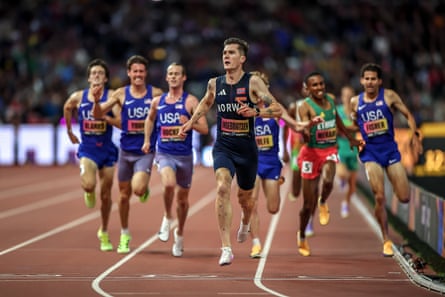
7) Fast shoes help with recovery too
Ingebrigtsen wears speedy and bouncy shoes for most of his running, with the Nike Zoom Fly 6 among his favourites. “You can decrease the load and impact by the amount of cushioning that’s now available in shoes,” he says. “So if I can get out of my Monday to Sunday programme 95% fatigued, that is enabling me to do the same the next week with the same amount of quality … just with 5% extra intensity.”
8) Training in mud is a waste of time
Ingebrigtsen sneers at the old-school approach of lots of running on trails and cross-country. “It is pointless. Training in mud or grass is not something I believe in. Let’s say I was going into a field and all of a sudden I’m doing 1k reps in mud and stones. Think about the extra risk that I’m taking, not only in terms of load and training but also tripping and snapping my ankle? Why would I risk it?”
9) Always question what coaches can teach you
Perhaps this is explained by Ingebrigtsen’s relationship with his father and former coach Gjert, who he ended up facing in court in 2025. But he is adamant that discussing everything with his brothers Henrik and Filip is better than a top-down approach.
“With a lot of coaches, it’s more like a priest. You can get really attached to them and it’s almost dangerous in the way it takes away responsibility from the athlete. If you have an ex-professional runner as a coach, it is always going to be ‘I did this, I did that, this is what worked for me, this is something new and revolutionary’. I don’t believe in it.”
10) You always have to keep yourself accountable
Some truths are universal when it comes to running and life. “You have to take responsibility for yourself,” he says. “Each individual and every athlete needs to build their own toolbox regarding their qualities and maybe lack of qualities. Responsibility, I think that’s the key word. And accountability.”