 2 hours ago
4
2 hours ago
4
Get ready for the dopamine crash. And this one really is a proper autumn nosedive. The past 17 days up to and including Sunday’s cut-off gave us 30 Premier League games and 79 goals. Which, if you take Spurs out of it – and this is fair because Spurs are now post‑goal, an entertainment concept unrelated to goals or even football itself – is really quite a lot.
Are your pathways stimulated? Are the neural connectors flickering? Well get ready for cold turkey, for 19 blank days of shivers and shakes until the Premier League show resumes in October. Maybe it really is time to buy one of those powders off the internet.
The international break will provide its own intrigue. There will be discussions about whether Thomas Tuchel is or isn’t responsible for the inherited cultural weaknesses of English football. There will be rage at Tuchel’s inability to coach the players to keep the ball as never before via his few short hours on the training pitch. And yet more rage at the real issues, basically the fact he continues to be German and looks like a scurvy-ridden Napoleonic naval commander powered solely by ship’s biscuits and morphine.
This is unlikely to fill the hole. There will be an unavoidable “contrast effect”, the rush of adrenaline that only serves to deepen the low when it is gone. But there are also some familiar autumn rituals to help us through. One of these is the state‑of‑the‑nation Premier League address, pegged out around key questions such as “where are we?”, “what are we?” and “where is it all going?”. This time around these are relatively easy to answer.
Five rounds into the Premier League season this is pretty much a cut-and-paste job. The big news: there is no big news. Events continue to happen at great volume. But in terms of teams, style, stars, energies and potential outcomes, not much has changed. Roll back one year and this was the broad situation. A powerful team with a bald, irascible manager had won all five games, but also looked defensively fragile. The team that would win the league was second. That team was also Arsenal.
The middle classes were the most interesting story, those functional, well-run teams beginning with B, an entity you might call Brightonmouth. Erling Haaland was scoring goals. Bruno Fernandes was generating hair‑tearing anguish, like a young Elvis, but based more around shithousery and risky attacking passes.
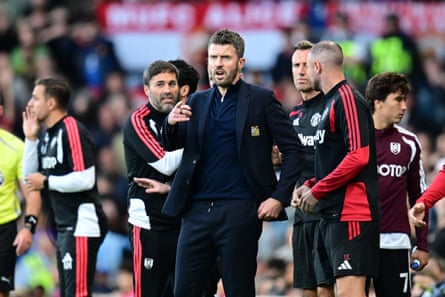
As ever there are still some key questions doing the rounds, but luckily these can all be answered easily. Is Michael Carrick the man to take Manchester United to the next level? No. Is Michael Carrick the reason United are not at that level, but in a state where they must now employ Michael Carrick? Also no.
The reality for United is that there are no other levels. This is the level, a club that instead acts as a grand, angst-ridden but very accurate metaphor for modern‑day Britain, furiously retailing its own heritage, run by fill-ins and opportunists, a mobile waxwork museum living on tourism and memories.
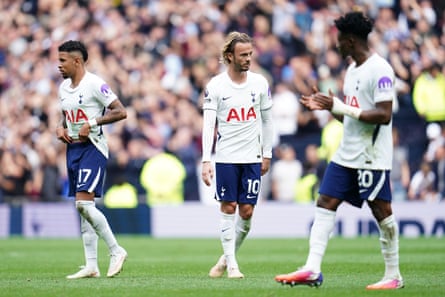
Are Tottenham doomed? Probably not. They have enough semi-interested players to retain a solid hold on 17th place. Although frustratingly for Premier League content addicts, even this has been degraded by repetition. Spurs could get relegated now and you would just keep scrolling.
Are Liverpool on the verge of a renaissance? Probably not. The Jürgen Klopp golden era is beginning to look quite distant, surrounded on all sides by something a bit like the present. And, yes, Florian Wirtz is a very good footballer. He just can’t resist contact very well, which is non‑negotiable in the Premier League. He is going to be really good at Paris Saint-Gemain/Bayern Munich/Inter.
Otherwise, it is a case of stasis and a reliable, entertaining, homogenised product. Tactically, we can still get excited about small changes. If you analyse it deeply you may find a little more counterattack, Anthony Elanga running fast, an inverted winger discovering almost by accident he can also cross with his strong foot.
It is a mark of how standardised the game has become that these are deemed things worth getting excited about. There is still only one elite level style, the Omniball template of the Cruyff-Michels-Guardiola-Gegenpressing school.
after newsletter promotion
This is skewed towards physicality over control in England, but it still produces football that can feel at times a bit like driving a brand new electric car: fun, high‑grade, but also endlessly repeatable. It seems possible some time soon that a robotic bait‑the‑press system will meet a robotic bait-averse system and in that moment football will just cease to exist, reduced to two banks of human units staring at each other across a strip of empty grass.
There are two things the Premier League could really do with in the remaining 87% of its season. The nudge into greater physicality is exciting and distinct. It is notable how many games have been decided by duels, collisions, a sense of greater wanting-it. Or perhaps not so surprising when the players are at roughly the same technical level, where the only real point of difference is sustained physical power and competitive will.
This is one reason why Brighton’s defeat of Arsenal on Saturday seemed so interesting. It is rare to see any reigning champions not just beaten, but outskilled and outmuscled. For 90 minutes, only one of these teams looked like genuine contenders for every trophy on offer.
This is the second thing the league could really do with. Is it possible for one of the well-run middle class to sustain this level over a season and give us another Leicester or something close? Can Brighton just play like that every week?
There are obvious answers why not. One very good game against an ambushed Arsenal is not a 38-game slog. Brighton have a good squad, but also regular midweek football. Other teams will react and nullify your strengths. Also, and this is not a throwaway detail, Fabian Hürzeler is going to be on TalkSport for an hour on Tuesday just chatting football, which will now include how did you beat the champs and why are you third in the league.
Nothing wrong with this. But it is an indicator of where we are. Hürzeler is 33. The entire job is essentially reinventing himself, just as all of the very good players at those middleweight clubs are auditioning for bigger clubs rather than dreaming of hauling them in, playing for the life-changing money a Champions League-level club will throw at them, motivated by a breezy and entirely logical collective individualism.
Perhaps this is why one of the themes of the season has been a suspicion among fans of bigger clubs that their players don’t want it enough, that being outrun or outworked is a sign of soul sickness or debauched management. But it is also what keeps the league brutally strong, state of the art, and endlessly moreish for all its repeated story arcs. Come back soon Premier League mega-product. The comedown is already hitting.